
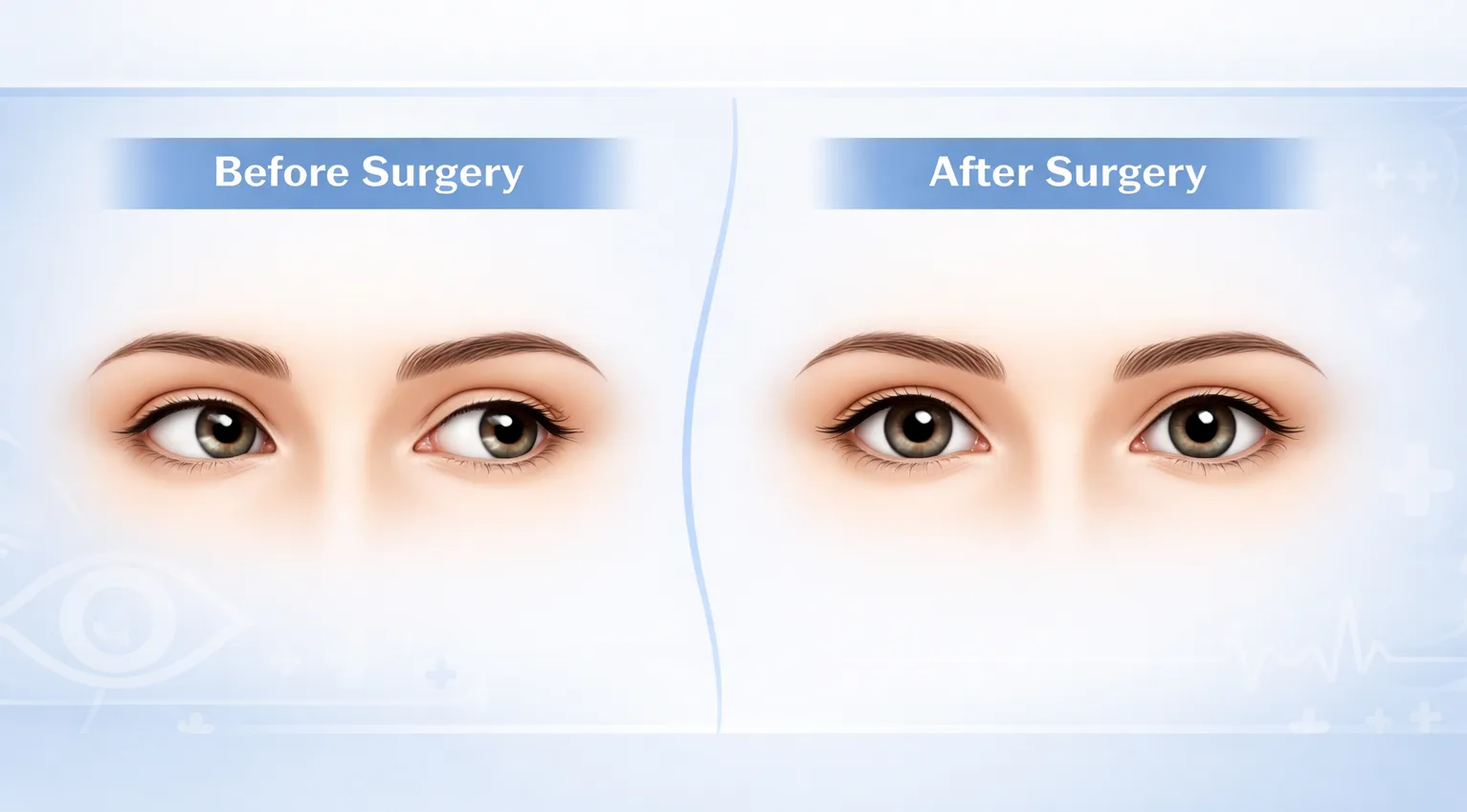
The medical term for squint eye which people commonly use to refer to the condition describes the eye disorder which causes improper eye alignment. The person experiences misaligned eyes because one eye moves inwards or outwards or upwards or downwards while the other eye maintains a straight gaze. The misaligned eyes create an effect that damages both appearance and ability to perceive depth and see clearly. The immediate need for medical treatment exists because doctors need to realign the patient while protecting them from developing permanent vision issues.
Squint Eye Treatment provides dependable results through its organized system which includes detailed pre-surgical assessments and accurate surgical methods and established patient recovery procedures. The process of learning surgical procedures establishes proper patient treatment methods which result in improved treatment results.
What is the Treatment for Squint Eye?
The approach to treatment needs to consider three factors which include the specific type of squint and its associated severity and underlying cause. The solution can include both non-invasive techniques and surgical procedures.
Non-Surgical Options
- Corrective glasses or lenses provide solutions for people who need to correct their refractive errors
- Prism lenses help users to see clearly by eliminating double vision
- Vision therapy or squint eye treatment exercise provides treatment which helps patients to develop their eye coordination abilities
- Patching therapy (especially in children) to improve weaker eye function
The methods provide effective results for treating mild conditions while they also help patients throughout their treatment process. The surgical operation becomes essential when patients face moderate to severe cases that require realignment.
Also Read: A Complete Guide to Squint Surgery: Benefits, Procedure & Recovery
Squint Eye Treatment in Adults
The condition of strabismus which people commonly call squinting affects all age groups. Adult patients with strabismus require treatment that addresses both their functional needs and their need for aesthetic improvement.
Key Considerations
- Adults may experience double vision, eye strain, or headaches
- Surgery improves binocular vision and depth perception
- Cosmetic correction enhances confidence and social comfort
People mistakenly think that age serves as an obstacle which restricts their abilities. Adults can achieve significant improvement through treatment when healthcare professionals develop suitable treatment strategies.
Pre-Surgery Evaluation: What to Expect?
The surgical process starts after an extensive eye examination has been completed to evaluate the patient’s complete health condition.
Clinical Assessment
- The test measures eye position changes when the subject looks in different directions
- The evaluation determines how well the eye muscles operate
- The assessment requires vision tests to be conducted on both eyes
- The assessment evaluates how well a person sees with both eyes and their ability to judge distances between objects.
Medical Planning
- Identification of the specific muscles causing misalignment
- Determination of surgical technique (muscle strengthening, weakening, or repositioning)
- Review of medical history and general health
Patients are guided through the procedure, expected outcomes, and recovery timeline. Clear instructions are provided to ensure readiness for surgery.
Procedure Highlights
- The procedure uses local anesthesia or general anesthesia based on specific case requirements.
- The procedure needs eye muscles to be either repositioned or their strength to be tightened or loosened.
- The procedure does not require the surgeon to take out any part of the eye or essential anatomical components.
- The process needs only a short time which exceeds its normal finishing time.
The objective requires restoration of equal muscle strength which enables both eyes to properly align and function as a team.
Immediately After Surgery
The process of post-surgery recovery starts immediately after the surgical operation ends. The patients experience only short-lived discomfort, which they can control easily.
Common Symptoms
- Redness in the operated eye
- Mild swelling
- Watering or irritation
- Temporary blurred or double vision
The expected effects will normally disappear after a period of several days to several weeks.
Recovery Timeline
The process of recovery from surgery depends on both the patient and the surgical procedure’s level of complexity. Yet, it is possible to create a general schedule for the procedure.
First Few Days
- Redness and irritation are most noticeable
- The patient needs to use prescribed eye drops and medications
- The patient needs to restrict their screen time and physical activity
First Few Weeks
- The eye alignment shows progress through time
- The eyes display reduced redness and discomfort
- The patients return for follow-up visits which will assess their progress
Long-Term Outcome
- The eye alignment reached permanent stability after time passed
- The two eyes now work together better than before
- The patient experiences better visual comfort and aesthetic appearance
Patients must adhere to all post-operative care guidelines because this will lead to their best recovery outcome.
Also Read: Squint in Children: Early Signs and When to Seek Help
Before and After Results: What Changes
The difference before and after squint surgery is often significant.
Before Surgery
- Patients show visible eye misalignment
- Patients experience problems with dual eye focusing
- Patients show potential social interaction challenges
After Surgery
The patient’s eyes now show proper alignment and equal distribution between both sides
- The patient demonstrates enhanced visual coordination abilities
- The patient experiences greater self-assurance and overall comfort due to their improved condition
The eye doctors will recommend additional treatments or therapy options when they need to enhance the results of medical treatment.
Role of Squint Eye Treatment Exercise
The medical procedure corrects physical misalignment, while eye squint treatment exercises function as additional support that helps patients develop better visual coordination.
Benefits of Exercises
- The program increases the strength of eye muscles.
- The program improves ability to focus and follow moving objects.
- The program helps patients recover from their surgical procedures.
The medical procedure requires professional supervision because it ensures both safety and effective results for patients.
Squint Eye Treatment Cost
The squint eye treatment cost depends on several factors:
- Severity of the condition
- Type of procedure required
- Diagnostic tests and follow-ups
- Hospital infrastructure and expertise
Many centres offer low price options with affordable packages to make treatment accessible. Patients should prioritise clinical expertise and outcomes over cost alone.
Choosing the Right Care
Selecting the right facility and specialists is critical for successful treatment.
What to Look For:
- Highly experienced ophthalmologists
- Proven track record in squint correction
- Access to advanced diagnostic tools
- Structured pre- and post-operative care
Eye Hospitals known for decades of excellence ensure consistent outcomes and patient safety.
Must Know Points Before Surgery
- Early intervention improves outcomes
- The complete evaluation process needs to be conducted because it establishes the foundation for achieving precise correction results.
- Recovery needs medical guidance compliance from the patient.
- The body goes through temporary pain which medical professionals can handle.
- The follow-up appointments serve an essential purpose because they track the patient’s healing process.
Patients need to maintain knowledge and readiness during their entire treatment process.
Don’t Miss Timely Treatment
Delaying treatment creates various medical complications which include:
- Permanent vision imbalance
- Reduced depth perception
- Increased difficulty in correction
The process of taking immediate action results in improved outcomes which decrease the requirement for complicated medical procedures.
Conclusion
The treatment for squint eyes provides a systematic and successful method to restore proper eye alignment and visual capabilities. Modern surgical methods together with improved recovery practices enable patients to achieve consistent and long-lasting results.
The combination of early diagnosis and proper treatment and ongoing monitoring constitutes the essential elements needed to achieve the best possible results.
Frequently Asked Questions (FAQs)
Treatment options vary based on the severity of the squint. Treatment may include glasses with prism diopter lenses, vision therapy, eye exercises or correcting through squint eye surgeries.
Treatment for squint eyes in adults results positively in restoration of vision and outside appearance, with complete restoration in all cases, even those with longstanding squints.
Recovery from squint surgery includes 2 phases. The first phase will take several days and the complete recovery will take many weeks, including all requisite times for proper bone alignment.
Exercise alone will be effective for treating squint in mild cases of squint and also to assist with recovery following squint surgery; however, those with moderate or severe squint will require surgical treatment.
The cost of treating squint will vary based on the difficulty of the condition being treated and whether or not you had surgery; however, most centres have affordable treatment costs.
Yes. Squint surgery is a standard, well-established procedure performed by trained, expert surgeons with a very high success rate, assuming that proper post-operative care is provided.
Squint Eye Treatments Near You: Squint Eye Treatment in Bangalore | Squint Eye Treatment in Hyderabad | Squint Eye Treatment in Chennai