
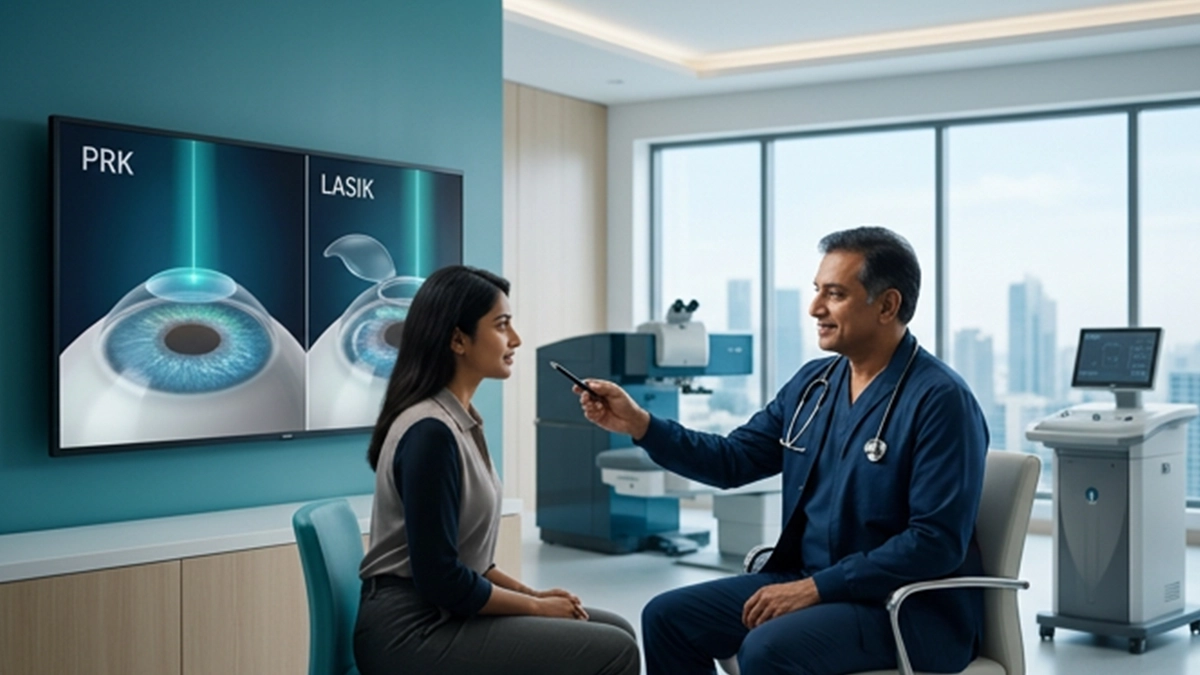
Are you finding yourself struggling daily with having to reach for your glasses? Or trying hard to get those contact lens drops just right before heading out for a workout session?You’re not alone! If you’ve been researching eye treatment procedures lately, chances are high that you might have come across the debate over PRK versus LASIK. Both are types of Laser Vision Correction which use an Excimer Laser to reshape your cornea in order to focus light better onto the retina. But how exactly does each approach work differently when it comes to preparing your eye’s surface ready for the laser treatment?
Ultimately, neither is necessarily always ‘better’ than the other – but whether LASIK eye surgery or PRK eye surgery will be more suitable for you depends upon several different factors including things such as your corneal thickness and shape, tear film health and prescription. Through this article you will find out all about these two popular treatments to decide which may be right for you.
Understanding LASIK
The LASIK surgical process involves creating a thin flap on the outermost layer of the patient’s cornea using a scalpel blade-like instrument that allows the doctor to lift away part of the outer layer. An excimer laser is used to alter the tissues under this flap. Once done, the flap is replaced onto the cornea and set to settle down naturally. Many people who undergo LASIK experience improved visual acuity within a short period following their surgeries. However, there are specific conditions required before one becomes eligible for LASIK treatment; those include having had a stable prescription for some time, sufficient cornea thickness, and having a regular-shaped cornea.
There are also several reasons why someone may not qualify for LASIK such as thinning of the cornea, suffering from considerable amounts of dry eyes, an irregularly shaped corneal map, or working with an occupation exposing you to potential injury by participation in contact sports. Thus it’s essential that these details are addressed during your pre-surgical examination prior to undergoing LASIK surgery.
Understanding PRK
PRK stands for photorefractive keratotomy. Rather than creating a flap, PRK involves removing the thin layer of tissue at the very front (the epithelial cells), then applying the laser directly onto what’s underneath. Afterward, the doctor places a special “protective” contact lens on your eye. Then, during the next couple of days you’ll wear this contact lens to protect the surface as your eyes heal naturally.
Because there isn’t a flap created here, PRK has been used occasionally as an alternative for those who have thinner than normal corneas or whose jobs make them susceptible to trauma to their eyes (boxers/martial artists/occupations involving lots of eye trauma). This comes at the expense of slower visual stabilization typically between a couple of days up to 2-3 weeks before you feel settled. In addition, some degree of irritability/light sensitivity/watering is also normal in the initial period after PRK surgery.
PRK vs LASIK: How They Actually Compare
| What’s Being Compared | LASIK | PRK |
|---|---|---|
| How the cornea is prepared | A thin flap is created before laser reshaping | The epithelial surface layer is removed before laser reshaping |
| Early visual recovery | Often noticeably clearer within a few days | More gradual, typically over one to a few weeks |
| Initial discomfort | Usually mild | Can be more noticeable in the first several days |
| Corneal flap | Yes | No |
| Often considered when | Cornea is sufficiently thick and regularly shaped | Flap creation isn’t ideal, or corneal thickness is limited |
Does One Give Better Vision Than the Other?
For suitable candidates, PRK and LASIK can both achieve favourable visual outcomes over time; the laser reshaping itself is comparable in both procedures. What differs more consistently is the path to get there. LASIK tends to offer quicker initial visual recovery, which is often why people with demanding work schedules bring it up first. PRK’s gradual healing process is frequently discussed alongside its potential to preserve more of the cornea’s structural tissue, since no flap is cut.
A proper evaluation before either procedure typically includes corneal topography, pachymetry (corneal thickness measurement), tear film assessment, pupil size evaluation, and a review of how stable your prescription has been. These tests are what actually determine candidacy not personal preference for a shorter recovery window.
Recovery and Aftercare
| Recovery Aspect | LASIK | PRK |
|---|---|---|
| Vision in early days | Often improves within the first few days | Improves more gradually as the surface heals |
| Comfort level early on | Generally mild | Watering, light sensitivity, or grittiness are common |
| Return to routine activities | Frequently sooner, depending on comfort | Can take longer, depending on healing pace |
| Follow-up visits | Important for monitoring dryness and the flap | Important for monitoring surface healing and haze |
Whichever procedure is performed, using prescribed lubricating drops, avoiding eye rubbing, wearing protective eyewear as advised, and attending every follow up appointment all play a real role in how smoothly recovery goes.
Possible Risks and Limitations
While these procedures involve lasers and precise technology, they still involve cutting through human anatomy with tools which means there are always potential risks – albeit rare ones. Temporary dryness, night haloes/glare around lights, under/over corrected results, etc., can all occur with any form of laser based eye surgery. With LASIK specifically, complications related to the flap itself have been most commonly reported, whereas with PRK, the area of greatest concern is simply the process of healing of the surface of the eye and the relatively uncommon development of corneal haze.
None of this is meant to discourage anyone from exploring these options it’s meant to underline why proper screening and honest post operative care matter as much as the surgery itself. Complications are uncommon in appropriately selected candidates, but “uncommon” isn’t the same as “impossible,” and a good surgical consultation should walk you through both.
Who Tends to Be a Reasonable Fit for Each?
In general, LASIK is preferred by surgeons if you have good enough corneal thickness but otherwise would benefit from refractive error correction. If you have less corneal thickness or want to avoid flap creation due to occupation/hobbies or another reason, however, PRK may be better suited for you.Even this is a generalisation. Two people with the “same” prescription can be candidates for two different procedures once their corneal maps and tear film are actually assessed.
Conclusion
There’s no universal winner in the PRK vs LASIK comparison, only a better fit for your particular eyes, lifestyle, and healing preferences. LASIK’s shorter recovery window appeals to many people, while PRK remains a reasonable, well established choice for those with thinner corneas or higher risk occupations. If you’re weighing the two, try not to base the decision purely on cost or on what a friend or family member has done. A full eye examination remains the only reliable way to know which type of laser vision correction suits you and it’s worth booking one before deciding anything else.
Frequently Asked Questions
1. Which is better, PRK or LASIK?
There isn’t a single answer here, it depends on your eyes. Lasik tends to have quicker initial healing whereas PRK can be ideal if you have thinner corneas or an active lifestyle that could increase the likelihood of eye trauma.
2. Is PRK more painful than LASIK?
There’s usually less initial discomfort with LASIK surgery than there would be with PRK because of how your cornea heals after those procedures. Both surgeries require you to use drops as directed by your eye doctor, who will also monitor your progress closely during regular visits after surgery.
3. Does PRK give the same result as LASIK?
For suitable candidates, both can achieve comparable long-term visual outcomes. The main difference tends to be the timeline PRK’s stabilisation period is usually longer than LASIK’s.
4. Who should avoid LASIK?
People with very thin corneas, serious dry eye issues, unstable prescription, an oddly shaped cornea, or other problems with their cornea might not qualify for Lasik surgery and could benefit from alternatives such as PRK. After tests that determine which options work best, your surgeon will talk about what makes sense for you personally.
5. Is laser vision correction permanent?
Corneal reshaping is permanent, although you can still develop age-related eye problems including presbyopia (“near-sightedness” that may require reading glasses), or cataract formation at some point in your lifetime.
6. How should I decide between PRK and LASIK?
A comprehensive corneal and vision assessment is the most reliable starting point. Your ophthalmologist can review your results and advise which approach flap-based or surface-based is more appropriate for your eyes.