
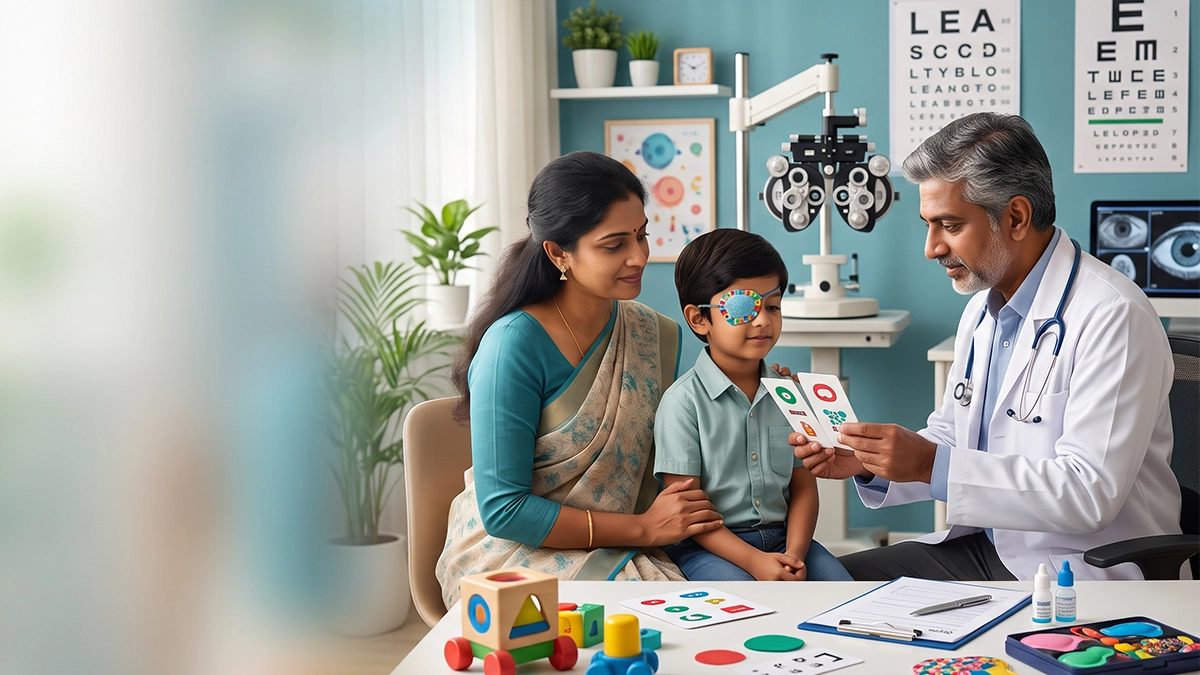
Yes. Amblyopia is treatable and in the great majority of cases the weak eye’s vision improves when the condition is caught at an early age. Amblyopia in pediatrics we see that treatment consists of getting the brain to use the weaker eye again which we do with the help of glasses, a patch, or drops. The earlier the better for results although do see some benefit in older children as well. That said a child doesn’t usually report that they have a problem out of one eye which is why amblyopia in kids is often diagnosed via a routine eye check up.
What Is Amblyopia and Why Does It Happen?
Amblyopia, what many parents refer to as lazy eye in children, is a condition that in early growth stages does not see the brain and one eye developing proper connection. The brain favors the stronger eye and over time ignores the weaker one.
Common issues are a squint, a large power difference between the eyes or also at times a childhood cataract. What is often seen is that a higher number in one eye goes unnoticed for years, Vasan Eye Care’s guide on myopia in children reports how power changes in growing kids go under the radar. Also in terms of amblyopia in children treatment it is about training the brain and not just fixing the eye. First Vasan Often have to determine the cause which in turn determines which amblyopia in children treatment will work for the child.
What Are the Common Amblyopia Symptoms?
The signs are often quiet, as the child may not know anything is wrong. Spotting them is the first step of amblyopia in children’s treatment.
| Sign | What parents may notice | Why it matters |
|---|---|---|
| Eye turning in or out | One eye drifts, especially when tired | Squint is a common cause of amblyopia |
| Closing one eye | Child shuts one eye to watch TV or read | The brain may be avoiding a blurred image |
| Head tilt | Head held at an angle while looking | Child may be using only the better eye |
| Poor depth judgement | Bumps into things, misses a catch | Both eyes are not working as a team |
| Lower reading in one eye | Fails a school vision screening | Often the only sign of a power difference |
Vasan Eye Care’s article on when do babies start seeing explains normal milestones so parents can tell when something is off. Since amblyopia symptoms can be very mild, a screening at 3 to 5 years is sensible even if the child seems fine. Early screening makes amblyopia in children treatment shorter, while a missed case means amblyopia in children treatment starts late.
How Does Patch Therapy for Lazy Eye Work?
Patch therapy for lazy eye is the best known part of amblyopia in children treatment. A patch over the stronger eye for some hours a day forces the brain to use the weaker eye and so rebuild the connection.
The National Eye Institute reports that patching the better seeing eye for two hours a day is the standard approach, usually advised if vision stays weak after about 10 weeks in glasses. For amblyopia that does not improve, an NEI funded trial found increasing patching to six hours a day can help.
| Option | How it is used | Who it may suit |
|---|---|---|
| Glasses | Correct the power difference, worn full time | First step for most children |
| Eye patch | Covers the stronger eye for set hours | Moderate to severe amblyopia |
| Atropine eye drops | Blur the stronger eye for some hours | Kids who will not keep a patch on |
| Digital therapy | Special games or videos viewed by both eyes | Selected cases, under doctor guidance |
| Treating the cause | Squint surgery or cataract removal | When something blocks vision |
A well planned amblyopia in children treatment is often a combination and not a single method. Within amblyopia in children treatment, patching works best with close-up activities like drawing or puzzles. The doctor reviews vision every few weeks and adjusts the amblyopia in children treatment, as amblyopia in children treatment without the right glasses rarely gives full benefit.
Is There a Treatment Window for Amblyopia?
Age does matter but it is not a hard cut-off. Visual connections in the brain are most flexible in the early years, so amblyopia in children treatment started before 7 years tends to give the best result.
It was long thought nothing could be done after 8 years, but an NEI funded trial of 507 children aged 7 to 17 found many improved with glasses, patching and drops. However most were left with some visual loss, which is why early amblyopia in children treatment is still the aim.
So child lazy eye treatment should not be delayed in the hope the child grows out of it, as amblyopia rarely corrects by itself.
Supporting Amblyopia Treatment at Home
Most amblyopia in children treatment happens at home and not in the clinic. A simple routine and a reward chart help kids stick to patching.
Some near activity on a tablet during patching is fine but long hours on a phone have their own effect, Vasan Eye Care’s article on mobile effect on eyes gives practical limits. Amblyopia can come back after patching stops, so follow-up visits remain part of amblyopia in children treatment for some months.
A sudden eye turn, a white glow in the pupil in photos or sudden poor vision needs prompt assessment rather than a routine visit.
Child Lazy Eye Treatment at Vasan Eye Care
Vasan Eye Care provides care for amblyopia and other eye diseases in children. We may test vision in each eye, check glasses power with dilating drops and assess eye alignment, retina and optic nerve. Our team plans amblyopia in children treatment to suit the child’s age, the cause and how well the child manages patching, as timely amblyopia in children treatment protects sight for life.
Frequently Asked Questions
1. What is the best age for amblyopia in children treatment?
Results are usually best before 7 years, but older kids and teens can still benefit.
2. How many hours a day should a child wear the patch?
In most amblyopia in children treatment plans kids start with two hours a day. The doctor may increase it if vision does not improve.
3. Can glasses alone fix lazy eye in children?
In some children yes. Glasses improve vision in many cases of power difference, and patching is added if the eye stays weak.
4. Will amblyopia come back after treatment?
It can. That is why the doctor may reduce patching slowly and keep follow-ups after amblyopia treatment ends.
References
- National Eye Institute — Amblyopia (Lazy Eye) https://www.nei.nih.gov/learn-about-eye-health/eye-conditions-and-diseases/amblyopia-lazy-eye
- National Eye Institute — Extended Daily Eye Patching Effective at Treating Stubborn Amblyopia in Children https://www.nei.nih.gov/about/news-and-events/news/extended-daily-eye-patching-effective-treating-stubborn-amblyopia-children
- National Eye Institute — Older Children Can Benefit From Treatment for Childhood’s Most Common Eye Disorder https://www.nei.nih.gov/about/news-and-events/news/older-children-can-benefit-treatment-childhoods-most-common-eye-disorder
- MedlinePlus (U.S. National Library of Medicine) — Amblyopia https://medlineplus.gov/ency/article/001014.htm