
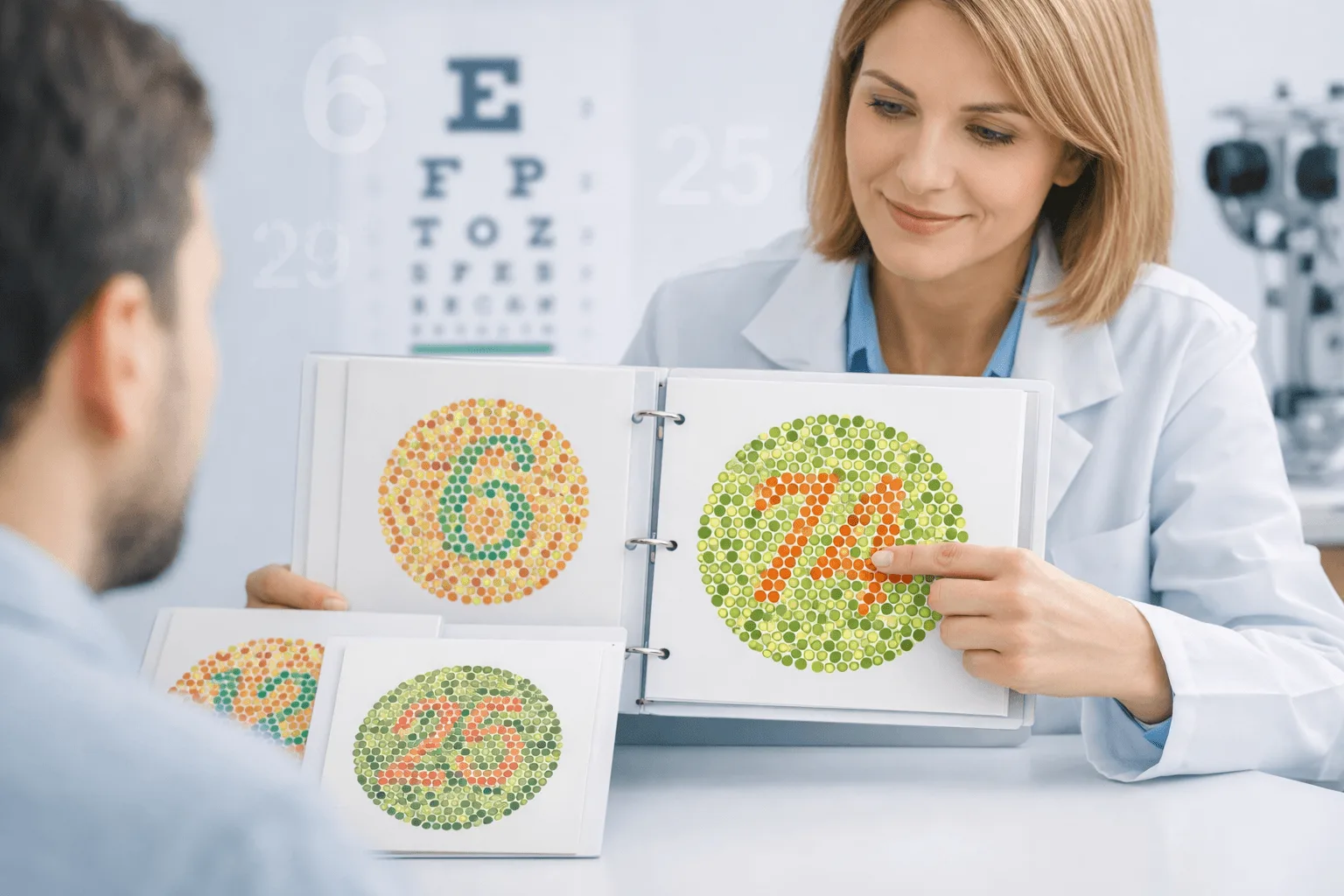
You’re at the eye hospital for a routine checkup, feeling pretty relaxed. Then the optometrist flips a book filled with colourful dots toward you and asks, “What number do you see here?”
And suddenly, you’re not so sure. Is that a 7… or nothing at all?
If you’ve ever wondered what a Colour vision test is really checking, or what those results actually say about your eyes, you’re not alone. Let’s talk it through, friend to friend.
What Happens During a Colour Vision Test?
First things first. A Colour vision test is simple, quick, and honestly kind of fascinating. You won’t need drops. No machines whirring around your head. Most of the time, it’s just you, a well-lit room, and a series of images.
The most common version looks like a book of circular plates made up of tiny coloured dots. Inside those dots is a number or shape. You’re asked to identify what you see. Sometimes out loud. Sometimes by pointing.
And that’s it.
The whole thing usually takes five minutes or less. Kids do it. Adults do it. You don’t need to “study” for it, and you definitely can’t cheat (your eyes will do what they do).
You might be wondering why it feels so casual. Here’s the thing it’s designed that way so your brain reacts naturally, without overthinking.
How Does a Colour Vision Test Work, Really?
Now, let’s talk about what’s actually happening behind the scenes.
When people ask how does a Colour vision test work, the answer is all about how your eyes and brain process Colour differences. Those dot patterns are carefully designed so people with typical Colour vision can spot the hidden number easily. But for someone with a Colour vision deficiency, certain Colours blend together.
That’s the giveaway.
Most clinics use the Ishihara test, which mainly screens for red-green Colour issues. But there are other versions too, including arrangement tests where you line up Coloured caps in order. These are often used when doctors want more detailed Colour vision test results.
And interestingly enough, lighting matters. So does fatigue. That’s why doctors try to keep conditions consistent same lighting, same distance, same timing.
What a Colour Blindness Test Is Actually Checking
People often use “Colour blindness test” as a catch-all phrase. But total colour blindness is rare.
What most tests detect are different types of Colour vision deficiency. Red-green issues are the most common. Blue-yellow problems show up less often. Some are inherited. Others develop later due to eye disease, injury, or even certain medications.
This is why a Colour vision deficiency test isn’t just about labels, it’s about patterns. How consistently you miss certain numbers. Which Colours cause trouble? And whether it’s one eye or both.
If you’ve ever mixed up green and brown crayons as a kid, this might suddenly feel very familiar.
Understanding Your Colour Vision Test Results
Here’s the part everyone cares about. The results.
Your colour vision test results usually fall into one of three categories: normal Colour vision, mild deficiency, or more significant deficiency. And no, “failing” isn’t really a thing here.
If your optometrist says your results are normal, great. If not, they’ll explain what type of Colour vision issue showed up and how it might affect daily life.
So what do Colour vision test results mean in real terms? For many people, not much changes. You might still drive, work, and live exactly the same way. Some professions, like pilots or electricians have stricter requirements, but for everyday life, most people adapt naturally.
Let me give you a real-world example.
And honestly, many don’t even realize they see colours differently until they take the test.
What Different Results Can Indicate
A friend of mine discovered during a routine Colour vision test that he had a mild red-green deficiency. It explained why traffic lights sometimes looked “off” and why ripe bananas never looked quite yellow to him. But he’d made it through school, work, and life without issues.
That’s common.
More pronounced deficiencies might make it harder to distinguish certain shades, read Colour-coded charts, or match clothing. If the test suggests a sudden change, doctors may recommend further checks to rule out underlying eye or nerve conditions.
And that’s where the test becomes more than just dots on a page.
If you’re considering a colour vision test, expert eye treatments is easily accessible across multiple locations in India. Vasan Eye Care has centres in key states like Tamil Nadu, Karnataka, Telangana, Andhra Pradesh, Kerala, and Puducherry, covering cities such as Chennai, Bangalore, Hyderabad, Coimbatore, Madurai, and more. This wide presence makes it convenient to consult an eye specialist close to home. A simple visit can help you understand your vision clearly and take the right next step with confidence.
Frequently Asked Questions
Q.1. Is a Colour vision test part of a regular eye exam?
A. Often, yes especially for kids or first-time patients. Adults may get it if there’s a concern or job requirement.
Q.2. How often should I take a Colour blindness test?
A. If your results are normal and stable, you usually don’t need repeat testing. Changes later in life may prompt another test.
Q.3. Can Colour vision test results change over time?
A. Inherited deficiencies usually stay the same. But injuries, eye disease, or medications can affect results later on.
Q.4. Is a Colour vision deficiencytest painful or tiring?
A. Not at all. It’s quick, non-invasive, and surprisingly low effort.
Q.5. What if I don’t see any number on the plate?
A. That’s useful information too. It helps your doctor interpret your Colour vision test results accurately and explain what they mean for you.
Find Us by State: Eye Hospitals in Andhra Pradesh | Eye Hospitals in Karnataka | Eye Hospital in Kerala | Eye Hospitals in Pondicherry | Eye Hospitals in Tamil Nadu | Eye Hospitals in Telangana
Find Us by City: Eye Hospital in Calicut | Eye Hospital in Cochin Shipyard | Eye Hospital in Guntur | Eye Hospital in Mysore | Eye Hospital in Tirupati | Eye Hospital in Visakhapatnam | Eye Hospital in Bangalore | Eye Hospital in Chennai | Eye Hospital in Coimbatore | Eye Hospital in Madurai | Eye Hospital in Salem | Eye Hospital in Trichy | Eye Hospital in Hyderabad | Eye Specialists in Hyderabad | Eye Specialists in Chennai | Eye Specialists in Bangalore
Treatments We Offer: Eye Treatments | Cataract Surgery | LASIK Eye Surgery | Squint Eye Treatment | Retinal Diseases | EPI LASIK | Corneal Services | Refractive Surgery | Oculoplasty Surgery | Dry Eye Treatment | Contoura Vision Surgery | Anti VEGF Agents Treatment | Photorefractive Keratectomy | Vitrectomy Surgery | Epi Contoura Eye Surgery | Customised LASIK Surgery | Retinal Laser Photocoagulation Treatment | Implantable Collamer Lens |Cataract Surgery in Bangalore | Cataract Surgery in Hyderabad | Cataract Surgery Chennai | LASIK Eye Surgery in Hyderabad | LASIK Eye Surgery in Bangalore | LASIK Eye Surgery in Chennai | Retina Services in Hyderabad | Retina Services Chennai | Squint Eye Treatment in Bangalore | Squint Eye Treatment in Hyderabad | Squint Eye Treatment in Chennai | Glaucoma Treatment in Bangalore | Glaucoma Treatment in Chennai | Glaucoma Treatment in Hyderabad
Eye Conditions We Treat: Glaucoma Treatment | Orbital Trauma | Macular Hole | Retinopathy of Prematurity | Uveitis | Traumatic Treatment | Retinal Detachment | Cataract Diseases | Posterior Subcapsular Cataract | Diabetic Retinopathy | Rosette Cataract Surgery | Squint Eye Disease