
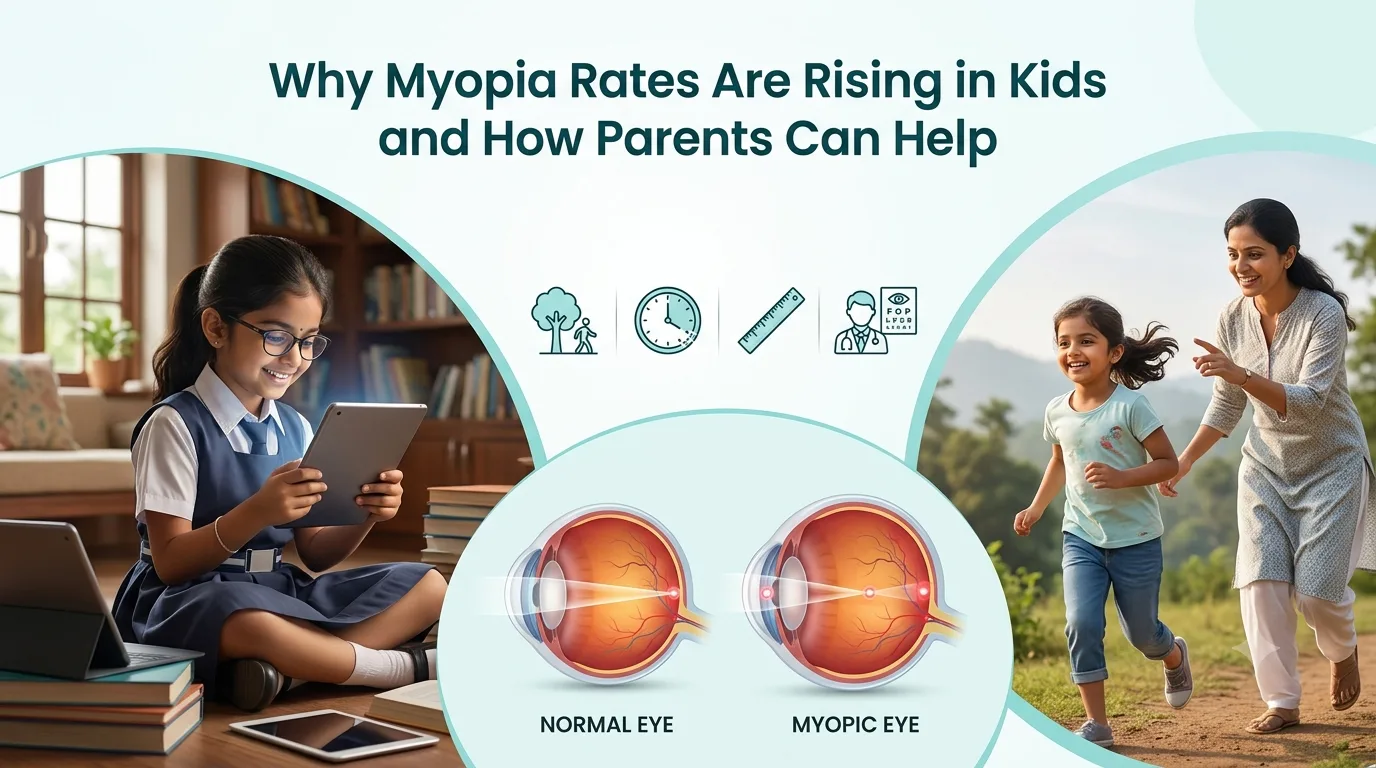
Childhood eye issues are on the rise all over the world which includes in India. Today parents’ greatest worry is the increase what is myopia in young children. Indoor time which is increasing, screen time which is going up and play time which is decreasing is thought to be a factor in this along with genetic elements.
Understanding what is myopia, identifying early warning signs, and getting in to see a professional at the first sign of an issue may help to slow its progress and reduce the risk of more serious eye problems. This guide details the rise of myopia in children, what changes you may notice in a myopic eye, and what actions parents can take to care for their child’s vision.
What Is Myopia?
What is Myopia? Also known as nearsightedness, myopia is a very common refractive error which causes distant objects to appear blurry at the same time nearby objects appear normal. This is because the light rays focus in front of the retina instead of directly on it.
A myopic eye usually is of a greater length front to back or has a cornea which is too large. Also what we see with this condition is children having difficulty with the blackboard at school, road signs when out and about, and distant television but they do fine with near work like reading and crafts.
Although many people use the term in a myopia disease context, myopia is in fact a refractive error which does not in itself constitute a disease. That said high myopia does put one at risk for developing serious eye issues later on.
According to the American Academy of Ophthalmology, increasing levels of myopia are associated with a higher risk of retinal complications, glaucoma, and certain other eye disorders.
Why Are Myopia Rates Rising in Children?
Experts report that we see an increase in myopia which is a result of a mix of genetic and environmental factors.
Today’s children are spending more time on digital devices for education, entertainment, and social interaction. At the same time many of them are getting less outdoor time than past generations. Research also reports that regular outdoor activity in childhood may play a role in reducing myopia risk.
Genetics and lifestyle are reported to play a role in the development and progression of myopia by the National Eye Institute.
Common Risk Factors for Childhood Myopia
Several factors may increase a child’s likelihood of developing myopia disease including:
- Family history of myopia
- Excessive screen time
- Prolonged reading or close-up work without breaks
- Limited outdoor activities
- Early onset of myopia during primary school years
Children that have at least one parent with myopia are at an increased risk to develop it themselves.
Common Risk Factors and Their Impact
| Risk Factor | How It May Affect Vision |
| Family history | Increases the likelihood of developing myopia |
| Long hours on screens | Encourages prolonged near focusing |
| Limited outdoor play | May increase the risk of myopia progression |
| Excessive reading without breaks | Can contribute to eye strain and prolonged near work |
| Early onset of myopia | Greater chance of higher myopia in adulthood |
Myopia Symptoms Parents Should Watch For
Early identification is key as many kids do not notice they have a change in vision.
Also see these which are common myopia symptoms:
- Squinting while looking at distant objects
- Sitting very close to the television
- Holding books or digital devices close to the face
- Difficulty seeing the classroom board
- Frequent headaches
- Eye rubbing
- Reduced interest in outdoor sports due to blurred distance vision
If at all you notice these myopia symptoms, do not delay in seeing an eye doctor.
How Is Myopia Diagnosed?
A full eye exam is the best way to what is myopia. In the exam the ophthalmologist measures visual acuity, determines the refractive error, and reports on the overall health of the eyes.
Children also go through cycloplegic refraction which is a process of using medicated eye drops to temporarily paralyze the focus muscles and in turn obtain accurate results.
Also it is very important for school age children to have regular eye exams even if they report no vision problems.
Understanding a Myopic Eye
A myopic eye is not a simple fix with glasses. As myopia progresses the eye may grow longer which in turn increases the risk of more serious issues as the condition worsens.
High myopia is a risk for retinal tears, retinal detachment, glaucoma, cataracts, and myopic macular degeneration. Routine assessment which also helps in the early detection of changes allows for timely management.
Can Myopia Progress Be Controlled?
While at present we have no definitive methods to stop myopia progression in its tracks, we do have some which are supported by research that may put the brakes on it.
Based on the child’s age and eye condition we may put forth the use of specially designed glasses, contact lenses for myopia control, or prescription eye drops as is clinical appropriate.
Encourage kids to get more time outdoors, reduce exposure to nonessential screen use, maintain proper reading distance, and to take regular visual breaks which in turn will support healthy visual habits.
As an adult, if it is determined that advanced correction is right for you your ophthalmologist will go over what eye treatments options are available for your visual needs.
Healthy Daily Habits That Support Children’s Eye Health
| Healthy Habit | Why It Helps |
| Spend time outdoors every day | Supports healthy visual development |
| Follow the 20-20-20 rule during near work | Helps reduce prolonged eye strain |
| Maintain proper reading distance | Encourages comfortable focusing |
| Ensure good lighting while studying | Reduces unnecessary visual stress |
| Schedule regular eye examinations | Detects changes before vision worsens |
How Parents Can Help Prevent Faster Myopia Progression
Parents play a key role in the health of their child’s eyes.
Get out for play whenever you can, set balanced screen time rules, improve lighting for homework, and have kids step away from the screens during long reading or digital use.
Most of all routine eye exams put into note changes eye doctor which before they become a large issue in a person’s life or learning we see them.
Treatment Options for Childhood Myopia
Parents report to the internet on how to cure myopia, also it is important to note that forms of myopia in childhood do not usually respond to natural remedies or exercises.
Treatment is directed at achieving clear vision and when appropriate to slow the disease’s progression. Options may include prescription glasses, contact lenses, and what the ophthalmologist recommends in terms of myopia control.
As young people mature into adults some may become good candidates for refractive eye treatments. What works best is based on age, eye health, and stability of prescription.
Children that have high myopia disease should also have regular eye checkups as they are at great risk of developing complications which may require special care. Also they may need to have cataract surgery if cataracts develop which may happen later in life.
When Should You Visit an Eye Specialist?
Parents should arrange an eye examination if their child:
- Complains of blurred distance vision
- Frequently squints
- Develops persistent headaches after school
- Moves closer to screens or books
- Has a family history of myopia
- Shows a sudden change in vision
Early diagnosis allows timely management and helps preserve long-term eye health.
Conclusion
The increasing trend what is myopia in children’s health brings to light the value of early eye care, healthy visual practices, and regular vision screening. While it is true that we may not fully prevent it, early diagnosis and proper management can slow the progress of the disease and reduce future health risks.
If your child has developed signs of myopia symptoms or is having trouble with distance vision, take them to a trusted eye doctor at a proven eye hospital. At Vasan Eye Care we do full eye exams and also offer personalized eye treatments which we use to help your child keep healthy vision through the process of growth.
Frequently Ask Questions
My vision may improve during childhood as the eyes grow, and also due to genetic heritage, extensive near work, large amounts of screen time, and a lack of outdoor activity. Also, regular eye exams are recommended to track any progressions and to help guide what management options are best.
No. At present there is no science to back up claims that myopia can be reversed through exercise, diet, or home remedies. Best results still go to proper correction and ophthalmologist recommended management.
For a large number of people myopia stabilizes in the late teens or early twenties. But progression does vary between individuals which is why we recommend regular follow-up visits with an eye doctor
Both play a role. In children with myopic parents we see a greater genetic risk, also environmental factors like extensive near work, increased screen time, and less outdoor activity play a part in the development and progression of myopia.
Most kids do not go blind from myopia. But very high myopia does put at risk for serious eye problems which affect vision. Regular check up at a trusted eye hospital facility is key to early detection of these issues.
References
- https://www.nei.nih.gov/learn-about-eye-health/eye-conditions-and-diseases/myopia-nearsightedness
- https://www.cdc.gov/vision-health/
- https://www.who.int/news-room/fact-sheets/detail/blindness-and-vision-impairment
- https://www.aao.org/eye-health/diseases/myopia-nearsightedness
- https://www.ncbi.nlm.nih.gov/books/NBK470669/