
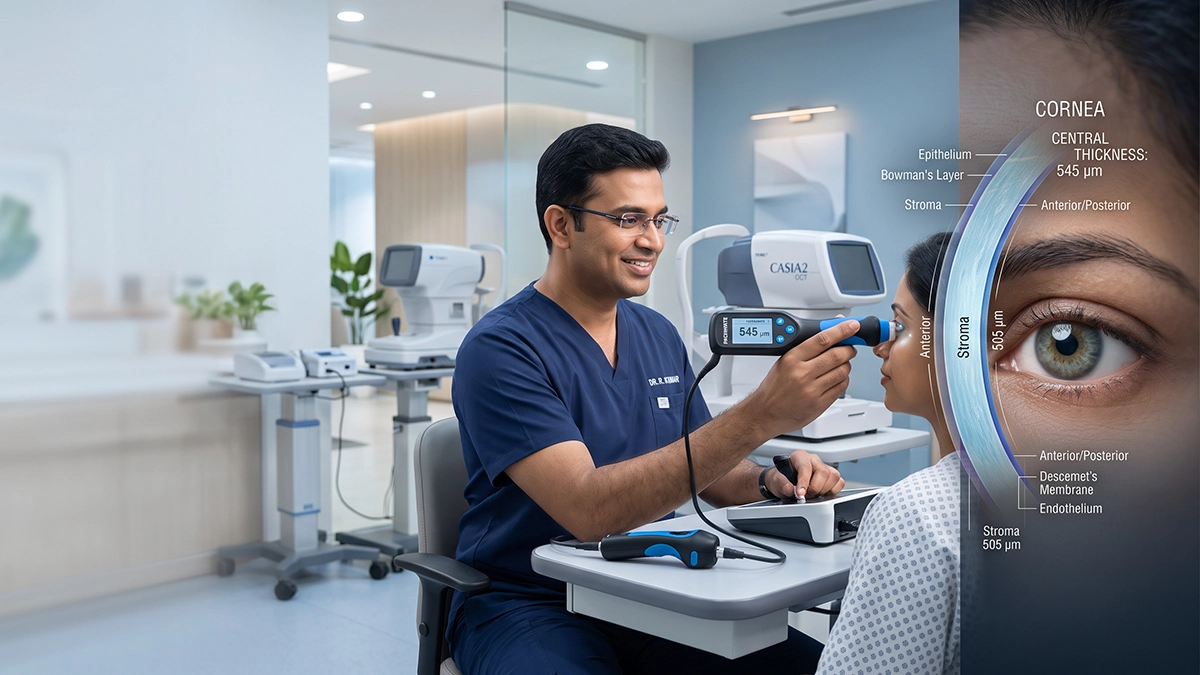
If you are thinking about LASIK it is very likely you already know that your spectacle power and that your age play a role. Also, another measure which is important is the thickness of your cornea. Checking of corneal thickness for LASIK at the time of evaluation is for the doctor to see that there is sufficient healthy corneal tissue that will remain post laser treatment
The cornea which is the transparent front part of the eye. In LASIK we use a laser to reshape a precise amount of corneal tissue which in turn causes light to focus better on the retina. Also because we remove tissue during this process the cornea must have adequate thickness and structural strength before surgery.
This is the fact that pachymetry which is a cornea test that measures thickness plays a very large role in complete LASIK evaluation. But as for LASIK eligibility, one thickness measurement is not enough also of what has to be taken into consideration is corneal shape, refractive power, what we are going to correct with the laser and the still present stromal tissue.
What Is Corneal Thickness?
Corneal thickness is that of the cornea which is the distance between the front and back of the cornea which we measure in microns that is written as µm. Also one micron is equal to one thousandth of a millimetre. In many adults’ healthy corneas we see a central thickness of about 540 to 550 microns which is a range which is wide which is normal. It is also very common for a person to have a thinner or a thicker cornea without that person having an eye disease. What we look at pre op for refractive surgery is not whether the cornea is at an average value but whether it is structurally appropriate for the procedure. That is why we do not use average values when we are evaluating a patient’s corneal thickness for LASIK procedure
Why Does Corneal Thickness Matter for LASIK?
LASIK changes the vision by remodeling the corneal stroma which makes up the bulk of cornea’s thickness. In the procedure a thin flap is made and the excimer laser removes a determined amount of stromal tissue beneath it.
The amount of tissue we remove is in part a function of the patient’s spectacle power and treatment plan. Greater refractive corrections may require us to remove more tissue than for smaller corrections. If too little structurally supportive corneal tissue is left after treatment the cornea may become mechanically unstable. In rare cases this may play a role in progressive corneal weakening and bulging which is also known as post-LASIK corneal ectasia.
The FDA reports that thin corneas are a factor which doctors should note perform refractive surgery as any attempt to reshape an unsuitable cornea will produce serious complications. In that regard which is related to LASIK the doctor will look at the base corneal thickness for LASIK to begin with and also what is the expected amount of tissue which will remain post procedure.
What Is Pachymetry?
Pachymetry is a measurement of corneal thickness. This is one of the key pre LASIK tests done. The cornea test which reports in microns enables the surgeon to plan treatment according to the patient’s specific eye anatomy.
Pachymetry which in present times is done via ultrasound or non contact optical methods. Also we see that modern corneal tomography has been introduced into the picture which is creating very detailed thickness maps of the cornea which in turn show how the cornea varies from the center out to the periphery. While a single central measurement is a start, at present doctors are to also look at the full map which in turn helps us to notice atypical thinning patterns which may need more in depth evaluation.
Is the Pachymetry Test Painful?
Pachymetry is a quick process which is also very well tolerated. With non contact optical methods we do not even touch the eye. For ultrasound pachymetry we do apply a small probe to the corneal surface after which we use anesthetic eye drops. The exam usually only takes a short time
Understanding Your Corneal Thickness Report
A corneal thickness reading is a standalone data point. In the case of two people who have the exact same corneal thickness, they may still get different LASIK results since their corrective lens powers, corneal geometry and which tissue will be removed is unique.
| Finding During LASIK Evaluation | Why It Matters |
| Central corneal thickness | Shows the amount of tissue available before treatment |
| Thinnest corneal point | Helps identify unusual thinning patterns |
| Corneal topography or tomography | Evaluates curvature, symmetry and signs of conditions such as keratoconus |
| Spectacle prescription | Helps determine how much laser correction may be required |
| Planned flap thickness | Influences how much stromal tissue remains |
| Planned laser ablation | Estimates how much corneal tissue will be reshaped |
| Residual stromal bed | Indicates the supporting stromal tissue expected to remain after LASIK |
A comprehensive assessment of corneal thickness for LASIK therefore combines pachymetry with other measurements rather than relying on a single number.
What Is the Minimum Corneal Thickness for LASIK Surgery?
Patients report to us all the time which is the minimum corneal thickness for LASIK surgery and they expect a certain number. What we can tell you is there isn’t a universal preop thickness that we can look at which will make LASIK safe or not for any given patient.
Some studies report that preop corneas of less than 500 microns require more care. But this does not mean that every cornea over 500 microns is automatically a go or that all below it are out
Different approved laser systems have their own set of treatment parameters. For example some FDA reviewed LASIK systems have reported that the surgeon must maintain at least 250 microns of posterior residual stromal tissue after the flap and laser ablation which is performed. That is a key point. The initial corneal thickness is different from the residual stromal bed.
What Is the Residual Stromal Bed?
The Residual Stromal Bed (RSB) is the amount of stromal tissue which is to remain under the LASIK flap post laser treatment. Doctors are able to determine it from the patient’s pre op measurement, planned flap thickness and expected ablation depth
For instance some patients may present with adequate total corneal thickness for LASIK but very high refractive errors which in turn may require a greater laser ablation. The resultant stromal bed may then become the limiting factor.
FDA reports of several LASIK laser systems which have used 250 microns as a base line for minimal residual stromal thickness. But to note, at 250 microns we do not see prevention of ectasia. Thus surgeons may choose more conservative margins based on the patient’s full risk profile. This is also a reason why online calculators and thickness reports don’t replace that specialist LASIK evaluation.
Corneal Thickness Is Only One Part of LASIK Eligibility
A normal pachymetry result does not in itself indicate that a patient is a candidate for LASIK. Before we recommend surgery we also look at the corneas’ shapes, rule out keratoconus, and identify early signs of ectatic changes. Preoperative corneal topography as I understand from the FDA input is a key part which helps to identify corneal problems that in turn may add to surgical risk. Also into the mix go such things as the stability of the glasses prescription, age, dry eye condition, size of the pupils, health of the eyes, and how much refractive correction is needed.
| Assessment | What the Doctor Is Looking For |
| Pachymetry | Adequate and appropriately distributed corneal thickness |
| Topography/tomography | Regular shape without suspicious thinning or bulging |
| Refraction | Stable spectacle power and amount of correction required |
| Dry-eye evaluation | Healthy tear film and ocular surface |
| Eye examination | Absence of conditions that may make LASIK unsuitable |
| Surgical calculation | Adequate predicted corneal tissue remaining after treatment |
The safest decision is therefore based on the entire eye rather than only the result of one cornea test.
What If My Cornea Is Too Thin for LASIK?
Being told that your cornea is a poor candidate for LASIK does not mean that there isn’t a solution for your vision correction. It means that LASIK may not be the best or a safe option for your eyes. By looking at the patient’s prescription, age, corneal and overall anatomical structure other options will be put forth by the ophthalmologist.
PRK is a laser vision correction procedure which does not create a LASIK flap. Also we use different methods which may be put to use for some patients who are not the best fit for LASIK. However PRK still removes corneal tissue and also requires that the cornea is of sufficient strength. Also we have the option of ICL surgery for some patients which corrects refractive error without use of corneal laser. ICL which is inserted into the eye may be a solution in many cases and is not based solely on corneal thickness
SMILE also may be a topic for some refractive errors which in fact changes corneal tissue and doesn’t at all times present the best option for each patient that has a thin cornea. Your ophthalmologist should determine the best procedure based on your individual results rather then to have chosen surgery simply because one test reports outside of the LASIK norm
Can Corneal Thickness Change?
Minor variations may present in results due to the method of test, what time of the day it is, tear film quality and also other variables. Also it is known that contact lens wear may change the corneal shape which is why we ask patients to go without their lenses for a while prior to the last refractive surgery evaluation
The FDA reports that patients should follow what their surgeons say about when to stop wearing contact lenses before base line testing it is noted that contact lenses may temporarily change corneal shape and which in turn may affect surgical results. Also if a result is close to a definite diagnosis or does not match up with other results, the ophthalmologist may do the cornea test again before coming to a final decision
Why Detailed Pre-LASIK Screening Matters
LASIK does improve vision which in turn lessens dependency on glasses and contact lenses at which point it is still a choice to go ahead with a surgical procedure. What we see as success in this is a result of careful patient evaluation. Also we do a full assessment of corneal thickness for LASIK which in terms of how much tissue is present, also determines if what is planned will preserve a proper structural margin.
The FDA also reports to patients that they should go over with their surgeon what are the pros and cons which include dry eye, glare, halos, under-correction and over-correction before you choose LASIK. At Vasan Eye Care we provide a free in depth eye exam for patients which are interested in refractive vision correction which in turn uses that data from the eye measures, refractive needs and overall eye health to make treatment recommendations.
Conclusion
Understanding the variable corneal thickness for LASIK which is a key factor in the informed decision to go for vision correction surgery is very important. Pachymetry reports to the ophthalmologist the corneal thickness but that number by itself is not a determinant of the safety of LASIK
The minimum corneal thickness for LASIK surgery varies based on many factors which include the starting thickness of the cornea, the cornea’s shape, your current corrective lens prescription, what we plan to remove of the tissue and what will be the left over stromal bed. Also of great importance is that pre-procedure work up of the cornea which may include cornea test, tomography and a full eye exam.
If you are interested in LASIK we have you cover that at Vasan Eye Care. We do a personal assessment also which will include other options in vision correction which may be better for your eyes.
Frequently Asked Questions
- Is 500 microns enough corneal thickness for LASIK?
A measurement of 500 microns in itself does not determine LASIK eligibility. The surgeon will look at your prescription, corneal shape, planned flap, estimated laser ablation and expected residual stromal bed. Some people may fit this measurement well, while for others it may not be recommended.
- What is the minimum corneal thickness for LASIK surgery?
In every case there is a unique minimum corneal thickness for LASIK surgery which does not apply to all patients or all laser platforms. The surgeon determines that sufficient structural tissue is present post procedure and also looks at corneal topography and other risk factors before he recommends surgery.
- Can I have LASIK with a corneal thickness of 480 microns?
A 480 micron measurement doesn’t by itself confirm or rule out LASIK. It is a very thin measurement which requires in depth analysis. Your ophthalmologist will evaluate your corneal shape, prescription, what is to be ablated and the left over stromal tissue before he decides that out of LASIK or other options which is best for you.
- What cornea test is done before LASIK?
Pachymetry is the main cornea test used to measure thickness. Also we do Corneal topography and tomography which we use to study the shape and thickness distribution of the cornea and to identify any issues that may lead to complications
- Does LASIK make the cornea thinner?
Yes. LASIK which is a surgical procedure that removes a very precise amount of stromal tissue to restructure the cornea and correct refractive error. This is the reason the surgeon measures corneal thickness for LASIK before hand and determines how much support tissue will be left post procedure
- Can a thin cornea become thicker naturally?
Corneal thickness is a feature of one’s anatomy which we are for the most part unable to increase enough to affect LASIK eligibility. Do not count on supplements or eye exercises to prepare your cornea for surgery. Other vision correction options may be looked at instead
- Is pachymetry enough to confirm LASIK eligibility?
No. Pachymetry is important but during LASIK screening we also look at the corneal shape, refractive error and general eye health. A normal pachymetry reading does not rule out issues with the corneal topography which may make a patient unsuitable for laser vision correction
- What happens if there is not enough corneal tissue for LASIK?
If a surgeon reports that LASIK will leave insufficient supporting tissue that procedure may not be performed. As per the eye condition and prescription other options like PRK or ICL may be looked at. The best option which is safe should be what is put forth after a full refractive surgery work up.
Reference
- LASIK Surgery Checklist – U.S. FDA
https://www.fda.gov/medical-devices/lasik/lasik-surgery-checklist - LASIK: What Should I Expect Before, During, and After Surgery? – U.S. FDA
https://www.fda.gov/medical-devices/lasik/what-should-i-expect-during-and-after-surgery - LASIK Risks and Finding the Right Doctor – U.S. FDA
https://www.fda.gov/medical-devices/lasik/what-are-risks-and-how-can-i-find-right-doctor-me - Corneal Pachymetry – NCBI / StatPearls
https://www.ncbi.nlm.nih.gov/books/NBK555970/ - FDA LASIK System Professional Use Information – Residual Stromal Thickness Guidance
https://www.accessdata.fda.gov/cdrh_docs/pdf/P970043S015C.pdf - FDA LASIK Patient/Professional Information – Corneal Safety Parameters
https://www.accessdata.fda.gov/cdrh_docs/pdf/P930016S021C.pdf