
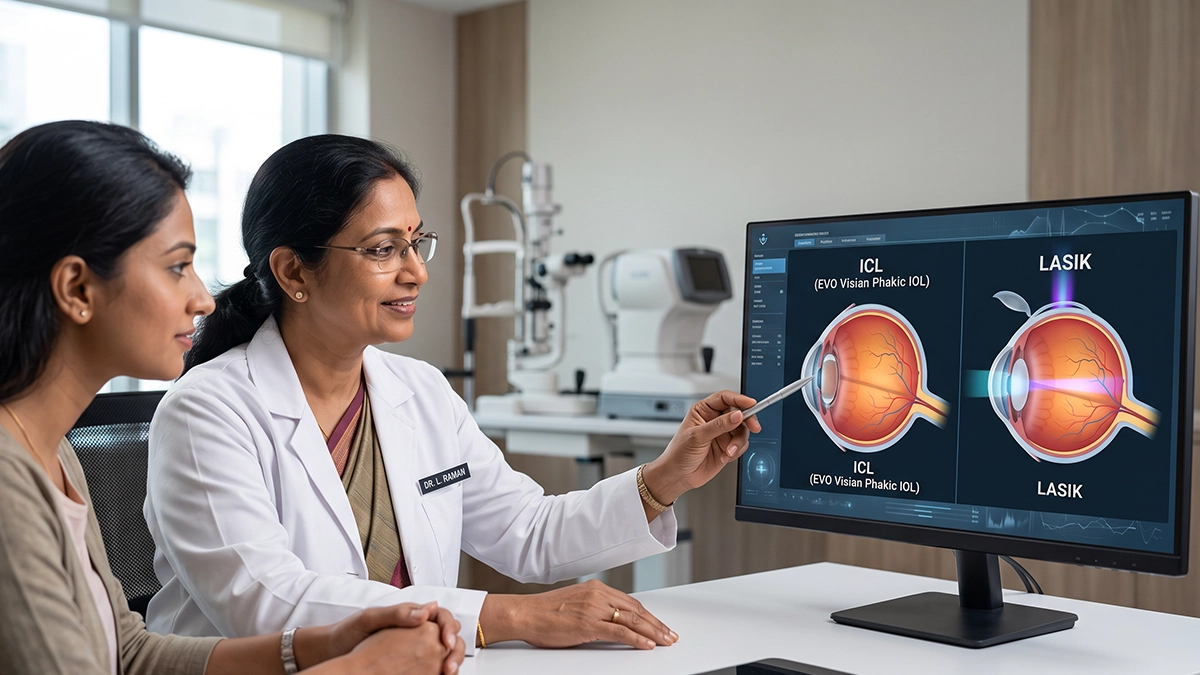
If you are thinking of going without glasses or contacts the choice between ICL vs LASIK may leave you confused. What both do is correct refractive errors but in different ways. In LASIK eye surgery the cornea is restructured with a laser, while in ICL surgery we put in a custom made lens which does not remove the natural one.
Which procedure is right for you depends on the strength of your prescription, corneal thickness, dry eye tendency and overall eye health. ICL vs LASIK choice should be made after an in depth evaluation by an eye specialist.
What Is the Main Difference Between ICL vs LASIK?
During the LASIK eye surgery the surgeon changes corneal tissue which in turn improves light focus on the retina. In the case of ICL surgery we do not see the cornea being reshaped. Instead a Collamer Implantable Lens (ICL) is placed in the eye, usually behind the iris and in front of the natural lens.
| Factor | ICL | LASIK |
| How vision is corrected | An internal lens is implanted | The cornea is reshaped with a laser |
| Corneal tissue removal | No | Yes, tissue is reshaped |
| Often considered when | Higher myopia or selected thin corneas are present | Corneal shape and thickness are suitable |
| Procedure type | Intraocular surgery | Corneal laser surgery |
| Reversibility | Lens may be removed or exchanged if medically required | Corneal reshaping is permanent |
ICL vs LASIK Eligibility: Who May Be Suitable?
Eligibility is at the core of ICL vs LASIK comparison. We see stable spectacle power as a given. Also evaluated is corneal shape, thickness, tear film health, pupil size, retina and eye pressure.
LASIK eye surgery is for adults with stable prescriptions, good corneal thickness and healthy corneal topography. Also which have severe dry eye, unstable power, certain corneal diseases or other eye issues out of the question for laser treatment.
ICL surgery which is used in some cases for adult patients with moderate to high myopia when for some reason laser correction is not appropriate. Also candidacy is based on having enough space in the eye, health of the endothelial cells and other factors. FDA reports that in this procedure the natural lens is left in place and only a phakic lens is inserted. That is to say spectacle power should not be the only reason for making the decision.
Benefits of ICL vs LASIK
The benefits of ICL vs LASIK are very individual. LASIK eye surgery is very popular for its short procedure time and that many suitable patients see early visual improvement in the recovery period.
A great benefit of ICL surgery is that we do not remove corneal tissue which in turn makes it a choice for some people who are not great candidates for corneal laser treatment. Also it may be looked at for certain patients with higher refractive errors. Also which procedure is better is a matter of which patient you are dealing with. A good LASIK candidate may not require an intraocular procedure and also it is the case that someone with high myopia or improper corneal geometry may do better discussing ICL surgery.
ICL vs LASIK Risks and Safety
Every time there is a refractive procedure which may have complications, at the ICL vs LASIK consultation we should have a clear risk discussion. As for what may happen after LASIK eye surgery, dry eye symptoms, glare, halos, fluctuating vision, under or over correction, and in rare cases issues related to the flap or infection are all possibilities. Also the FDA reports that some patients do in fact develop glare, halos, or double vision after refractive surgery.
Because in the eye ICL is performed its risk profile is different. Complications may include infection, inflammation, raised eye pressure, cataract development, glare or halos, lens position issues and very rarely retinal complications. Follow up is used by the doctor to monitor healing, lens position and eye pressure.
| Area | ICL | LASIK |
| Dry-eye concern | No corneal laser reshaping, but dry eye still needs assessment | Dryness can occur or temporarily worsen |
| Halos or glare | Possible | Possible |
| Infection | Uncommon but possible | Uncommon but possible |
| Cataract concern | Possible after phakic lens implantation | No implanted lens |
| Main follow-up focus | Lens position, eye pressure and healing | Corneal healing, vision and ocular surface |
ICL vs LASIK Recovery: What Should You Expect?
Recovery is also a point of difference between ICL vs LASIK. What we see is that many patients who have had LASIK eye surgery have functional vision almost right away, within the first day or so, though they may still experience dryness, light sensitivity or that the vision may fluctuate a bit as the eye is in the process of healing.
After the ICL surgery vision may also improve quickly but recovery includes that of the intraocular implant. We see early mild discomfort, light sensitivity or halos. Follow up visits are important to check eye pressure, lens position and healing. ICL vs LASIK return to work shouldn’t factor into the decision. Suitability is based on eye measures and clinical need.
How Does an Eye Specialist Choose Between ICL vs LASIK?
A proper evaluation may include refraction, corneal topography or tomography, corneal thickness measurement, tear film assessment, pupil evaluation and retinal exam. For ICL we also require measurement of anterior chamber depth and lens sizing.
At Vasan Eye Care we present to our patients a wide range of refractive options along with our full spectrum of eye treatments. If laser correction is a suitable option we may recommend LASIK eye surgery. In some cases where the cornea or prescription do not fit for laser treatment we may look at ICL surgery.
In a consultation for ICL vs LASIK we should discuss safe and realistic correction. An eye hospital which has the proper diagnostic tools can assist patients in understanding their options.
Which Is Better in an ICL vs LASIK Comparison?
In many cases there is not a single winner. For people with appropriate corneas and prescriptions within the treatable range LASIK eye surgery is a good option. In some patients with high myopia, thin corneas or other which make laser correction less of a solution, ICL surgery may be the preference.
A personalized examination is the most reliable way to decide ICL vs LASIK for an individual patient.
Conclusion
Between these options what is put forth is that which best suits your eye condition rather than what is latest. LASIK eye surgery which puts into play the cornea and which in turn gives quick visual recovery we see for right candidates. ICL surgery which puts in a lens inside the eye and which in some cases is a great solution for certain patients who do not do well with corneal laser treatment.
If you are considering ICL vs LASIK, at Vasan Eye Care we do a personal evaluation of your prescription, the health of your cornea, eye anatomy and what you expect from the procedure. We then discuss the benefits, risks, alternatives and which option is best for you.
Frequently Asked Questions
- Is ICL safer than LASIK?
Also not at all better in terms of safety. ICL vs LASIK safety which is better for you depends on your prescription, cornea, eye anatomy and overall ocular health.
- Is ICL better for thin corneas?
In some cases ICL is a solution for thin corneas which do not suit laser procedures, although full eye evaluation is still necessary.
- How fast is LASIK recovery?
Many patients report improved vision right after LASIK eye surgery, which is great, but full healing and stable results may take time.
- Can ICL be removed later?
An ICL can be put in or out of the eye if health needs them which is a plus, also it may not return vision to exactly what it was before the surgery.
- Which procedure is better for high power?
For some patients with high myopia we may turn to ICL surgery as an option when laser correction doesn’t work as well. In depth testing is required.
Reference Links
- FDA – What Are Phakic Lenses?
https://www.fda.gov/medical-devices/phakic-intraocular-lenses/what-are-phakic-lenses - FDA – LASIK Risks and Choosing the Right Doctor
https://www.fda.gov/medical-devices/lasik/what-are-risks-and-how-can-i-find-right-doctor-me