Imagine waking up one morning to see clearly without the need for your glasses. That is what Ortho K lenses do. You wear these specially designed firm lenses while you sleep. Over the night they gently change the shape of the front of your eye. In the morning you take them out and often report that your vision is great all day. Many parents in India are now turning to them for their kids whose prescription is always changing. In this guide that explains how Ortho-K works, who it may help, how to care for the lenses and what risks to know.
What Are Ortho K Lenses?
Ortho-K is a term for orthokeratology. “Kerato” is the cornea out which is the clear dome at the front of the eye. Ortho K contact lenses are made of rigid gas permeable material. They are hard yet allow oxygen to the eye.
Unlike normal soft lenses, they are not worn during the day. The idea of wearing lenses only at night is what makes them special. Each pair is fitted to the exact shape of your eye.
How Do They Work?
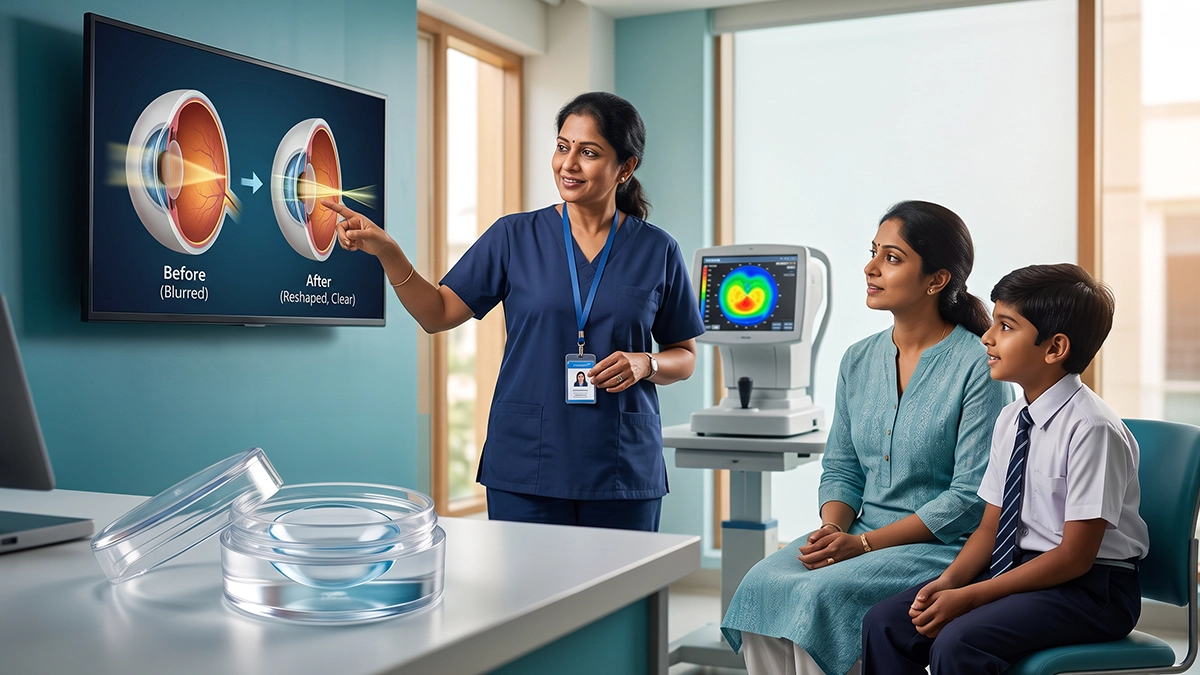
In the case of myopia which is short sightedness, far away objects appear blurry. As you sleep, ortho k lenses which are very thin and almost invisible press lightly on the center of the cornea. This causes the cornea to flatten a little which in turn causes light to focus properly. The results are temporary. The cornea slowly goes back to its original shape within a day or two which is why the lenses are worn nightly.
Who Can Benefit from Ortho-K?
Your eye doctor will decide who ortho-k suits after a full eye examination. Good candidates often include:
- Children and teenagers whose myopia is increasing
- People with mild to moderate myopia
- Sports players and swimmers
- Adults not ready for, or not suitable for, LASIK
- People whose eyes feel dry with daytime lenses, since ortho k contact lenses stay out of the eye all day
Can Ortho-K Slow Myopia in Children?
Studies suggest that ortho k lenses may slow the growth of the eyeball in many children. This can slow the rise in spectacle number. Results differ from child to child, and Ortho-K does not cure myopia.
Ortho-K Is Not the Same as Multifocal Glasses
Spectacle lenses which change in power from the top to the bottom, thus one pair which corrects distance, intermediate and near vision. Progressive lenses are for the most part used by adults over 40 which have difficulty with reading. Ortho-K mainly treats nearsightedness. Once you grasp the progressive lenses issue you see that these two options address different vision issues at different stages of life.
Table 1: Ortho-K Compared with Other Options
| Feature | Ortho k contact lenses | Progressive lenses | LASIK |
| When used | Only at night | During the day | One-time surgery |
| Main use | Myopia, myopia control in children | Near + far vision after 40 | Stable power in adults |
| Usual age | Children and adults | Mostly 40+ | Usually 18+ |
| Reversible? | Yes | Yes | No |
Getting Started: Number Eye Test and Fitting
The first step is a number eye test, which checks your spectacle power. The doctor also maps the shape of your cornea and checks your tear film and eye health.
Step-by-Step Process
- A full eye check-up, including a number eye test
- Corneal mapping to design the lens
- Ordering custom ortho k contact lenses
- First night of wear, with a check-up the next morning
- Follow-up visits after one week, one month, and then regularly
Many people notice clearer vision within a few days. The full effect may take one to two weeks.
Safe Daily Care of Ortho K Lenses
The biggest risk with overnight lenses is an eye infection called keratitis. Good hygiene lowers this risk. Here is the cleaning routine that matters for every user.
Table 2: Ortho-K Care – Do’s and Don’ts
| Do’s | Don’ts |
| Wash and dry hands before touching lenses | Never rinse lenses or the case with tap water |
| Clean lenses with the advised solution every morning | Never use saliva or homemade salt water |
| Use fresh solution in the case every time | Don’t top up old solution |
| Replace the lens case as advised | Don’t wear lenses if your eye is red or painful |
Tap water has been reported to carry a virus of Acanthamoeba which causes severe infections. If you see redness, pain, discharge or blurred vision remove the lenses and see an eye specialist that same day. Also parents should watch over kids who are wearers of ortho k lenses.
What If You Miss a Night?
Many users ask what happens if you skip a night. Usually, vision stays fairly clear for the first day, then slowly becomes blurry. Simply wear the lenses again the next night. Children using ortho k lenses for myopia control should wear them regularly.
Ortho-K for Adults Over 40
Ortho-K mainly corrects distance vision, so reading trouble after 40 may remain. Some adults use reading glasses with it, while others choose progressive lenses instead. An easy way to remember the progressive lenses meaning is “three glasses in one”.
Conclusion
Ortho k lenses provide a painless non-invasive approach to clear day time vision, also they may help in the development of myopia in kids. Results are based on proper fit, regular checks and careful cleaning. If you or your child has trouble with glasses the experts at Vasan Eye Care can determine if Ortho-K is for you. Drop by your nearest Vasan Eye Care center to see what they have to offer.
Frequently Asked Questions
1. Are ortho k lenses safe for kids?
In many cases they can be fit by a trained eye care professional and cleaned properly. Supervision during care is required of parents.
2. Is it permanent?
No. If you stop wearing the lenses the cornea goes back to its original shape within a few days to weeks.
3. Do I still need a number eye test every year?
Yes. Yearly check-ups track your power and corneal health, even with ortho k contact lenses.
4. Who explains the progressive lenses meaning for my eyes?
Your eye doctor can explain the progressive lenses meaning after a number eye test, and suggest whether progressive lenses or Ortho-K suits you better.
References
- Nearsightedness (Myopia) – National Eye Institute
https://www.nei.nih.gov/eye-health-information/eye-conditions-and-diseases/nearsightedness-myopia - Premarket Submissions for Orthokeratology Rigid Gas Permeable Contact Lenses – U.S. Food and Drug Administration
https://www.fda.gov/regulatory-information/search-fda-guidance-documents/guidance-premarket-submissions-orthokeratology-rigid-gas-permeable-contact-lenses-guidance-industry - Contact Lens Health Week, 2018 (MMWR) – Centers for Disease Control and Prevention
https://www.cdc.gov/mmwr/volumes/67/wr/mm6732a1.htm - National Programme for Control of Blindness and Visual Impairment – Ministry of Health and Family Welfare
https://npcbvi.mohfw.gov.in/