
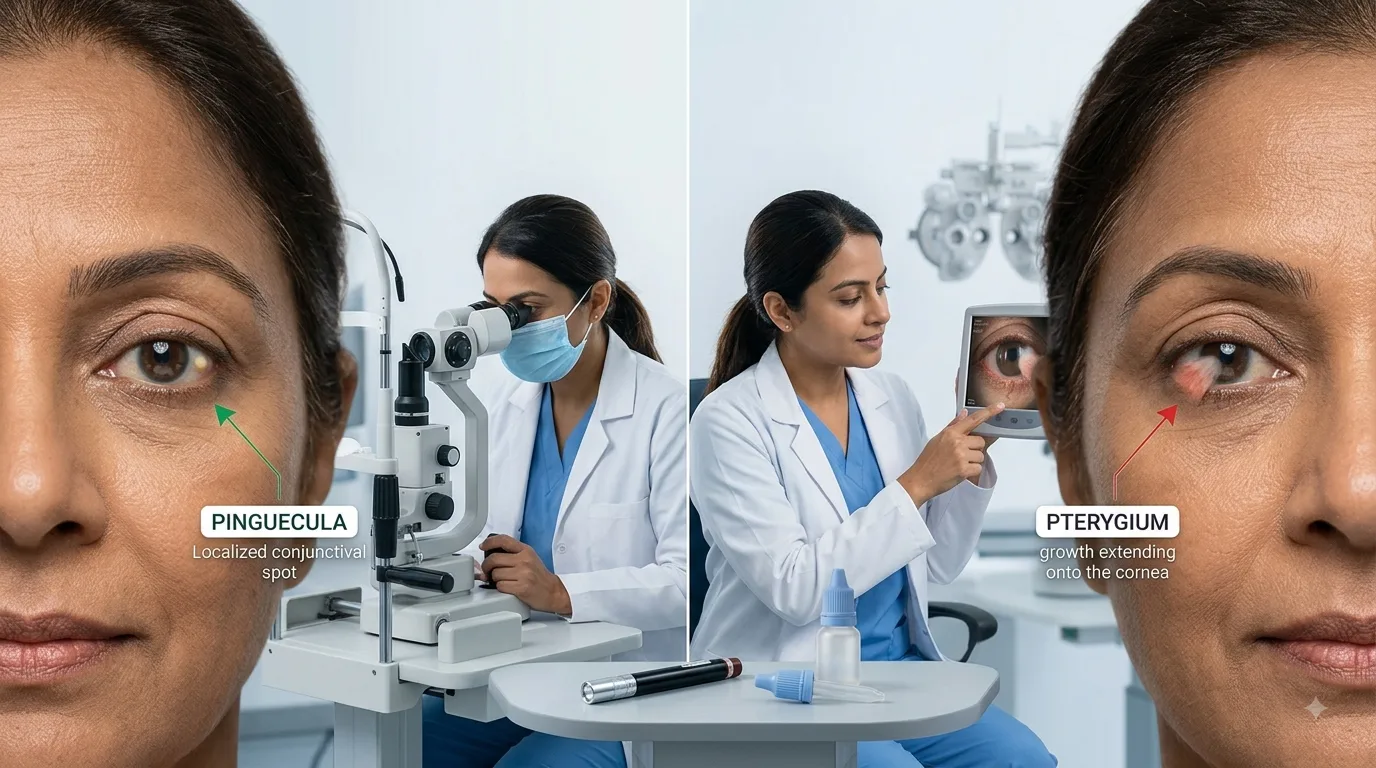
In the eyes we may notice a yellow bump or a fleshy growth in the white part of the eye which is worrying. Also known to cause this are pinguecula and pterygium eye disease. Although they appear on the eye’s surface and have some of the same risk factors, they are in fact different.
A pinguecula will present in the conjunctiva which is the clear tissue that covers the white of the eye. In the case of pterygium eye we see growth from the conjunctiva into the cornea. This is important as when the cornea is involved it may cause irritation, astigmatism or changes in vision.
What Is a Pinguecula?
A pinguecula is a small raised white and yellow in color area which usually appears on the conjunctiva by the cornea. They are most common on the nasal side of the eye but may present on either.
Most of which are benign and do not cause vision problems. Some may report dryness, a sandpaper feeling in the eye or intermittent redness. At which point the tissue becomes irritated and swollen which is when the condition presents as Pinguecula.
A pinguecula doesn’t usually need to be removed. When dryness or mild discomfort patients may be given lubricating drops. Medicated drops should only be used after consulting an ophthalmologist especially when inflammation is present.
What Is a Pterygium?
A pterygium eye which is a raised triangular or wing shaped growth of the conjunctival tissue which extends onto the cornea. It is also known for what we term “surfer’s eye” which we see in folks that have had long term exposure to ultraviolet radiation, wind and dry outdoor elements which play a role in it’s development.
The American Academy of Ophthalmology provides a patient-friendly explanation of both conditions at https://www.aao.org/eye-health/diseases/pinguecula-pterygium.
A small pterygium eye may be stable for years. In some patients though it gradually grows toward the center of the cornea. A large growth may change the cornea’s shape, produce astigmatism or interfere with the visual axis.
Pinguecula vs. Pterygium: The Main Differences
| Feature | Pinguecula | Pterygium |
| Typical appearance | Small yellowish or whitish raised patch | Fleshy, triangular or wing-shaped growth |
| Location | Remains on the conjunctiva beside the cornea | Extends from the conjunctiva onto the cornea |
| Effect on vision | Usually does not affect vision | May cause astigmatism or obstruct vision as it grows |
| Common symptoms | Dryness, mild irritation or redness | Irritation, redness, foreign-body sensation and blurred vision |
| Usual management | Observation and lubricating drops | Observation, medication or surgery depending on progression |
Both growths are noncancerous, but any which appear new or which are changing in any way should be evaluated by an eye doctor. Some atypical surface conditions may present like a pinguecula or a pterygium and an exam is the way to sort that out.
What Causes Pinguecula and Pterygium?
Long term exposure to ultraviolet light is a key element. Also present are dry weather, wind, smoke, dust and repeated environmental irritants which affect the conjunctiva.
People that spend great amounts of time outdoors which includes farmers, construction workers, drivers, athletes and field professionals may see greater levels of these conditions. Living in a hot, sunny or dusty environment also puts you at greater risk for developing a pterygium eye.
Ultraviolet and dry or dusty environments which cause chronic irritation are reported to be at risk in the medical overview which the National Center for Biotechnology Information puts forth: https://www.ncbi.nlm.nih.gov/books/NBK558907/.
Symptoms That May Require Attention
A small pinguecula or pterygium eye may go unnoticed by some. Should symptoms present themselves out may see redness, burning, itching, watering, dryness or that there is something foreign in the eye
During episodes of pterygium inflammation the growth may present more prominently. Also in the case of chronic pterygium inflammation wearing contact lenses may be uncomfortable.
Blurred and distorting vision which is a result of growth which in turn changes the cornea’s curvature, causes astigmatism or may be progress towards the pupil. Also sudden pain, light sensitivity, discharge or quick change in the appearance of the eye should not automatically be put down to pterygium which in fact requires prompt assessment.
How Are These Conditions Diagnosed?
An ophthalmologist will in most cases recognize a pinguecula or pterygium eye disease during an exam which includes the use of a slit lamp. The assessment will note the growth’s location, size, thickness, vascularity and corneal involvement.
Visual acuity and refraction will be tested to see if the growth is affecting eyesight. For astigmatism or surgical planning issues corneal measurements may be recommended. Also we take photos which will help the ophthalmologist to compare the growth at the follow up visits.
What Are the Available Treatment Options?
Treatment is based on symptoms, growth of the lesion, and its effect on vision. For a small stable lesion which is not changing may just be monitored. Preservative free lubricating drops are used to reduce dryness and friction. In case of marked redness or inflammation we may see your ophthalmologist prescribe appropriate anti-inflammatory drug for a short term.
Steroid eye drops should never be started without medical supervision. Incorrect or prolonged use may lead to complications, including raised eye pressure or infection.
| Clinical situation | Possible management approach |
| Small growth without discomfort | Periodic observation and UV protection |
| Dryness or mild irritation | Ophthalmologist-recommended lubricating drops |
| Recurrent redness or inflammation | Examination and short-term prescribed medication |
| Progressive corneal growth | Regular measurement and discussion of surgical options |
| Astigmatism or reduced vision | Detailed evaluation for surgical removal |
| Persistent symptoms despite medication | Review of suitable pterygium eye treatment |
When Is Pterygium Surgery Considered?
Surgery is not always a requirement for pterygium eye, we often talk about it at the times when the growth has progressed to affect the visual axis, changing cornea shape, which in turn affects vision or when it’s causing symptoms that do not respond to other eye treatments.
Surgery is also an option for patients which have had repeated pterygium inflammation which in turn causes great discomfort or in which the growth interferes with contact lens use. Cosmetically oriented issues may be brought up, but the benefits should be balanced against possible complications and recurrence.
During surgery the affected tissue is removed. We may put in a small graft of healthy conjunctiva which we take from another part of the patient’s eye. The approach we take is based on the state of the eye and also what I judge best clinically. Recurrence is a issue which we still see after we remove it.
Recovery and Follow-Up After Surgery
After pterygium eye treatment which may include a procedure, it is known that in the short term some redness, watering, tenderness or a foreign body sensation is very common. We will put you on a drop regimen to help reduce inflammation and aid in the healing process. Also do not rub the affected eye, and we ask that you follow our advice regarding which activities like bathing, swimming, driving, exercise, and which environments to stay away from which may be full of dust.
Follow up visits are for the ophthalmologist to check healing, to watch eye pressure when needed and to look for early signs of recurrence. Postop medication should be taken exactly as prescribed, do not discontinue or lengthen without first speaking to your eye doctor.
Can Pinguecula and Pterygium Be Prevented?
It may not always be possible to prevent each case but which of them can be reduced is through changing your environment such as by limiting ultraviolet exposure and wearing sunscreen which in turn will also help to slow progress of what is at issue. Also wear proper fitting sunglasses that provide ultraviolet protection, and a large brimmed hat for extensive outdoor exposure.
Protective gear for the eyes is a good idea in dusty, windy or industrial settings. As for dry eye issues, stay away from smoke and take breaks from harsh environments which may also better your comfort. Also if you have a pre-existing growth in the eye go for the recommended follow up visits to the eye specialist hospital.
When Should You Consult an Ophthalmologist?
Upon notice of a new, changing, inflammatory or painful surface growth which also includes light sensitivity or blurred vision, we ask that you have a check up. Also report when redness persists, symptoms affect daily life or it looks like the growth is spreading across the cornea.
At early stages of diagnosis it does not mean that surgery is a requirement. This allows the ophthalmologist to confirm the diagnosis, document the growth and put forth the best pterygium eye treatment before vision is affected.
Conclusion
Pinguecula and pterygium may look the same at first but they have different relationships with the cornea. A pinguecula is usually found on the white of the eye, while a pterygium eye may grow onto the cornea and at times will affect vision.
Do not try to diagnose or out treat eye growth with over the counter medicated drops. Go to Vasan Eye Care or a trusted eye hospital for a personal exam, appropriate follow up and medical care.
Frequently Asked Questions
Most pingueculae stay small and are localized to the conjunctiva. At times a surface growth will grow larger and begin to extend toward the cornea. While progression doesn’t always happen, it is advised to have a regular check up when the lesion changes in size, shape or appearance.
Surgery is usually a treatment for pterygium eye which is progressive, affects vision, changes corneal shape or does not respond to medication. An ophthalmologist will look at the size of the pterygium, its rate of growth, level of discomfort, visual impact and also the issue of recurrence before deciding on a surgical option.
Surfer’s eye is a term for pterygium eye disease. This disease is related to long term sun exposure and repeat irritation from wind, dust, smoke or dry conditions. It affects not only surfers but also any one that spends a great deal of time outdoors.
Complete avoidance is not always possible. We put on UV protective sunglasses, we wear broad brimmed hats, we protect the eyes from dust and wind, we avoid smoke and manage dryness which in turn reduces environmental irritation and helps to at which these growths may be minimized or slowed.
A pinguecula usually does not affect eyesight as it forms at the edge of the cornea. With pterygium eye sight may be affected if the growth changes corneal shape, causes astigmatism or extends far enough to interfere with the visual axis.
Reference Links
- https://www.ncbi.nlm.nih.gov/books/NBK558907/
- https://pubmed.ncbi.nlm.nih.gov/33156079/
- https://www.guysandstthomas.nhs.uk/health-information/pterygium
- https://www.guysandstthomas.nhs.uk/health-information/pterygium/having-surgery-pterygium
- https://www.uhsussex.nhs.uk/resources/your-guide-to-pterygium-surgery-2/