
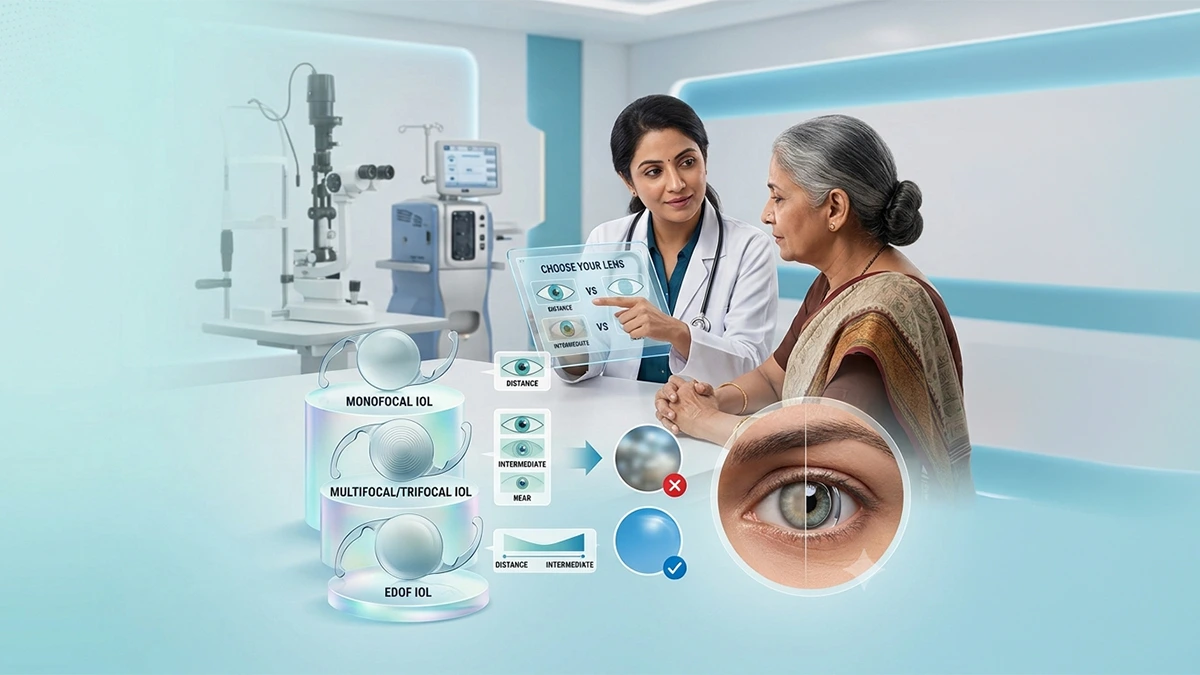
Selecting the right intraocular lens is a key decision pre cataract surgery. At the time of the removal of the cloudy natural lens the surgeon puts in a clear artificial intraocular lens which is also known as an IOL. This artificial lens stays in the eye and helps to focus light which in turn restores clearer vision.
Which is the best lens for cataract surgery? There isn’t a universal best lens that works for everyone. What is best depends on your overall eye health, your level of astigmatism, your lifestyle, your need for better near vision, your screen use, if you like to drive at night and also how much you wish to still use glasses post op.
Modern which includes monofocal, toric, multifocal, trifocal and extended depth of focus lenses is what we see in today’s IOL lens types. Each type presents a different trade off between range of vision, dependency on glasses and also to which may be the optical side effects. Your ophthalmologist thus should only put forth a recommendation after they have had a careful look at your eyes and have talked through your expectations.
What Is an IOL in Cataract Surgery?
A cataract is what happens when the natural transparent lens of the eye turns opaque. In cataract surgery we remove the affected lens and in its place we put in a clear artificial lens which is also known as an IOL.
Before surgery your eye doctor does in depth measurements that determine the IOL power. Your current spectacle prescription is not a stand alone determinant for which lens will be put in. Also the doctor may look at your cornea, retina, optic nerve, astigmatism and the overall health of your eye.
Understanding of the main IOL lens types which in turn will make it easier to talk to your surgeon about what is available.
Different IOL Lens Types for Cataract Surgery
| IOL Type | Main Visual Benefit | Glasses May Still Be Needed For | May Be Considered For |
| Monofocal IOL | Clear vision at one selected distance | Reading or other distances | Patients wanting a simple, established option |
| Toric IOL | Corrects cataract-related focusing needs plus suitable corneal astigmatism | Near tasks or residual prescription | Patients with clinically significant astigmatism |
| Multifocal IOL | Provides vision across more than one distance | Fine print or selected tasks | Suitable patients wanting less dependence on glasses |
| Trifocal IOL | Designed for distance, intermediate and near vision | Certain demanding visual tasks | Suitable patients seeking a broad visual range |
| EDOF IOL | Extended range, especially distance and intermediate | Close reading may still require glasses | Patients who prioritise driving, computers and intermediate vision |
The performance and results of an IOL may differ based on the type of lens and also on the person’s eye characteristics. Thus this comparison is to be used as a guide which in no way should take the place of an ophthalmologist’s evaluation.
Monofocal IOL: A Reliable Choice for One Focusing Distance
A single focus IOL has one primary point of focus. This is the most used type of IOL in cataract surgery. Many patients choose to have very good distance vision which they don’t have to correct and then use reading glasses for close work.
Monofocal implants are a good option for those that are happy to wear glasses post op and prefer a simple visual correction solution.
For an individual that values good distance vision and is willing to use glasses for reading, a monofocal IOL may be the best lens for cataract surgery which aligns with your personal needs.
Toric IOL: Designed for Patients With Astigmatism
Astigmatism is a result of the eye’s irregular curvature which in turn causes blurred or distorted vision. Toric IOLs are put in to correct that which is of suitable degree of corneal astigmatism also it is to replace the removed cataract affected natural lens.
Additional tests are also required to see if a toric lens is a good option for you. At your consultation your eye specialist professional will determine the degree and pattern of astigmatism which will in turn inform their recommendation of this IOL.
A toric lens is what we may turn to in best lens for cataract surgery for some patients which in turn will include the issue of astigmatism they had which was to persist post surgery.
Multifocal and Trifocal IOLs: Greater Range of Vision
Multipeer and triple function IOLs are what many turn to for premium lenses which we have designed to improve vision at many different distances.
Multifocal lenses present different optical zones which in turn provide more than one focus. Trifocals which are a type of multifocal are designed to include distance, intermediate and near vision. These may put less demand on the use of glasses in the right patients.
Reduced reliance on spectacles does not mean a patient will never need them again. Glasses may still be necessary for fine print or certain visual tasks.
Some patients report seeing glare, halos or other visual issues around lights at night. These should be brought up before we go with premium lenses.
EDOF IOLs: Extended Range of Vision
Extended depth of field, or EDOF, lenses are also a top of the premium lenses line category.
Instead of creating separate focal points for near and far objects, EDOF lenses are designed to have a wide range of in-focus distance. They do this to improve distance and mid range vision which is very useful for actions like driving, using a computer, cooking or looking at a car instrument panel. For close work however reading glasses may still be required.
In the same way as other presbyopia correcting lenses some may see glare or halos. Your ophthalmologist should go over these which may be pros and cons beforehand.
Monofocal vs Premium Lenses: Which Is Better?
The term “premium” does not mean that a lens is always the best medical choice for each patient. It usually refers to IOL technology which brings in extra visual benefits like astigmatism correction or a greater range of focus.
| Factor | Monofocal Lens | Premium Multifocal/Trifocal/EDOF Lens |
| Primary aim | Clear vision at one selected distance | Wider range of functional vision |
| Dependence on glasses | Usually higher for non-target distances | May be reduced |
| Near vision | Reading glasses often needed | May provide greater near vision depending on design |
| Intermediate vision | Depends on target and lens design | Often improved, particularly with EDOF/trifocal lenses |
| Halos or glare | Generally less of a concern | Can occur in some patients |
| Patient selection | Suitable for a wide range of patients | Requires careful selection |
| Cost | Usually more economical | Usually more expensive |
| Best choice | Depends on the individual | Depends on the individual |
A patient that values spectacle independence may notice that premium lenses are a very appealing option. Also, another person who does night shift work and is used to wearing reading glasses may prefer a monofocal solution.
Some present eye diseases may also play a role in what is best for a presbyopia corrective IOL. The American Academy of Ophthalmology reports that eye conditions like glaucoma or macular degeneration may also impact which multifocal or EDOF lenses are appropriate.
This is to say that a full eye care assessment is of great importance which goes beyond just the technology or price of the lens.
How Is the Best Lens for Cataract Surgery Chosen?
Choosing the optimal best lens for cataract surgery is a result of an in depth pre op evaluation. We may look at the state of your cornea, retina and optic nerve, also we will look at the degree of astigmatism, past eye procedures and total visual outcome.
Your lifestyle matters too.
A person that works at the computer for many hours may see which intermediate vision is best for them. One who reads a great deal may put more value on near vision. A patient that mostly drives at night may want to go over night vision issues in detail.
The surgeon also requires you to determine the degree of your desire to reduce your use of glasses.
A visit to a good Eye hospital which has experience in the field will allow us to study these issues prior to determination of which IOL to use. We should not only look at the latest or most expensive lens. Instead we should find the one which best fits your eyes and your realistic visual expectations.
Which IOL Lens Should You Choose in 2026?
In many cases we see that a monofocal IOL is a very reliable and common choice. For issues of significant astigmatism a toric lens may be appropriate. As for multifocal or trifocal lenses we put that forward for patients which are right for a greater range of vision, also EDOF lenses we present as a good option for people that value distance and mid range activities.
Therefore when it comes to IOL lens types, think which visual tasks are most important to you in day to day life instead of only looking at the name or price of which lens is best.
What is the best lens for cataract surgery is a lens which puts together appropriate eye health, accurate measurements, realistic expectations and your individual lifestyle needs.
Conclusion
Modern cataract surgery has a variety of IOL lens types, but to go with the most tech based option all the time is not always the best. What is the best lens for cataract surgery will depend on your eye health, visual needs, lifestyle and what you expect.
At Vasan Eye care we present to you a thorough assessment for those of you that are looking at cataract surgery also we discuss appropriate lens options with a very experienced eye doctor. If cataracts are to the point of affecting your daily routine, our professional eye care team is here to help you out in understanding what Eye treatments are available and which IOL may be best for your individual eyes.
Frequently Asked Questions
There isn’t a single best lens for cataract surgery. Monofocal, toric, multifocal, trifocal and EDOF lenses present different options for vision. An ophthalmologist will evaluate your eye health, astigmatism, lifestyle and expectations before putting you into a certain lens.
Neither lens is a clear choice. A monofocal lens is for primary correction of distance or near vision, while a multifocal is designed to improve vision at multiple distances. Multifocal lenses may reduce the need for glasses in some but for others may cause issues like glare or halos.
A toric IOL may in some cases be used for patients that present with what we would term as large amounts of corneal astigmatism. In each patient’s assessment prior to the procedure our surgeon will perform a very detailed evaluation to determine if toric correction is an option for that patient and will also determine the exact power and placement of the lens.
Not always. Premium lenses do reduce the dependency on glasses in some patients, but no IOL should be put forth as a guarantee of total spectacle independence for all activities or all patients.
No. The health of the retina, optic nerve, cornea as well as other structures plays a role in which contacts will suit you and the visual results you may expect. Your eye specialist will do an evaluation of your eyes’ health and go over with you what the pros and cons are before they put you forward for which lenses to use.