
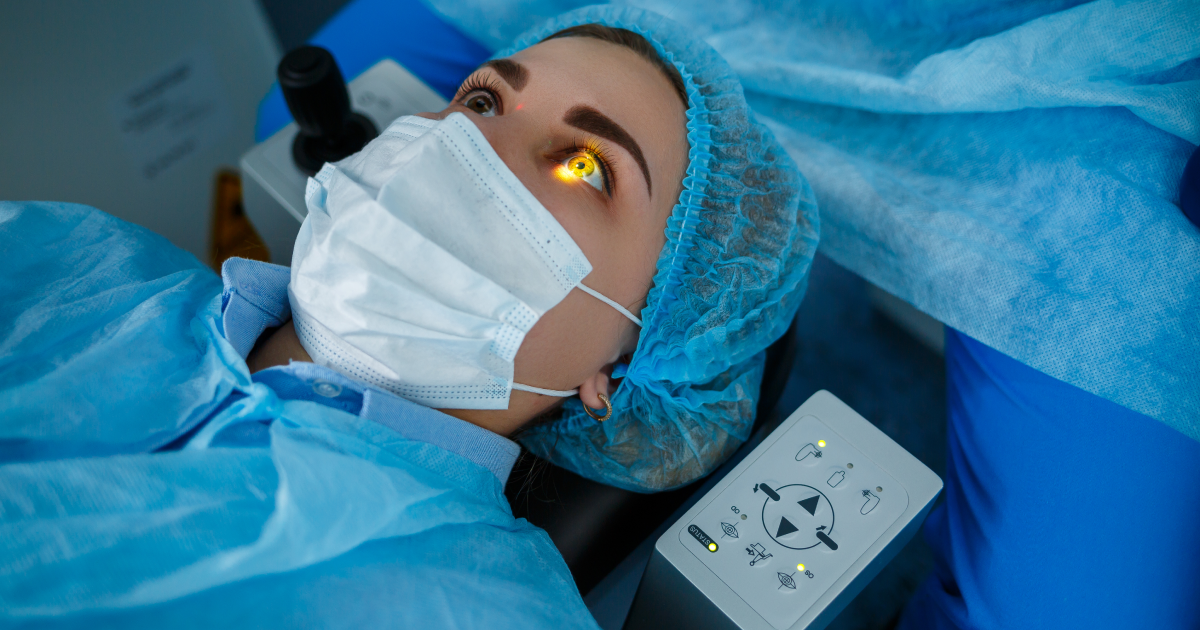
For instance many young people report that wearing glasses and contact lenses is a bother during sports, travel, long work days, or a very active social life which is a daily affair. This has seen an increase in interest in SMILE, a low invasive laser vision correction procedure which is also known as “SMILE LASIK.
Although the terms are often used together, SMILE is technically different from conventional LASIK. It does not produce a large corneal flap. What it does is use a femtosecond laser to form a thin lens like piece of tissue within the cornea which the surgeon then removes via a small incision. This in turn reshapes the cornea for improved light focus.
What Is SMILE Surgery?
SMILE which stands for Small Incision Lenticule Extraction is a procedure we use for myopia which may or may not include astigmatism. The laser makes a precise lenticule in the cornea which the ophthalmologist then removes through a small incision.
SMILE is characterized by the use of a femtosecond laser for the creation of corneal cuts which in turn is what removes the need for a blade.It is also flapless, distinguishing it from traditional lasik eye surgery. Eligibility is based on the laser platform, prescription, corneal measurements, eye health and clinical assessment. The US FDA device info notes that there are regulated treatment parameters and the importance of a stable prescription: https://www.accessdata.fda.gov/scripts/cdrh/cfdocs/cfpma/pma.cfm?ID=P150040S003.
Why Do Young Adults Consider SMILE?
Young adults may explore spectacle removal surgery for greater freedom during exercise, commuting, professional responsibilities and day to day activities. The flapless approach may turn out to be very much those with active lifestyles. Also it is important to note that lifestyle is not the only factor in terms of medical suitability.
SMILE can reduce dependence on distance glasses, but it cannot guarantee lifelong freedom from spectacles. Residual power, natural ageing, or future eye conditions may still make glasses necessary. The treatment corrects a refractive error; it does not prevent eye disease.
Clinical reviews report broadly comparable visual and refractive outcomes between SMILE and femtosecond LASIK in appropriately selected patients. Some evidence suggests less short-term disturbance to corneal nerves and the ocular surface, but no procedure is universally superior: https://pmc.ncbi.nlm.nih.gov/articles/PMC5778540/.
SMILE, Femto-LASIK, and PRK: Key Differences
| Feature | SMILE | Femto-LASIK | PRK |
| Corneal access | Small incision; no flap | Femtosecond-laser flap | Surface treatment; no flap |
| Laser method | Femtosecond laser creates a lenticule | Femtosecond and excimer lasers | Excimer laser |
| Early recovery | Usually progressive over several days | Often rapid, but variable | Generally slower |
| Common use | Suitable myopia and myopic astigmatism | Broader customisation in selected cases | Selected corneas and lifestyle needs |
| Main limitation | Not suitable for every prescription | Flap precautions and dry-eye concerns | More early discomfort |
A full evaluation is required prior to choosing SMILE, LASIK, PRK or any other corrective method.
Who May Be Suitable?
A proper candidate is for adults with stable prescriptions, health corneas, realistic expectations, and refractive error which the treatment can correct. The ophthalmologist must report adequate corneal thickness and regular corneal shape.
SMILE may also not be appropriate at the time of diagnosis of keratoconus, large scale dry eye, active infection or inflammation, unstable refraction, or in a condition which has a large effect on the healing process. During pregnancy and breastfeeding there is change in refraction so it may be best to delay elective procedures. Careful screening is essential for every spectacle removal surgery.
Tests Before SMILE
| Test or assessment | Why it matters |
| Refraction and prescription history | Confirms the power and whether it is stable |
| Corneal topography or tomography | Detects irregular shape and keratoconus risk |
| Pachymetry | Measures corneal thickness |
| Tear-film assessment | Identifies dry eye requiring treatment |
| Pupil and eye examination | Reviews night-vision factors and other eye disease |
| Lifestyle discussion | Aligns treatment with work, sport, and expectations |
Procedure, Recovery, and Follow-Up
Anaesthetic drops which cause numbing of the eye are used. The patient will look at a fixation light as the femtosecond laser creates the lenticule and small incision. Then the surgeon gently dissects out and removes the lenticule through that opening. Patients should make arrangements for transport home and to avoid driving until cleared by their ophthalmologist.
Mild symptoms of watering, grittiness, light sensitivity, dryness, or fluctuating vision may present early. Vision tends to improve within the first few days but the rate at which it does varies. As prescribed we must use the antibiotic, anti-inflammatory, and lubricating drops exactly as directed.
Eye rubbing, swimming, dusty environments, and eye make up may be avoided for a while. We will do follow up visits which will see to the progress of your healing, will check your vision, dryness and eye pressure. Should you have sudden change in your vision, increase in pain, more redness, discharge, an injury or that which is a rise in light sensitivity please come back right away.
Risks and Limitations
Possible issues with dry eye, glare, halos, fluctuating or reduced night vision, inflammation, infection, undercorrection, overcorrection, residual astigmatism, or the need for enhancement. Also rare are complications to the cornea.
Some patients will still use glasses for certain tasks. Presbyopia also causes the need for reading glasses as we age. A thorough consultation should go over what the benefits will be, what other options are out there, what the drawbacks are and which surgeries may not be the best fit for the patient.
Understanding the SMILE LASIK Cost in India
The smile lasik cost in India is not a fixed national price. It varies with the city, hospital infrastructure, laser platform, which doctor you see, pre op tests, if one or both eyes are treated, medications, and post op care.
When comparing the spectacles removal surgery cost in India, patients should look beyond the lowest advertised price and see what the quote includes. The breakdown should include consultation, investigations, procedure charges, medicine, follow ups, and management of residual power.
The lasik surgery cost may differ because SMILE and LASIK use different technologies and consumables. The most reliable way to understand the smile in India is to complete an eye evaluation and obtain a personalised written estimate.
Frequently Asked Questions
Yes. SMILE, which uses a femtosecond laser for the creation of the lenticule and small corneal incision, does not use a mechanical blade. Also it is to be noted that SMILE is a separate bladeless procedure as opposed to conventional LASIK.
Blade free femtosecond LASIK does offer precise flap creation which is a plus, but it isn’t the best option for all patients. SMILE, femtosecond LASIK and PRK each have their own benefits. Corneal shape, prescription, dry eye issues, occupation, and visual goals should play a role in which procedure is chosen.
LASIK may correct your dependency on glasses for some refractive errors but we can not guarantee full or permanent freedom from them. Some people do have minimal power still present and may use glasses some of the time for certain tasks also you may at a later age need reading glasses due to presbyopia.
Cost depends on the city, hospital, technology, testing, surgeon, and whether treatment is performed on one eye or both. An examination is needed to provide an accurate estimate. Patients should ask for an itemised quotation and check exactly what the package covers.
SMILE may work for some younger patients in which it’s no flap procedure is what is matched to their eye structure and lifestyle. It is not meant to be a universal trade-in for LASIK eye surgery, PRK, contacts, or glasses.
Consult a qualified ophthalmologist at Vasan Eye Care or visit a trusted eye hospital for corneal testing, personalised advice, and an accurate estimate of the spectacles removal surgery cost in India.