
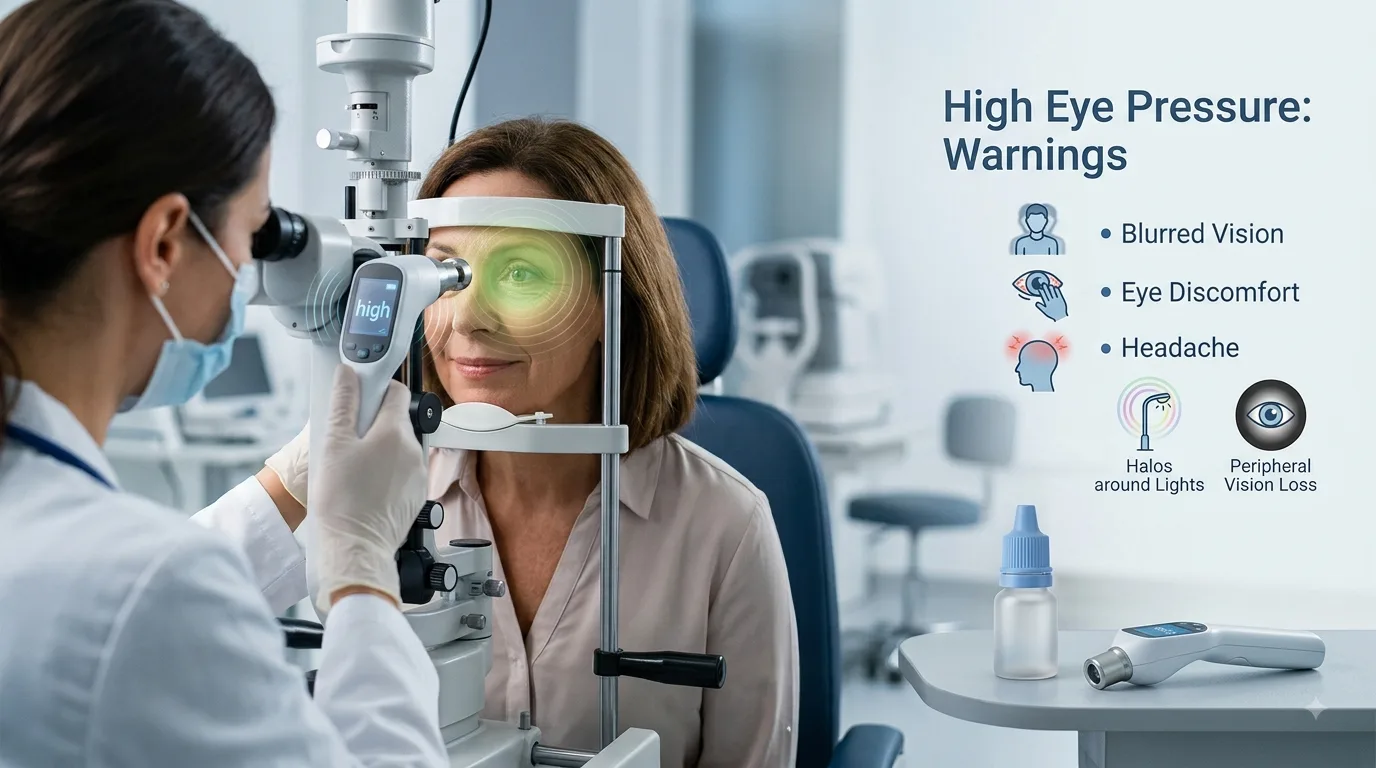
High eye pressure is a risk factor for glaucoma, but a single out of the ordinary reading does not in and of itself indicate that a person has the disease. It is in reference to the health of the optic nerve, the thickness of the cornea, visual field results, and the passage of time.
Because the early signs of increased eye pressure are not present in most cases, we use exams to determine if we should put a patient on a monitoring or treatment path.
What Is Eye Pressure and Why Does It Matter?
Eye pressure also known as intraocular pressure or IOP is a result of the fluid within the eye. A constant production of clear fluid that we call aqueous humour takes place in the front of the eye and usually leaves the eye through special tissue at the eye’s angle between the cornea and the iris.
Pressure may increase when the eye makes fluid faster than it can drain, or when the drainage pathway does not work as efficiently. The National Eye Institute explains that impaired drainage can cause fluid to accumulate inside the eye:
Understanding the Normal Eye Pressure Range
For most adults normal eye pressure is reported to be between 10 to 21 mmHg. This is a clinical guideline not a hard and fast rule. Some people develop glaucoma related damage within this range, and also you will see some with readings above it which do not show any optic nerve damage.
People looking for the eye normal range shouldn’t base a report on a single number. Readings also change throughout the day, and corneal thickness plays a role in measurement.
| Reading or finding | What it may mean | Usual next step |
| About 10–21 mmHg | Often within the commonly quoted normal eye pressure range | Interpret with optic nerve findings |
| Above 21 mmHg | May suggest ocular hypertension or another cause | Repeat the measurement and assess glaucoma risk |
| Any reading with nerve change | May need investigation even if the number seems “normal” | Imaging, visual-field testing, and follow-up |
What Causes High Eye Pressure?
Reduced low outflow of aqueous humour is a common cause. Also we see raised intraocular pressure in patients which are on corticosteroids, had prior eye injury, have inflammation inside the eye, which have drainage angle abnormalities, or which have had changes post eye surgery.
Risk evaluation also looks at age, family history, high myopia, diabetes, corneal thickness, and past test results. These play into what we decide for follow up but do not in themselves confirm a diagnosis.
Does High Eye Pressure Cause Symptoms?
Ocular hypertension and open angle glaucoma often present no symptoms at first. A person may report they are doing well even with raised eye pressure or early optic nerve damage. Headache, eye strain, or some vision blur are not good indicators of the pressure level at which these conditions present as these symptoms also have many other causes.
A sudden onset which is what we see in angle closure is different. Severe eye pain, redness, sudden blurred vision, colored halos, headache, nausea, or vomiting require immediate medical evaluation. Do not delay in seeing an eye care professional when these symptoms present.
How Is Eye Pressure Measured and Evaluated?
Ophthalmologists perform tonometry to measure eye pressure. With Goldmann applanation tonometry the doctor will gently touch the numbed corneal surface. Non-contact tonometry which uses a brief puff of air is also a method. At times handheld instruments are used. MedlinePlus goes into detail on these methods and also notes that corneal thickness plays a role in the interpretation of results:
https://medlineplus.gov/ency/article/003447.htm
A pressure reading alone cannot diagnose glaucoma. A complete assessment may include the following tests.
| Examination | What it helps assess |
| Tonometry | Current eye pressure in mmHg |
| Pachymetry | Corneal thickness and its effect on interpretation |
| Gonioscopy | Whether the drainage angle is open, narrow, or abnormal |
| OCT and optic nerve examination | Structural nerve or nerve-fibre changes |
| Visual-field test | Loss of side or central vision |
Treatment and Long-Term Management
Not all patients with high eye pressure require treatment at once. In some cases when the optic nerve and visual field are in good health and the risk is low, watchful waiting may be an option. Follow up will depend on the reading, corneal thickness, age, family history, and exam results.
When treatment is recommended, prescription drops can either decrease fluid production or help it drain. Some patients may be candidates for laser treatment; surgery is considered if medication and laser therapy fail to control the condition adequately. The right eye treatments depend on the diagnosis and the target pressure. Do not borrow someone else’s drops or stop treatment without medical advice.
Regular monitoring remains essential. Attend reviews, use medicines as directed, and tell the doctor about any steroid use.
Can High Eye Pressure Be Prevented?
Not all causes can be prevented. We see that regular exercise, sufficient sleep, not smoking, and a balanced diet support good health but they do not in place of glaucoma screening. While very high caffeine intake may in some people temporarily increase eye pressure it is diet which does not in itself reliably bring it down.
Avoid use of steroid meds around the eyes unless a clinician advises it. Also if you have a family history of glaucoma, past eye trauma, diabetes, high myopia, or past high eye pressure readings see an eye specialist doctor to determine how often you should have an exam.
When Should You See an Ophthalmologist?
Arrange a visit after an atypical high reading which has appeared out of the blue, also if it is a repeat issue or there are risk factors present. Go to emergency for sudden severe pain, redness, rapid blurring or loss of vision, halos, nausea, or vomiting.
Instead of what is put forward online as a list of eye hospital options or what a screening may suggest, choose a facility which does full glaucoma evaluation .A good eye hospital facility will check the optic nerve, cornea, drainage angle, and visual field before they put together their treatment plan.
Protect Your Vision with Timely Evaluation
High eye pressure is often manageable when it is identified early, even if your vision seems perfectly normal. A raised reading, glaucoma risk factors, or visual symptoms warrant an appointment with a qualified ophthalmologist at Vasan Eye Care or a visit to a trusted eye hospital for a personalised evaluation.
Frequently Asked Questions
For most people the typical range is between 10-21 mmHg. There is not a separate safe number for each age. Age does play a role in glaucoma risk, but the result should also be looked at in relation to corneal thickness, health of the optic nerve, family history, and past results.
No one case of high eye pressure is a sure case of glaucoma. A measurement over 21 mmHg is at which point we see it as high, but diagnosis is not given until we see damage to the optic nerve or field loss. It is also true that some people get glaucoma which in fact does not present with high numbers at all.
Yes. Ocular hypertension is a condition which has elevated pressure in the eye which is beyond the normal range without any detectable damage to the optic nerve or visual field loss. It is a risk factor for glaucoma which may develop in the future, thus an ophthalmologist may recommend either close monitoring or treatment which will depend on the person’s total risk profile.
Tonometry measures intraocular pressure in mmHg using a non-invasive device which makes gentle contact, a numbing eye drop, a hand held probe or a short air puff. The doctor may repeat the measurement and also evaluate the corneal thickness which will help in better interpretation of the results.
Stress, breath holding, and some activities may at times affect reading also high caffeine intake can bring about a temporary rise in some people. These effects do not take the place of medical evaluation. Diet and stress management should support, not replace, prescribed care.
Reference Links
- https://www.aao.org/eye-health/anatomy/eye-pressure
- https://www.nei.nih.gov/eye-health-information/eye-conditions-and-diseases/glaucoma/glaucoma-and-eye-pressure
- https://www.nei.nih.gov/eye-health-information/eye-conditions-and-diseases/glaucoma
- https://medlineplus.gov/ency/article/003447.htm
- https://www.nhs.uk/conditions/glaucoma/