
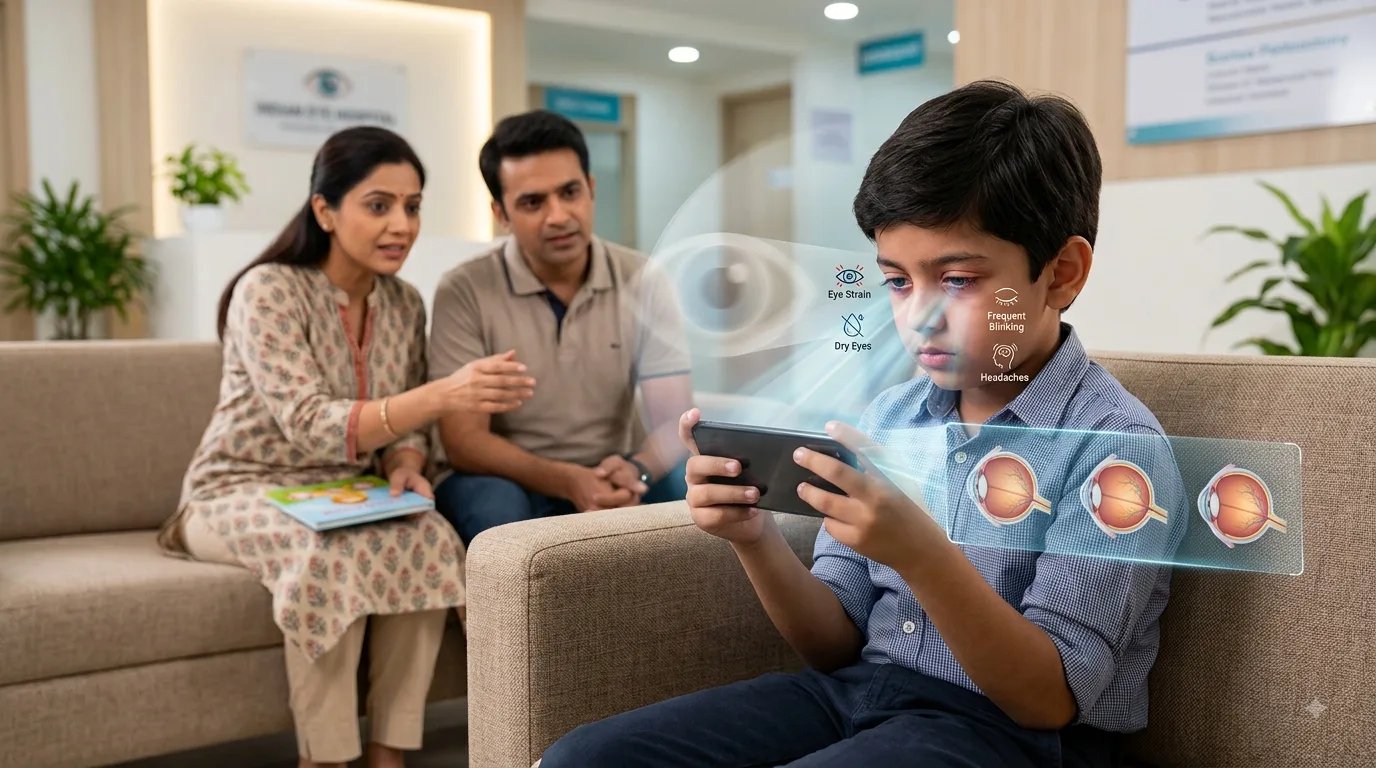
Smartphones are a daily aspect of a child’s life. They use these devices for school, fun, games, video calls, and social interaction. It is at issue when the use of phones becomes a priority which in turn replaces outdoor play, sleep, physical activity, or other healthy practices.
Parents often worry that excessive screen time children experience will permanently damage their eyesight. Current evidence does not support the idea that ordinary screens cause permanent eye damage. That said we do see that extended near work causes temporary visual discomfort and also that very into device use brings to light existing but uncorrected vision issues. Also that kids report developing what we term mobile vision problems or digital eye strain kids which presents after use of devices for long periods.
Understanding these warning signs can help families introduce healthier digital habits and seek professional Eye care when needed.
What Does Mobile Addiction Mean for a Child’s Vision?
The term “mobile addiction” is often used to describe excessive and hard to break habits related to smart phone use as opposed to a specific ophthalmic issue. From a visual health stand point the issue is usually what the person is doing. Proximal phone holding, continuous use, that which is done in poor lighting, and large blocks of time spent in near focused work are what report eye discomfort.
During prolonged screen time children may blink less frequently and keep their focusing system active for extended periods. The US Centers for Disease Control report that with increased screen use we see an exacerbation of uncorrected vision issues and also recommend that during near vision tasks breaks should be taken frequently.
Why Are Children More Vulnerable to Unhealthy Screen Habits?
Children may be so engaged in their games or videos that they will use a device for long periods before noticing signs of strain. Also younger kids may not yet have developed the ability to tell us their eyes are tired out that they are having trouble with distance vision. That which increases the chance of digital eye issues includes the habit of holding a phone right up to the face, spending large blocks of time on digital devices without resting them in between, using screens in the dark, having an ophthalmic correction issue at home which is not fixed, also spending little time out in the open.
Myopia which is also known as short sightedness usually begins in childhood. The National Eye Institute reports that kids which spend more time outside are less at risk for developing nearsightedness, although it is still a matter of research as to what in particular outdoor activity is protective. Screen time has to be a part of the child’s total routine which also includes play and social interaction instead of being looked at as a separate issue.
Signs of Digital Eye Strain in Children
Parents should watch for changes in behaviour as well as direct complaints. A child experiencing digital eye strain kids symptoms may not always say that something is wrong.
| Sign noticed in a child | What parents may observe |
| Tired or uncomfortable eyes | Rubbing the eyes after online classes or gaming |
| Temporary blurred vision | Difficulty changing focus from the phone to distant objects |
| Dry or irritated eyes | Frequent blinking, burning or discomfort |
| Headache | Complaints after prolonged near work |
| Focusing difficulty | Losing concentration while reading or using a device |
| Holding devices very close | May indicate a visual habit or an uncorrected refractive error |
These symptoms do not point out that smartphones are the only cause. Also in a like manner these complaints may be present with refractive errors, dry eye, focusing issues, or other eye conditions. For this reason persistent symptoms should be evaluated by an Eye doctor instead of at first reducing device use.
Does Too Much Mobile Use Cause Myopia?
Screens and childhood myopia’s relationship is a more in depth issue than to say that smart devices cause short sightedness. Genetics play a role in a child’s risk, also the environment does at large. We see that over use of near point focus which is a large element of what kids do on screens may play a role. Long periods of screen time children spend on smartphones often involve sustained near focusing. At the same time, children who spend more hours indoors with devices may have fewer opportunities for outdoor activity.
For that which it is the case healthy visual development includes breaking away from close work and putting in time outdoors. Also a trained Eye specialist may evaluate if a child has myopia and will give parents a report on what it takes to do proper monitoring or management.
How Much Screen Time Is Appropriate?
There isn’t a one size fits all screen time limit we apply to all children for they are of different ages, have different academic needs, health issues, lifestyle and are into different types of screen activities.
For young children WHO puts out reports on sedentary screen use. They report that it is not recommended at all for one year olds and for two year olds it should be in general no more than one hour, which also includes the recommendation of less is better. Also these recommendations are included in a larger scale put out which also covers physical activity, sedentary behavior and sleep.
For school-going children, families should focus not only on total duration but also on uninterrupted screen time children spend at close viewing distances.
Practical Ways to Reduce Mobile Vision Problems
Simple changes can make digital use more comfortable without preventing children from accessing necessary educational technology.
| Situation | Healthier visual habit |
| Online classes | Encourage regular distance-viewing breaks between lessons |
| Smartphone use | Keep the device at a comfortable viewing distance instead of very close to the face |
| Gaming sessions | Break long sessions into shorter periods and encourage movement between them |
| Evening device use | Avoid letting mobile use repeatedly replace adequate sleep |
| Indoor leisure time | Balance digital entertainment with age-appropriate outdoor activity |
| Reading on a device | Use comfortable text size and adequate room lighting |
After which you will have had around 20 minutes of intense visual focus do a 20 second break looking at an object 20 feet away. The CDC puts forth that this is a good way to give your eyes a rest in the case of extended focusing. Healthy screen habits should become part of every day Eye care, rather than something introduced only after symptoms begin.
Diagnosis and Treatment of Screen-Related Eye Complaints
There isn’t any specific test which identifies “mobile addiction eye damage”. What we do is we take the child in to see the ophthalmologist who in turn looks at the child’s symptoms and also looks for baseline vision issues. By the time of the exam we may look at visual clarity, we check for refractive errors like myopia or astigmatism, eye alignment, focusing ability and also we will do a general health check of the eye.
In the case of a refraction error which is identified by the exam, we will put in a prescription for proper glasses or other appropriate eye treatments as per the diagnosis. Also before we recommend over the counter eye drops for dryness or irritation issues we do a full evaluation which is also to avoid us from giving out unneeded medication. At Vasan Eye care we do an evaluation that also helps to tell the difference between which is a temporary screen induced discomfort and what is a present condition which requires more attention.
Recovery and Follow-Up Care
Symptoms that come out of very long device use tend to improve when children take breaks and vary from unbroken near work. Also note that blurred vision, headaches, frequent squinting, or difficulty seeing the board at school should not be so quickly attributed to mobile phone use.
Children which do wear glasses may also require regular checks as their eyes grow and prescriptions change. Also very important is that you take your child to the ophthalmologist if symptoms persist despite adoption of healthy device practices or begin to interfere with school, reading, sports, or everyday activities.
When Should Parents Consult an Eye Specialist?
Parents may bring their child in for an eye exam if they report blurred vision, headaches, eye discomfort, or have trouble with focus. Also a cause for evaluation is when a child reports that they sit very close to screens, squint to see, close one eye at a time, frequently rub at their eyes, or have issues with distance vision.
A trip to the Eye hospital is a good idea when you’re still experiencing symptoms as they don’t improve with rest. Early in-put to an ophthalmologist will allow for determination of mobile vision problems that are related mainly to device habits or whether another condition is present.
Conclusion
Smartphones will continue to be a part of kids’ lives which is why we shouldn’t foster fear of technology. Instead we should focus on the health of digital use. Managing screen time children spend on devices, we encourage breaks from the screen, we provide proper lighting, we support play in the great outdoors and we pay attention to early signs of trouble which may affect their vision.
If your child develops continuing mobile vision problems, symptoms associated with digital eye strain kids, or noticeable changes in vision, consider consulting a qualified ophthalmologist at Vasan Eye care or visiting a trusted eye hospital for a personalised evaluation.
Frequently Asked Questions
Normal use of digital devices has not been proven to cause permanent eye damage. But long term exposure may cause temporary issues like dryness, headaches, and focusing problems. Persistent symptoms should be evaluated instead of immediately attributing them to the phone without a work up.
Common digital eye strain kids symptoms can include tired eyes, dryness, temporary blurred vision, headaches, irritation, and difficulty going back and forth between near and far objects. Symptoms which are frequent or do which impact school performance should be brought to the attention of an ophthalmologist.
Myopia is a result of many factors which may be genetic or environmental. Prolonged near work and less outdoor activity are among the factors being studied in childhood myopia. It is up to parents to instill a balanced routine instead of thinking that a single device is the cause of short sightedness.
Special blue light glasses should not take the place of healthy screen practices or a proper eye exam. If a child reports discomfort from screen use, parents should first look at the child’s habits and bring in an ophthalmologist if the issues persist.
One is advised when a child has persistent blurred vision, frequent headaches, is a lot of time a squinter, very much into eye rubbing, has difficulty with reading, or has trouble seeing in the distance. An Eye specialist is able to identify issues which the child may not recognize or describe accurately.
References
- World Health Organization – Guidelines on physical activity, sedentary behaviour and sleep for children under 5 years:
https://www.who.int/publications/i/item/9789241550536 - Centers for Disease Control and Prevention – Keep an Eye on Your Child’s Vision:
https://www.cdc.gov/vision-health/prevention/youth-vision-problems.html - National Eye Institute, NIH – Nearsightedness (Myopia):
https://www.nei.nih.gov/eye-health-information/eye-conditions-and-diseases/nearsightedness-myopia - NHS – Eye Tests for Children:
https://www.nhs.uk/tests-and-treatments/eye-tests-in-children/ - National Institutes of Health – Digital Eye Strain: A Comprehensive Review:
https://pmc.ncbi.nlm.nih.gov/articles/PMC9434525/