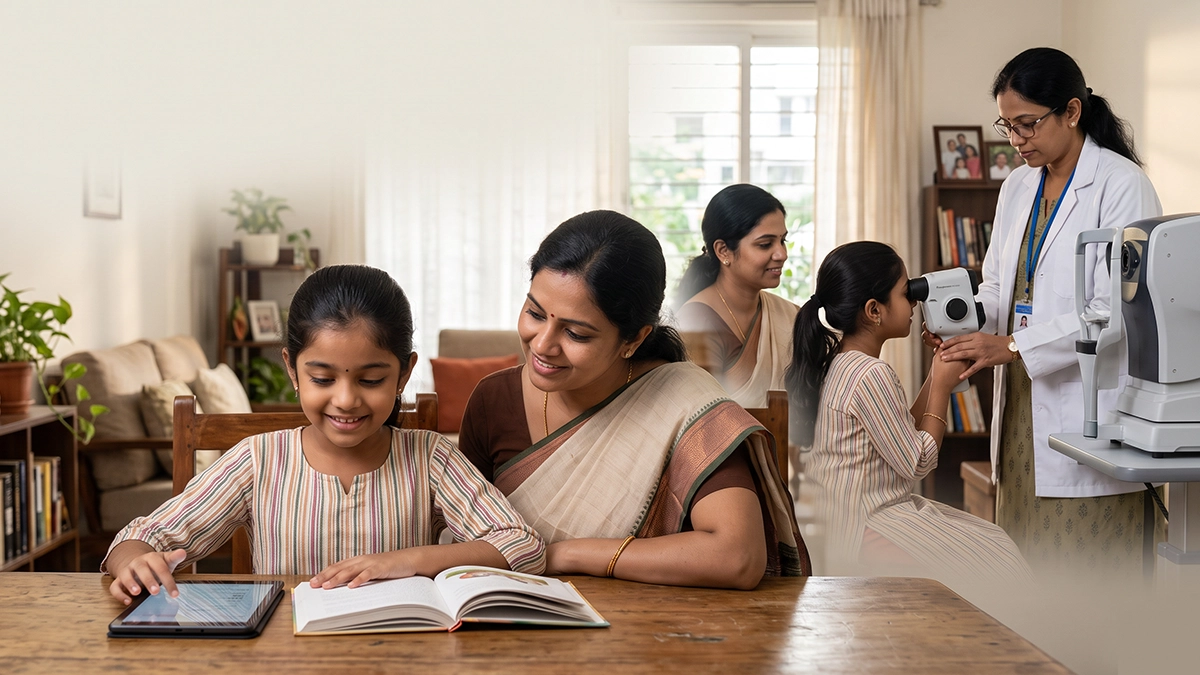
A child who sits very close to the TV, squints at the blackboard in class, or has issues with distant signs may be showing myopia symptoms. For many parents the first question is what is myopia? Myopia, also known as nearsightedness, causes distant objects to appear blurred while nearby objects may still be clearly seen. It is important for parents to identify what is myopia at an early stage because childhood myopia may progress as the eyes grow
The National Eye Institute reports that myopia usually starts between 6 to 14 years of age and may progress into the early 20’s. Also they note that increased time spent in outdoor activities is related to a lower risk of developing nearsightedness. To put it into perspective what is myopia is a key element in preventive eye care.
What Is Myopia in Children?
To know what is myopia it is best to look at how light focuses in the eye. In myopia the eye ball is generally longer than average which causes light to focus in front of the retina. This results in blurred distance vision.
Childhood myopia tends to develop slowly. Common myopia symptoms in kids include squinting, trouble with the board at school, sitting very close to screens, or frequent changes in prescription for glasses. As these signs may present very subtly a visit to the eye doctor is recommended. For parents that are unsure what is myopia refraction test will provide a better answer.
| What parents may notice | What it may suggest |
| Squinting at distant objects | Possible myopia symptoms |
| Sitting close to TV or board | Reduced distance vision |
| Frequent prescription changes | Progressing childhood myopia |
| Trouble seeing distant signs | Need for an eye test |
Why Is Myopia Increasing in Children?
After I looked into what is myopia parents often ask what causes it to run so high today. Childhood myopia is a product of genetic and environmental factors. If a child has myopic parents they are at greater risk, also we see that many a time we are putting our kids to more near work
In North India we did a study which reported that in urban schools, children read and writing and greater computer or video game use is associated with myopia progression. Also we saw that more than two hours of daily outdoor activity has a protective association. This does not prove that screens cause myopia on their own but does support the case for a balanced approach which families may research into what is myopia.
Recognizing the myopia symptoms at early stages is more important than pointing out one device. Many factors play a role which is why an eye specialist should assess the child.
How Can Parents Help?
Once parents know what is myopia regular eye exams can identify it in children, regular eye examinations can detect childhood myopia, If myopia symptoms are present the doctor may use age appropriate tests which may include a cycloplegic refraction if needed.
Parents can promote outdoor play, good lighting, a comfortable reading distance, and breaks from close work. These are a part of eye care routine which however does not do away with the use of glasses. Also, it is important to inform kids what is myopia so they see the value in wearing their correct glasses.
| Parent action | Why it matters |
| Regular eye examinations | Tracks childhood myopia |
| Outdoor activity | May lower myopia risk |
| Breaks from near work | Supports visual comfort |
| Prescribed spectacles | Corrects blurred vision |
Can Myopia in Children Be Controlled?
Knowing what is myopia also brings in the fact that treatment may go beyond just prescription of glasses. In some children with progressive childhood myopia we may look at options for myopia control. Based on age and eye health our eye specialist doctor may put forth special types of spectacle lenses, contact lenses, or low dose atropine.
Parents should not start medicated drops or specialty lenses without guidance. At Vasan Eye Care we offer paediatric ophthalmology services which include assessment of myopia symptoms, explanation of what is myopia, and recommendation of eye treatments. Learning what is myopia can make treatment discussions easier.
When Should Parents Book an Eye Check-Up?
If your child squints, cannot see distant writing clearly, or needs frequent spectacle changes, those myopia symptoms deserve attention. Knowing what is myopia early allows myopia to be monitored before it affects school. If you are uncertain what is myopia in your child’s case, an eye examination is the right next step.
Conclusion
Parents which recognize what is myopia do so by identifying changes and they seek help. In childhood myopia is often managed with the use of proper glasses, good visual health practices, and regular check ups. If myopia symptoms are affecting school or daily life we at Vasan Eye Care can do an exam and give you a personal care plan. To have a myopia free growth into adulthood is what we aim for which is why we think early assessment is key. For parents which are asking what is myopia early assessment is very important.
Frequently Asked Questions
1. What is myopia in simple words?
What is myopia? It is a condition which causes you to see distant objects blurry because the light focuses in front of the retina.
2. What are common myopia symptoms in children?
Common myopia symptoms include blurred far vision, squinting, and trouble seeing the classroom board.
3. Can childhood myopia worsen as a child grows?
Yes. Childhood myopia can progress while the eye is still growing.
4. Does outdoor time help reduce myopia risk?
Yes. More time spent outdoors is associated with a lower risk of myopia which is not to say we are guaranteed prevention
5. Does every child need myopia-control treatment?
No. Treatment is based on age, prescription, progression rate, and an eye specialist assessment.