
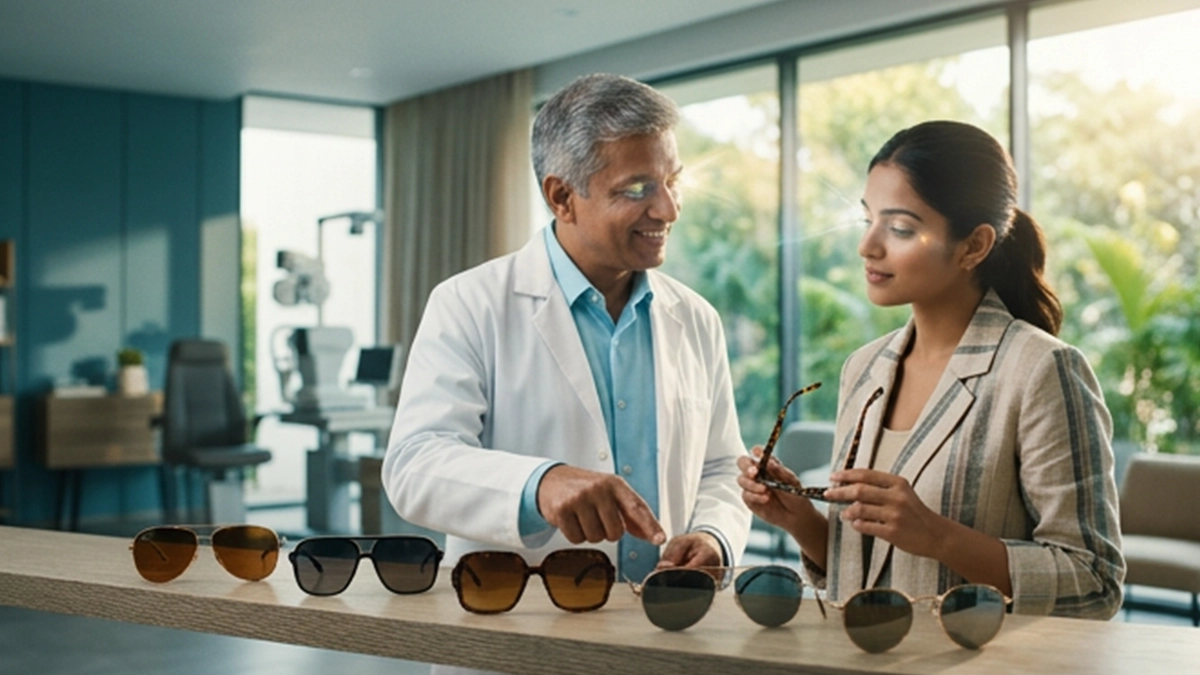
How to choose sunglasses starts with which provide proven protection from the sun. Go for UV400 or 99–100% UVA and UVB protection then try for a good fit, coverage, glare control and a prescription if you need it. The best sunglasses for eyes aren’t always the darkest or most expensive. What you want in a pair of protective sunglasses is that they reduce your UV exposure which at the same time doesn’t compromise on clear comfortable vision.
Why UV Protection Matters for Your Eyes
Learning out how to choose your sunglasses is a health decision for your eyes as well as a style choice. Ultraviolet radiation affects the cornea, lens and the tissues around the eye. The World Health Organization reports that world wide there are 15 million cases of blindness due to cataracts which we think at least 10% of that is related to UV exposure.
The National Eye Institute recommends that you choose UV protection sunglasses which block 99-100% of UVA and UVB rays or have a UV400 rating. This is true for routine travel, outdoor work and summer eye care which in turn includes days at the beach or very sunny days.
10 Tips on How to Choose Sunglasses
1. Check the UV rating first. When it comes to the choice of sunglasses, go for those that provide UV400 or 99–100% UVA and UVB protection. A pretty frame is one thing but if it doesn’t have that which filters out the UV rays, it isn’t really protecting you.
2. Do not judge protection by darkness. Dark lenses may not necessarily be the best indicator of UV protection; just a tint to that. What is important for reliable UV protection is that the sunglasses have a clear UV rating.
3. Choose good coverage. Large frames and side shields which cover the sides reduce light entry. They are practical for eye protection while driving, walking and in the great outdoors.
4. Prioritise a stable fit. When it comes to your choice of sunglasses choose styles which stay put. Large spaces between the frame and face let in more light.
5. Understand polarisation. Polarized lenses reduce glare from roads, water and other surfaces. But polarized does not necessarily mean UV protection. Always check the UV rating separately.
6. Match sunglasses to the activity. Water, sand and snow are to reflect the sun’s light. For that reason broad spectrum UV protection in sunglasses is recommended for extended outdoor activity.
7. Consider impact-resistant materials. Polycarbonate lenses are a favorite for active people due to their impact resistance. For high risk sports or work which is a hazard to the eyes specialized protective eyewear may be required. Vasan’s eye safety tips also discuss what may be proper additional protection.
8. Do not depend on contact lenses alone. Some types of contact lenses which outperform in UV protection, do not which to report for the eyelids or full eye coverage. As for the choice between glasses or contact lenses people should still resort to wearing sunglasses which are appropriate for the outdoor setting.
9. Consider prescription sunglasses. Refractive errors such as myopia, hyperopia and astigmatism may require corrective lenses outdoors. A comprehensive eye check-up can confirm whether the current prescription remains suitable.
10. Check children’s sunglasses carefully. The best for kids’ eyes are sunglasses that fit well and which have been verified for UVA and UVB protection. A broad brimmed hat also gives extra shade.
| Feature | What to Look For | Why It Matters |
| UV protection | UV400 or 99–100% UVA/UVB block | Reduces ultraviolet exposure |
| Coverage | Large or wraparound frame | Limits light entering from the sides |
| Fit | Secure and comfortable | Keeps lenses correctly positioned |
| Lens quality | Clear, undistorted vision | Supports safe, comfortable use |
How to Choose Sunglasses Based on Lens Features
Understanding which sunglasses to pick out also includes telling which are the facts from the marketing. Polarization is for reducing glare, and UV protection is for the sun’s ultraviolet radiation. Lens color mainly affects how bright and how much contrast you see; a dark color does not mean better UV protection.
The best sunglasses for eyes combine verified UV filtration, suitable coverage and clear optics. Other habits also influence long-term eye health. Vasan Eye Care provides further guidance on daily habits that are secretly affecting eyesight and common eye care frequently asked questions.
| Lens Feature | Main Purpose | Does It Confirm UV Protection? |
| Polarised lens | Reduces reflected glare | No |
| Dark tint | Reduces visible brightness | No |
| UV400 rating | Filters UV wavelengths up to 400 nm | Yes, when accurately labelled |
| Wraparound frame | Improves side coverage | No, but improves physical protection |
When Should an Eye Examination Come First?
Knowing that you can pick out the right pair of sunglasses doesn’t take the place of an eye exam. Persistent glare, blurred vision, light sensitivity or trouble with night time driving may be symptoms of something other than the sun. Trading out your sunglasses frequently will not fix an undiagnosed refractive or eye issue.
People that have corneal conditions may require specialized vision correction. For example Vasan’s information on keratoconus contact lenses reports that some irregular corneas do in fact require custom fit lenses. An ophthalmologist will do an assessment of visual acuity, refraction and eye health before they write the prescription for sunglasses. This is especially true when an existing prescription is no longer giving clear vision.
Are Expensive or Dark Sunglasses Better?
Price is not the issue in terms of how well sunglasses protect the eyes. As you choose your sunglasses pay more attention to the UV rating which is far more important than the brand name or price.
Also very dark lenses are not in fact the best for your eyes. What we see in very dark lenses is that they mainly reduce visible light. For eye protection what you should look for in your sunglasses is reliable UV filtration which is to be combined with a good fit and optical clarity.
Eye Care at Vasan Eye Care
Vasan Eye Care offers full assessment for routine and symptomatic vision issues. An ophthalmologist will determine if glare and reduced visual acuity are a result of refractive error, corneal issue or some other eye health problem.
Understanding that we put in place what works for your sunglasses is a part of preventive eye care. We put together proper UV protection in sunglasses, sensible sun habits and regular exams which in turn support long term eye health. Persistent or unexplained visual symptoms should not be managed by just changing out your glasses. An eye exam at a Vasan Eye Care center can help to identify the root cause and to determine appropriate next steps.
Frequently Asked Questions
1. How can someone tell whether sunglasses provide proper UV protection?
Check for UV400 or 99–100% UVA and UVB protection in the product info. As you learn to choose your sunglasses that is what you should look for over lens color, fashion, price or brand name.
2. Are polarised lenses the best sunglasses for eyes?
Polarized filters reduce that uncomfortable glare that comes from reflection; which is a problem while driving or by water. Also, it is the duty of the best sunglass choice for eyes to present tested UV protection, enough coverage, and a secure as well as a very comfortable fit.
3. Are dark sunglasses safer for the eyes?
Not at all. Dark lenses may improve the look of bright light but they do not always protect against UV radiation. For true protection which is a must select UV protection sunglasses that have a verified UV400 or 99 100% UVA and UVB rating rather then what appears to be dark.
4. Can people who wear contact lenses skip sunglasses?
Usually not. Also UV protective contact lenses do not cover the full range of exposed eye or nearby lid tissues. For eye protection sunglasses do which also include reduced glare, wind exposure and they ameliorate visual discomfort while out.
References
- National Eye Institute — Protecting Your Eyes from the Sun’s UV Light
National Eye Institute UV eye-protection guidance - World Health Organization — Ultraviolet Radiation
World Health Organization ultraviolet radiation guidance