
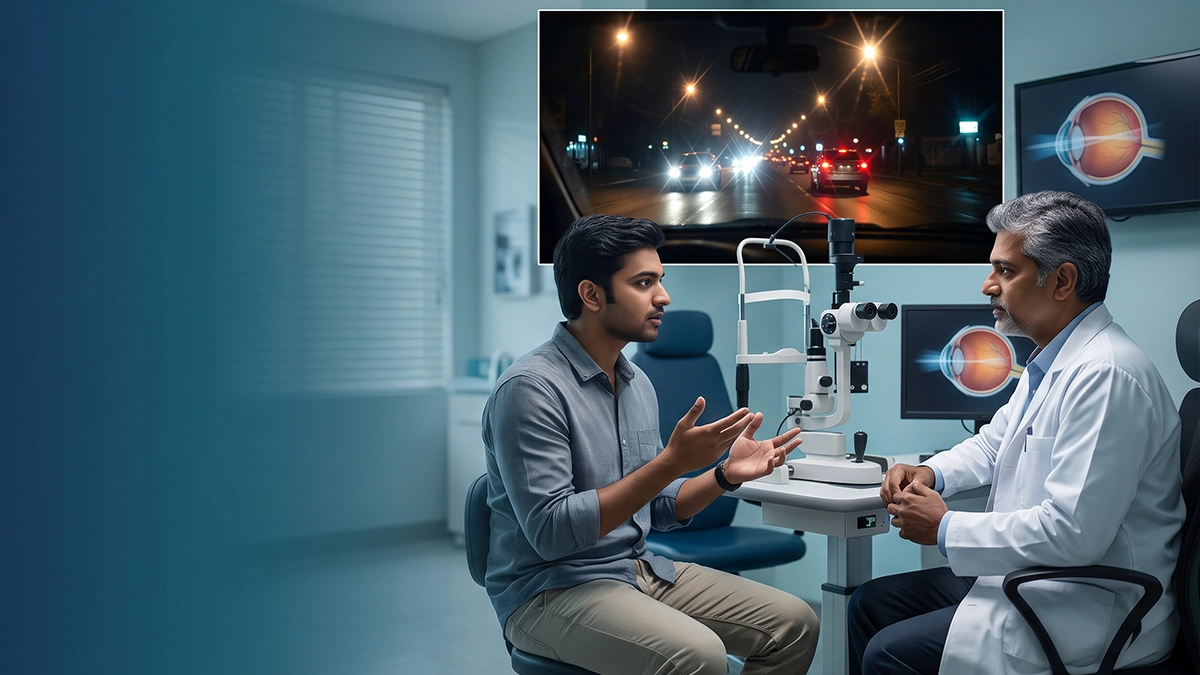
Bright lights at night can be very intense which is a result of the background dark which enhances the light’s presence. Also in low light our pupils get larger which in turn lets in more light. But at the same time persistent glare, halos, light sensitivity, or night vision issues may be a sign of refractive errors, dry eye, cataracts or other eye issues. If you have new or changing symptoms you should see an ophthalmologist.
Why Do Bright Lights at Night Look More Intense?
In variable light the eyes adjust in different ways. At night time the pupils get larger which in turn lets in more light to the retina. Also the visual system itself becomes more sensitive to what light is available.
As a result bright lights at night stand out much more so against a dark background as they do during the day. This is a common visual response in many people.
However light which is scattered by the cornea, lens, or tear film plays into this. As for refractive errors, dry eye, cataracts, and some corneal conditions, what you may see in terms of bright lights at night is they may be very distracting or uncomfortable.
What Causes Bright Lights at Night?
Some causes of bright lights at night are related visual symptoms.
- Uncorrected refractive error : Myopia, hyperopia, and astigmatism cause the light to not focus sharply on the retina at all. As a result street lights, head lights, and tail lights may present as halos or very blurry.
- Dry eye: An unstable tear film is a cause of variable vision, discomfort and light sensitivity. The National Eye Institute reports that light sensitivity and blurred vision are very present in dry eye patients.
- Cataracts: A foggy natural lens which in turn may cause bright headlamps, lights, or sunlight to appear very intense at night. Also may cause halos and poor visibility at night.
- Corneal conditions: Issues with the cornea which cause blurred vision, discomfort, redness and light sensitivity. These symptoms are present around strong lights.
- Retinal conditions: Some retinal diseases which present with impaired vision in low light. For instance Retinitis pigmentosa which is a common cause of trouble seeing in dark settings and may cause progressive night vision problems.
Bright Lights at Night: Symptoms to Notice
Bright lights at night may present in many different ways based on what the cause is. Some report to see wide glare, others note halos, streaks, starbursts, or blurred edges around headlamps
| What you notice | Possible explanation | When to seek assessment |
| Headlights seem unusually bright | Dark adaptation, refractive error or cataract | If persistent or worsening |
| Halos around lights | Cataract, corneal changes or refractive error | If new or affecting driving |
| Burning with light sensitivity | Dry eye or ocular-surface irritation | If recurrent or uncomfortable |
| Poor vision in dim surroundings | Refractive, retinal or other conditions | If progressive |
Glare at Night and Night Vision Problems
Glare at night is more of a nuisance. Bright headlights may cause some objects to disappear in terms of contrast which in turn may put the driver at a great disadvantage..
Night vision problems may present as a hard time to recognize things in low light, slow transition between bright and dark settings, or decreased confidence while driving at night. Outdated spectacle prescription is a cause but also may be a result of an eye condition.
Age is a factor in these symptoms. Also from the National Eye Institute were they learn that by age 80 most people either develop cataracts or have had to have cataract surgery. Cataracts which may cause poor night vision and make lights appear too bright.
For people who have bright lights at night which don’t go away they should not be put down as a normal part of aging..
How Are Bright Lights at Night Evaluated?
An ophthalmologist will ask at what point symptoms present, which eyes are affected, and if vision changes in the day. Visual acuity and refraction tests will identify a bad prescription.
A slit lamp examination of the cornea, lens and other front eye structures is performed. As per results they may also do a dilated retinal exam or retinal imaging.
Vasan Eye Care which also includes for their diagnostic services visual acuity test, slit lamp examination, and retina test.
| Examination | What it checks | Why it may help |
| Visual acuity and refraction | Clarity and focusing error | Identifies refractive causes |
| Slit-lamp examination | Cornea, lens and front eye structures | Detects cataract or surface changes |
| Dilated retinal examination | Retina and optic nerve | Assesses retinal abnormalities |
| Retinal imaging | Retinal structure | Supports evaluation of suspected retinal disease |
How Can Glare at Night Be Reduced?
Management is based on the cause for bright lights at night. For refractive error which is a factor in glare wearing the correct spectacle prescription may improve symptoms.
When dry eye results in light sensitivity proper treatment of the ocular surface will ameliorate fluctuating vision and pain. Should cataracts produce large scale visual symptoms, an ophthalmologist will determine if that intervention is required.
Avoid direct exposure to oncoming headlights, keep spectacles and windscreens clean, and give your eyes time to adjust between different lighting conditions which in turn may improve comfort.
However these measures don’t take the place of an eye exam which should be done when glare at night is persistent or worsening.
When Should You See an Eye Specialist?
Persistent bright lights at night, increased glare at night, or night vision problems which in turn may impact performance while driving or in day to day activities.
Sudden onset of vision loss, acute eye pain, large degree of redness, new flashes or floaters, or a curtain like shadow over vision is a reason to get immediate ophthalmic care. Sudden changes which are not a result of normal night adaptation.
An eye specialist is able to determine which part of the cornea, lens, retina, optic nerve, refractive error or any other element of the visual system is affected.
Eye Care at Vasan Eye Care
Vasan Eye Care which evaluates what is causing issues like glare, night vision problems, and light sensitivity. As per the results of the exam they may recommend refraction, slit lamp exam, retinal evaluation, or other tests.
Patients who are sensitive to bright light at night should schedule an eye exam at a Vasan Eye Care center for a more in depth evaluation.
Frequently Asked Questions
1. Why do bright lights at night bother me more than during the day?
Dark settings which bring out the difference between light and dark in a background. Also pupil dilation which lets in more light. As for the excessive symptoms they may be a result of refractive error, dry eye, cataract or some other eye issue.
2. Can cataracts make bright lights at night look brighter?
Yes. Cataracts cause light to be broken up as it passes through the hazy lens. Also which may in turn cause headlights or lamps to appear very bright and at the same time produce halos, glare and reduced night vision. An ophthalmologist is able to tell if cataract changes are present.
3. Is light sensitivity at night always a sign of an eye disease?
No. Some degree of discomfort is present as the visual system adapts to the dark. Persistent or severe light sensitivity which also includes pain, redness, or reduced vision requires an ophthalmic evaluation to determine the cause.
4. Should someone drive with glare at night?
Driving is to be avoided or minimized when the glare at night or you have reduced night vision problems which in turn makes it hard to see road hazards. Also an eye exam can identify what treatable causes you may have and will determine what vision correction or other care is needed.
References
- National Eye Institute — Cataracts
https://www.nei.nih.gov/eye-health-information/eye-conditions-and-diseases/cataracts?utm_source=chatgpt.com - National Eye Institute — Dry Eye
https://www.nei.nih.gov/eye-health-information/eye-conditions-and-diseases/dry-eye?utm_source=chatgpt.com