
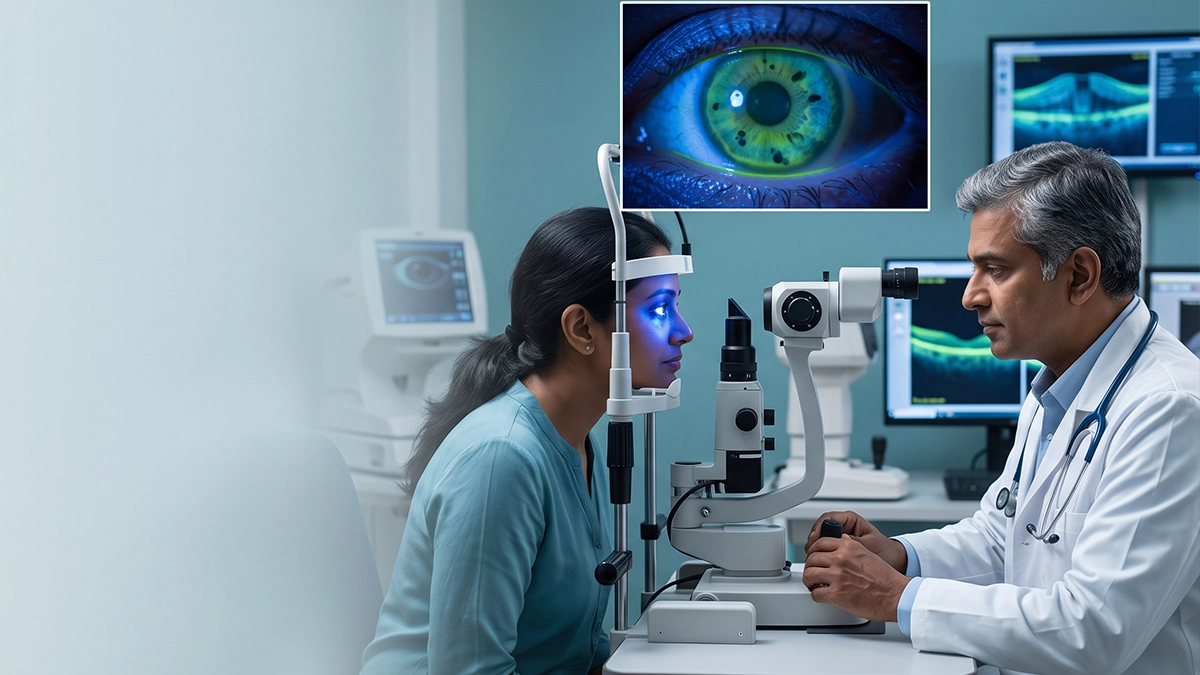
The tear film breakup time test measures the stability of the tear layer on the eye post complete blink. Short results in this test may indicate tear film instability which is a feature of dry eye disease. The TBUT test is used by ophthalmologists to assess tear quality, it does not however diagnose dry eye by itself. Symptoms and other dry eye tests complete the assessment.
What Is the Tear Film Breakup Time Test?
The tear film breakup time test which is also referred to as tear breakup time or TBUT is the interval that they look at between a blink and when the tear film starts to break down on the cornea.
A healthy tear layer which is also known as the lacrimal film serves to lubricate the cornea, support clear vision and to reduce friction during blinking. By understanding the function of tear film vasan eye care see that quick break up may cause symptoms like burning, grittiness or fluctuating vision.
The tear film breakup time test is very much used when an ophthalmologist has dry eye disease in mind. It gives info on tear stability as opposed to which is how many tears the eyes produce.
| TBUT assessment | What it evaluates | Clinical relevance |
| Fluorescein TBUT | Time until the stained tear film first breaks | Common clinical tear film test |
| Non-invasive TBUT | Tear stability without fluorescein dye | Avoids altering the natural tear film |
| Short breakup time | Faster tear-film instability | May support dry-eye assessment |
| Repeated measurements | Consistency of tear stability | Helps reduce measurement variability |
How Is a TBUT Test Performed?
During a traditional TBUT test, an eye care professional puts in a little fluorescein dye into the tear film. The patient blinks to spread the dye which then the patient holds his eyes open. With a slit lamp that has blue light the ophthalmologist watches the corneal surface. The tear breakup time is from the last full blink to the first dark area which appears in the fluorescent tear layer.
Non-invasive methods can perform a similar tear film test evaluation which does not require dye to be put in the eye. TFOS DEWS II reports that in situations where appropriate equipment is available non-invasive breakup time assessment is preferred for that very reason that fluorescein may in fact change tear film stability.
The tear film breakup time test should be determined prior to any procedures which may affect the ocular surface. Room humidity, air flow, blink rate and the amount of fluorescein used play a role in the results.
What Do Tear Film Breakup Time Results Mean?
A reduced tear breakup time means the tear film breaks down more quickly after it is blink. TFOS DEWS II reports that a fluorescein TBUT of below 10 seconds has been used as a positive result in many cases, although with the use of small, controlled volumes of fluorescein different thresholds may apply. Interpretation of results therefore is a matter of technique rather than a single value.
In a 2019 study of 174 patients with dry eye and 97 controls they found that fluorescein measurement at 5.3 to 6.0 seconds’ interval was a useful diagnostic tool. The authors reported 87% sensitivity and 81% specificity at the 6.05 second mark for one test volume.
For this reason, one tear film breakup time test result should not stand alone in terms of diagnosis. A borderline or abnormal TBUT test result requires to be put in the picture with symptoms and other clinical signs.
How Does TBUT Help Diagnose Evaporative Dry Eye?
Evaporation is a key element in tear film breakdown. The oily element which is mainly produced by the meibomian glands acts to slow this down. Poor function of the oil layer may thus cause tears to break up at an earlier stage.
For an evaporative dry eye diagnosis, an ophthalmologist may evaluate the eyelid margins and meibomian glands along with TBUT. A short tear breakup time may support the evaporative dry eye diagnosis but it does not identify the cause itself. Airflow also plays a role in the increase of evaporation. Those that see their symptoms worsen indoors may benefit from info on air conditioning and eye irritation. Also excess watering may happen with an unstable surface as reported in Vasan Eye Care’s guide to watery eyes.
What Other Dry Eye Tests May Be Needed?
The tear film breakup time test is a part of a larger assessment. Also available are tests which look at tear production, ocular surface damage, osmolarity, eyelid health and meibomian gland function.
| Dry eye test | What it assesses | Why it complements TBUT |
| Schirmer test | Tear production | Helps assess aqueous tear deficiency |
| Ocular-surface staining | Corneal and conjunctival damage | Shows surface effects of dryness |
| Tear osmolarity | Concentration of dissolved particles | Assesses disturbed tear homeostasis |
| Meibomian gland assessment | Oil-gland structure and function | Supports evaporative dry eye diagnosis |
Combination of dry eye tests is key because symptoms and what is seen in the exam do not always correlate. An ocular surface assessment also differentiates between dryness which may be from allergy, blepharitis or other conditions. At Vasan Eye Care you can find out more on ocular surface disease.
A TBUT tear film test does not assess every cause of blurred vision. For example, it does not diagnose internal lens disorders such as a zonular cataract.
Does an Abnormal TBUT Change Dry Eye Treatment?
Dry eye treatment is based on the root cause of the issue as opposed to the TBUT test result. A short tear breakup time may cause an ophthalmologist to look into meibomian gland issues, insufficient blinking, environmental factors or other causes of excessive evaporation.
Management includes use of proper lubricants, eyelid care, environment changes or other therapies as they evaluate. Patients should avoid frequently changing types of eye drops without professional guidance. Persistent symptoms require cause based dry eye treatment which extends beyond use of artificial tears.
Eye Care at Vasan Eye Care
Vasan Eye Care looks at persistent dryness, burning, watering and fluctuating vision through clinical exams and appropriate dry eye tests. Vasan eye care may perform a tear film breakup time test, ocular surface staining, tear production testing and evaluation of the eyelid glands based on our findings.
Persistent discomfort, very red eyes, light sensitivity, eye pain or a change in vision should be evaluated by an ophthalmologist instead of assuming the issue is dry eye.
Frequently Asked Questions
1. What is a normal tear breakup time?
Interpretation is a function of the testing method. For fluorescein based methods which have for long used values at or below 10 seconds to report abnormal results and controlled methods which may have lower thresholds. An ophthalmologist should put into account the tear breakup time in the context of symptoms and in correlation with other findings.
2. Is the TBUT test painful?
The TBUT test is usually quick and minimal in terms of comfort. Fluorescein dye has the ability to produce a short mild effect during application. In the case of non-invasive TBUT dye is not required and tear stability is assessed by reflected light or imaging.
3. Can TBUT alone diagnose dry eye disease?
No. The tear film breakup time test is a measure of tear stability, but dry eye disease has many causes. Diagnosis usually puts together patient symptoms with dry eye tests which may include ocular-surface staining, osmolarity, tear volume assessment or meibomian gland evaluation.
4. Does a short TBUT always mean evaporative dry eye?
Not at all. It is seen that a short TBUT which supports tear film instability is a factor in the development of evaporative dry eye diagnosis. But also it is seen that in mixed dry eye and other ocular surface issues the TBUT may be shortened which is why clinical correlation still is very important.
References
- TFOS DEWS II Report – Diagnostic Methodology
https://tfosdewsreport.org/report-diagnostic_methodology/131_36/en/ - Efficacy of the Fluorescein Tear Breakup Time Test in Dry Eye – PubMed
https://pubmed.ncbi.nlm.nih.gov/31513046/