
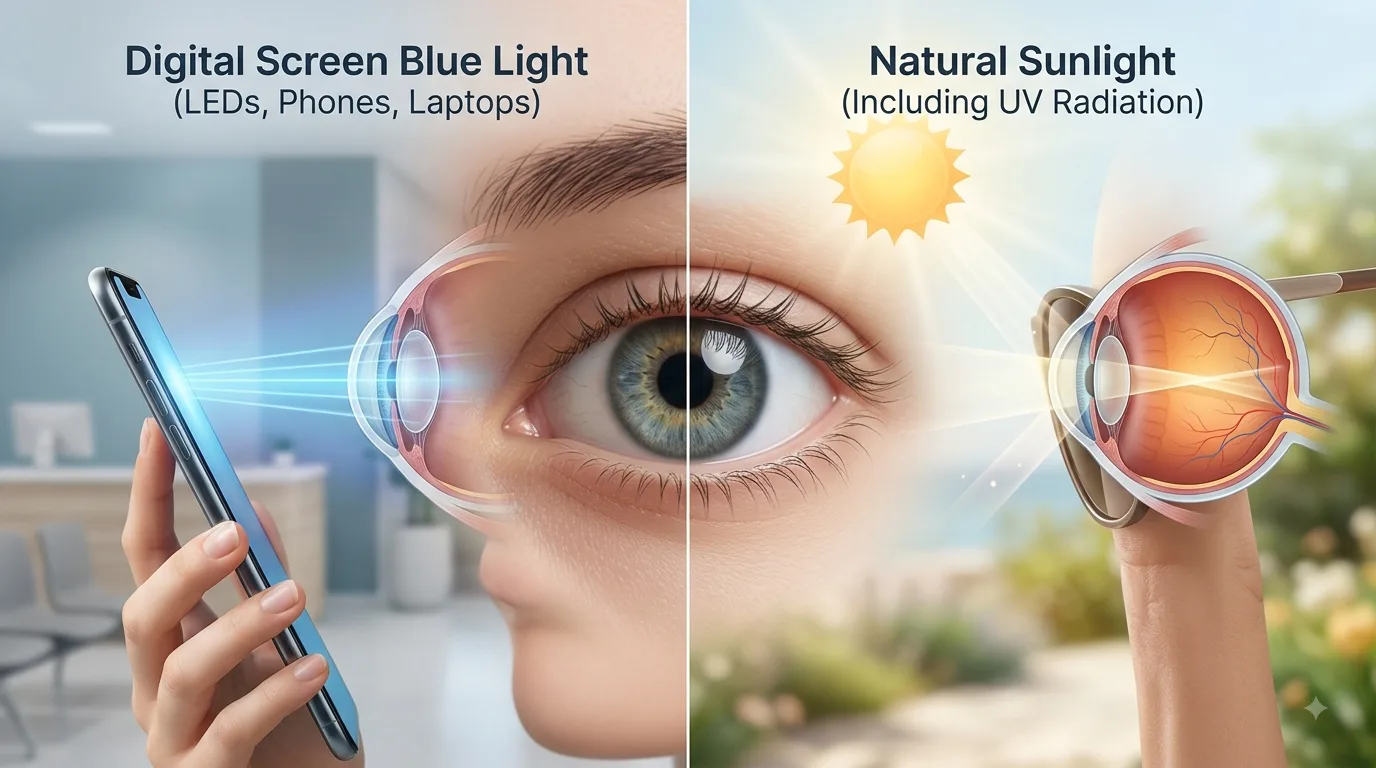
Smartphones, computers, LED lights, and also long work hours have brought into focus the issue of blue light. Many people that are doing research on blue light eyes report to be interested if in fact time spent in front of a screen does the same damage to your health as being in the bright sun.
Both parties report on blue wavelengths of light but in fact they do not report the same thing. Sunlight which is what we get naturally is far more intense and also includes ultraviolet radiation. At present there is no evidence that blue light from screens which we use every day cause retinal damage in humans. However, prolonged screen exposure can contribute to digital eye strain, dryness, headaches, and temporary blurred vision.
Understanding this difference can help you protect your vision without becoming unnecessarily worried about everyday device use.
What Is Blue Light?
Blue light is a part of what we see in the light spectrum. The sun is by far the main natural source but we also get it from LED lights, smartphones, tablets, televisions and computer screens which are common artificial sources. What we worry about regarding blue light eyes is mostly digital device use. Also the amount of blue light which we get from regular screens is not the same in intensity and quantity as what we get from natural sunlight.
In a report by the U.S. National Library of Medicine it is noted that present research does not support the claim that LCD or LED based digital devices produce at- home usage levels of retinal damage.
This does not mean screen time is without issues for the eye health of which dryness and strain are common as a result of how we use them for long periods and at close range rather than from proven cases of retinal injury due to blue light.
Sunlight vs Blue Light: Which Is More Harmful?
For issues of long term physical eye damage, we pay more attention to the sun than we do to digital screens which are a part of our everyday life. Sunlight includes ultraviolet radiation along with what we see as visible blue light. The National Eye Institute reports that UV radiation penetrates eye tissue and is related to problems like cataracts and changes to the surface of the eye. Thus it is important to protect your eyes from UV exposure is therefore an important part of preventing sunlight eye damage.
| Factor | Digital Screens | Sunlight |
| Main concern | Digital eye strain and visual discomfort | UV-related eye damage and intense light exposure |
| UV exposure | Minimal from normal screens | Present in natural sunlight |
| Typical symptoms | Dryness, tired eyes, headache, temporary blur | Irritation, glare and, with excessive exposure, potential tissue damage |
| Main protection | Breaks, comfortable brightness and proper viewing distance | UV-blocking sunglasses, shade and avoiding direct sun viewing |
| Retinal damage from normal use | Not established from ordinary screen blue light | Directly staring at the sun can seriously injure the retina |
Why Does Screen Exposure Make the Eyes Feel Tired?
Extended screen exposure requires continuous near focusing. Also people may blink less as they concentrate on digital devices. This in turn may cause the tear film to evaporate at a faster rate which in turn causes dryness, irritation, burning or a grittiness.
Also digital eye strain may cause headaches, tired eyes, difficulty in refocusing and temporary blurred vision. CDC reports on computer vision syndrome also put forth that regular visual breaks, reducing screen glare, adjusting brightness and having regular eye exams are solutions.
Therefore, symptoms blamed on blue light eyes are often connected to sustained near work, reduced blinking, glare or an uncorrected vision problem rather than blue light alone.
What Does Sunlight Do to the Eyes?
Sunlight puts eyes in contact with visible light and also with invisible ultraviolet radiation. Over time repeated exposure before protection plays a role in the development of UV related eye issues. The National Eye Institute reports that UV exposure is linked to conditions like cataracts, pinguecula and pterygium. Also they recommend wearing sunglasses that block out 99 to 100% of UVA and UVB.
Direct exposure to the sun is a different issue which is more present and immediate. Typical sunglasses do not provide adequate protection for looking at the sun because the intensity of the light may cause retinal damage. As for every day prevention of sunlight eye damage, UV protection should be a standard part of outdoor Eye care.
Who May Experience More Eye Discomfort?
People that are on computers or smart phones for many consecutive hours may see an increase in more symptoms from screen exposure. Also in people with dry eyes, uncorrected refractive errors or poor screen placement discomfort may notice a greater degree.
Outdoor workers and those that spend large amounts of time in bright sun without proper eye protection may see greater cumulative UV exposure. Also which appropriate sun protection is given to kids for they develop healthy habits early which in turn support lifetime eye health. It is also true that persistent symptoms aren’t always due to screens. An Eye doctor can check whether dry eye, spectacle power, focusing problems or another eye condition is contributing to the discomfort.
Symptoms That Should Not Be Ignored
Most screen-related symptoms improve after the eyes receive adequate rest. Persistent or sudden changes deserve medical assessment.
| Symptom | What You Should Consider |
| Dry, burning or gritty eyes after device use | Take breaks, blink frequently and review your screen habits |
| Temporary blur after prolonged near work | Rest your eyes and arrange an examination if it keeps returning |
| Persistent redness or discomfort | Seek professional assessment rather than relying on self-medication |
| Sudden central blur or distorted vision after looking directly at the sun | Seek prompt ophthalmic evaluation |
| Ongoing light sensitivity or reduced vision | Consult an Eye specialist |
How Are Screen-Related Eye Problems Diagnosed?
There isn’t a specific test for a condition which we term “blue light eyes”. Instead, an ophthalmologist that looks at symptoms and determines the root cause. In the exam we may check visual acuity, spectacle prescription, eye alignment, focusing ability and the surface of the eye. Also in the case of burning, irritation or fluctuating vision we may do a tear film or dry eye assessment.
If symptoms continue despite reducing device use, visiting a qualified Eye hospital can help determine whether another eye condition requires attention or specific Eye treatments.
Managing Digital Eye Strain
For the most part what we see is a push for healthier device habits which in turn reduces screen time as much as possible.
The National Eye Institute says to take the eyes out of the action for a bit every so often to literally look at something 20 feet away for 20 seconds out of every 20 minutes. Also they say in the habit of getting your eyes checked as part of your health routine. Adjusting screen brightness to suit the surrounding room, reducing reflections, keeping a comfortable viewing distance and remembering to blink can also make prolonged screen exposure easier on the eyes.
Blue light filtering glasses are very popular at the moment but they should not take the place of good screen habits or an eye exam. A Cochrane review of the research which looked at blue light filtering spectacle lenses reports that over the short term they may not in fact reduce computer related eye strain when compared to traditional lenses.
How to Reduce Sunlight Eye Damage
Good outdoor protection is particularly important because sunlight eye damage can result from UV exposure accumulated over time. Choose sunglasses of good design which block 99 to 100% of UVA and UVB rays and which also give comfort with the coverage they provide around the eyes. Also wear a broad brimmed hat for extra shade. On top of that UV protection is still useful on cloudy days.
Never look at the sun straightly at any time, even during a solar eclipse, with the use of regular sunglasses. For proper eye protection during a solar eclipse use special purpose filters.
When Should You Consult an Eye Specialist?
See an eye care professional if you have recurring eye strain which does not improve with breaks, also if you have persistent dry eyes, get repeated headaches, have blurred vision, see redness in your eyes or notice light sensitivity.
Urgently get in for an evaluation if you see signs of blur or distortion in your center vision which may have come from looking at the sun. At Vasan Eye Care there are exams which also include us looking at how digital use may be affecting you, dry eye issues, refraction issues and other issues which may in turn require we tailor make your eye care treatment.
Conclusion
When comparing sunlight with concerns around blue light eyes, sun puts forth the greater known risk of physical eye damage which is from UV rays and also the high level of solar exposure. Digital devices are more known for reports of temporary discomfort which comes from extended use as opposed to proven retinal damage from what is considered normal blue light exposure.
As for good eye care we advocate for a balance of what we do with digital products in our daily lives and also the use of proper UV protection when out in the sun. Should you experience discomfort, blurred vision, persistent dryness or light sensitivity we advise that you seek out an evaluation by a qualified ophthalmologist at Vasan Eye care or a trusted eye hospital which will give you a personal assessment.
Frequently Ask Questions
Current research does not report that blue light from what we typically use in phones and other screens causes retinal damage. However, prolonged screen exposure can cause temporary eye strain and blurry vision which is a result of insufficient breaks.
For the most part that’s a no go for physical eye damage — solar radiation is a much more well proven issue as a concern since it also has UV which is far more in your face (intense level) than everyday screen light. Also we see UV association with a number of ocular health issues so that is a reason to really prevent sunlight eye damage.
There at present is little which reports that blue light filtering glasses out perform standard lenses in the care of computer related eye strain. Healthier screen practices and appropriate vision correction are the key.
Digital eye strain symptoms are typically temporary and may go away with rest and change in how you use the screen. But persistent issues like dryness, blurred vision or headaches should be checked out by an eye doctor as they may be a sign of an underlying refractive or ocular issue.
Take breaks from your devices, control for glare, keep screen brightness a comfort level, and wear UV blocking glasses when outside. Also it’s a good idea to have regular eye check ups which will catch issues before they turn into daily activity interferences.
Reference Links
- National Eye Institute – Keep Your Eyes Healthy
https://www.nei.nih.gov/eye-health-information/healthy-vision/how-eyes-work/keep-your-eyes-healthy - National Eye Institute – How to Watch an Eclipse Safely
https://www.nei.nih.gov/research-and-training/research-news/how-watch-eclipse-safely - CDC Stacks – Computer Vision Syndrome
https://stacks.cdc.gov/view/cdc/203065 - PubMed – Blue Light Exposure: Ocular Hazards and Prevention
https://pubmed.ncbi.nlm.nih.gov/36808601/