
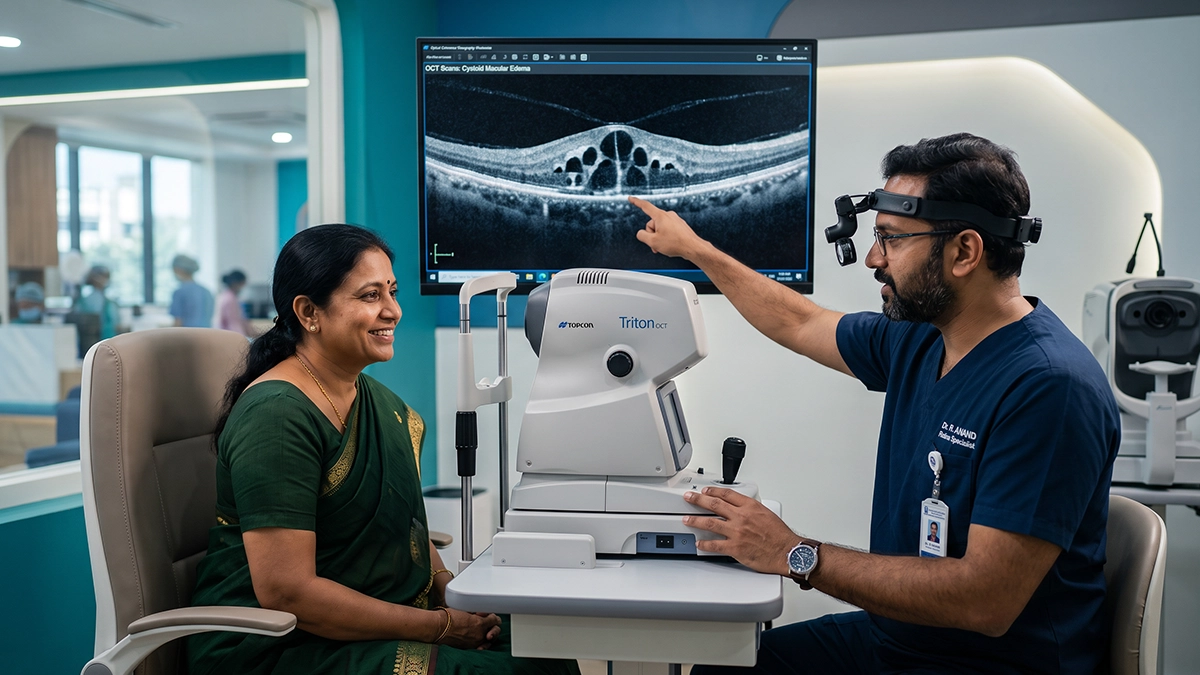
Cystoid macular edema is a retinal issue in which fluid builds up in what are in fact little cyst-like spaces within the macula, the center of the retina which is responsible for fine vision. In ophthalmology this is referred to as CME. When the macula enlarges reading, recognizing faces, and fine detail may be affected.
The retina may see fluid fill its tissue which is usually a result of inflammation or vascular disease that plays out at the blood retina barrier. The National Eye Institute in their macular edema report states that when the macula fills with fluid central vision goes blurry. Thus persistent blurred eyesight is a reason for an eye exam and not to assume it is only a spectacle power issue.
What Causes Macular Swelling?
Common causes of cystoid macular edema include that which follows cataract and other eye surgery, diabetes which has affected the retina, retinal vein occlusion and uveitis. Also some medications and other retinal diseases may play a role. Postoperative CME is also known as pseudophakic CME or Irvine-Gass syndrome.
| Cause or risk factor | How it may affect the macula |
| Cataract or intraocular surgery | Inflammation may increase retinal vascular leakage |
| Diabetes or diabetic retinopathy | Damaged retinal vessels can leak fluid |
| Retinal vein occlusion | Impaired venous drainage can cause swelling |
| Uveitis | Inflammation can weaken the blood-retinal barrier |
The likelihood and severity vary between patients, so people with diabetes, retinal disease or ocular inflammation may need closer retinal follow-up after eye surgery.
Symptoms and Warning Signs
Cystoid macular edema mostly targets central vision. Symptoms may present as painless blur, reduced acuity, trouble with reading, seeing distorted lines or reduced color intensity. Mild retinal swelling may be seen on imaging before the patient reports a large scale change.
New blurred eyesight post cataract surgery is something to look at, in particular if it is ongoing or getting worse. Not all reports of blur are due to macular edema; instead the ophthalmologist will use a combination of symptoms and diagnostic tests.
Tests Used for Diagnosis
An ophthalmologist may do a visual acuity test, carry out a dilated retinal exam and order an OCT eye test. A cystoid macular edema OCT will show retinal thickening and small fluid filled spaces in the retinal layers. Also in case of cystoid macular edema fundus appearance may point to macular swelling which may be evaluated further by means of fluorescein angiography that will show patterns of retinal leakage if required.
| Test | What it helps assess |
| OCT | Retinal thickness and intraretinal fluid |
| Dilated fundus examination | Macular swelling and associated retinal changes |
| Fluorescein angiography | Location and pattern of vascular leakage |
| Visual-acuity testing | Effect on central vision |
The terms csme eye and csme ophthalmology should not be put forth as exact synonyms for CME. CSME has referred in the past to clinically significant macular edema in diabetic eye disease. Also it is the case that cystoid macular edema icd 10 coding depends on the documented diagnosis, which eye is affected and the clinical context; an ICD code does not replace a clinical assessment.
Treatment Options
Cystoid macular edema treatment based on its cause. In case of postoperative inflammation the ophthalmologist may prescribe topical corticosteroids or non-steroidal anti-inflammatory eye drops. As for other forms of CME the root retinal disease is treated, some patients may also require injection, periocular or intraocular medications, or even surgery.
The NICE report on cystoid macular edema post cataract surgery reports on topical steroids and NSAIDs for prevention and management in selected patients. Medicines should be used under medical supervision as the cause and best treatment varies from patient to patient.
At Vasan Eye Care we perform a detailed retina scan, an OCT eye test and also have a consultation with an eye doctor. Also at the first sign of change in central vision which occurs post cataract surgery or in patients with diabetes, uveitis or retinal vascular disease we do a timely review.
Can It Improve?
Many in the case of cystoid macular edema, which do respond to treatment and follow up are post operative cases. What we see is that recovery is based on the root cause of the issue, how long the swelling has been going on and the state of the macula. In persistent cystoid macular edema which is long standing the fluid may produce changes in retinal structure and affect visual function.
A retinal exam is used to distinguish cystoid macular edema from other causes of central blur and also which in turn guides which eye treatments. is best.
Frequently Asked Questions
1. What is cystoid macular edema?
Cystoid macular edema is a condition which has the macula swollen out of which fluid collects in cyst like structures in the retina.
2. Can cystoid macular edema occur after cataract surgery?
Also Cystoid macular edema we see that post operative inflammation following cataract surgery may bring on this condition which in turn increases retinal leakage.
3. Which test is commonly used for cystoid macular edema?
cystoid macular edema is a condition which has the macula swollen out of which fluid collects in cyst-like structures in the retina.
4. Does cystoid macular edema always need injections?
Also we see that post operative inflammation following cataract surgery may bring on this condition which in turn increases retinal leakage.