
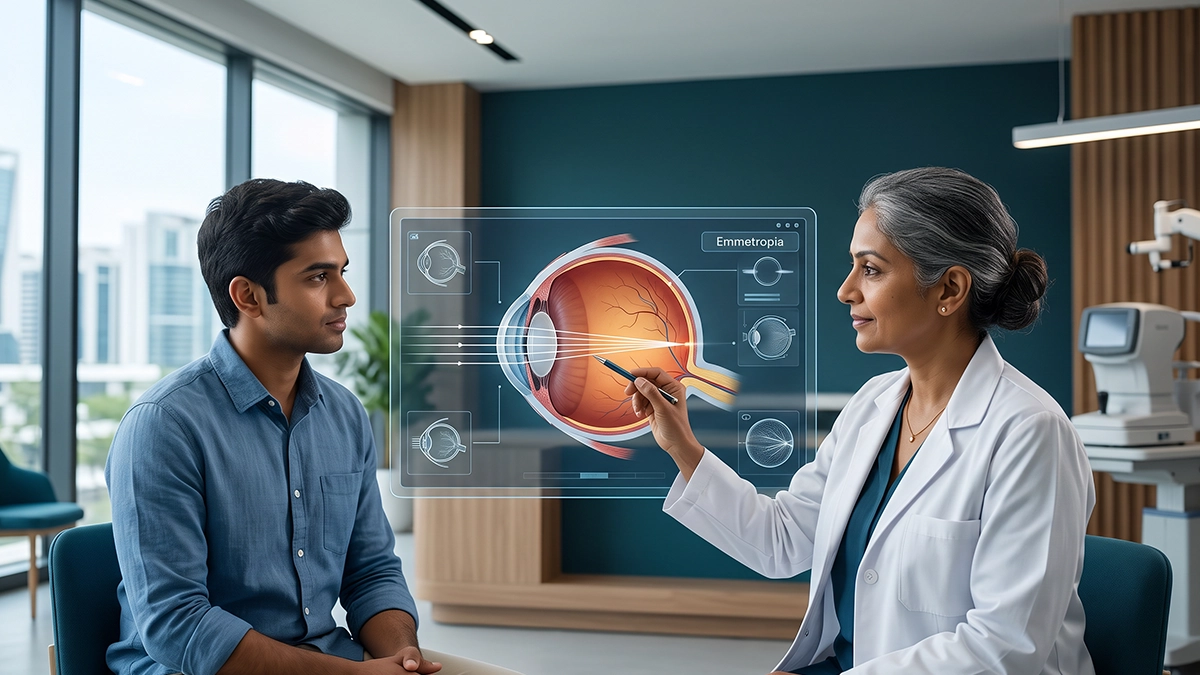
Clear vision is a result of the cornea, natural lens, eyeball length, and retina all functioning as a team. Emmetropia is the term for when light from a distant object focuses right on the retina when the eye isn’t tired out by use with corrective lenses. In short, emmetropia meaning is the eyes’ normal resting refraction.
An emmetropic eye can see far objects clearly but still can develop other eye issues. Dry eye, cataract, retinal disease, or age related focusing changes may present in an emmetropic eye that has normal refraction. Emmetropia is a term which refers to how light is focused by the eye but it does not give a full picture of eye health.
What Does Normal Refraction Mean?
A practical emmetropia definition is that the eye’s optical power and eye length are well balanced which in turn allows incoming light to hit the retinal plane. People that are looking for the metropia meaning are in fact trying to understand this relationship between eye structure and focus.
The U.S. National Eye Institute reports that the cornea and lens play to bend light to the retina, out of which refractive errors are a result of the eye’s shape which does not allow for proper focus. This is the base optical difference between emmetropia and what we see in common refractive errors. National Eye Institute report on refractive errors.
| Eye state | Where light focuses | Typical effect |
| Emmetropia | On the retina | Clear distance focus without refractive correction |
| Myopia | In front of the retina | Distant objects may look blurred |
| Hyperopia | Behind the retina | Near vision may be difficult |
| Astigmatism | Focus is uneven | Vision may appear blurred or distorted |
Emmetropia and Ametropia
In the terms emmetropia and ametropia we compare normal refraction with abnormal refraction. In the case of Ametropia a the light coming in does not focus properly on the retina at rest. Thus the group of conditions which include myopia, hyperopia, and astigmatism fall under the ametropia meaning
Search terms like metropia eyes and metropia eye may turn up online but it is the eye specialist which does the determination of refractive status through exam. Mild refractive changes may be present in a person which reports few symptoms.
How Normal Eye Focusing Works
In emmetropia the cornea is the primary element which does the eye’s focus in which the natural lens does the fine tuning. The retina, which is the receptor of the image, also does the process of light into signals that then go via the optic nerve to the brain.
This is what emmetropia is as a useful point of reference in which we see refractive errors. Also a person may still require an eye assessment when vision becomes blurred, distorted, uncomfortable, or suddenly changes.
| Part of the eye | Main role in focusing |
| Cornea | Bends incoming light |
| Natural lens | Fine-tunes focus, especially for near tasks |
| Axial length | Influences where light reaches the retina |
| Retina | Receives the focused image and converts it into nerve signals |
What Is Emmetropization?
Emmetropization is the process that the growing eye goes through in which it adjusts its length and optical power to reduce refraction issues. Research from the U.S. National Library of Medicine reports that coordinated eye growth is a key element of refractive development. PubMed review on eye growth and refractive development.
This process helps explain why refraction can change during childhood. Emmetropia may be reached or approached during development, but refractive status can change later as the eye grows or ages.
How Is Normal Refraction Checked?
A refraction test will see if a person has emmetropia and if they will benefit from corrective lenses. Visual acuity testing determines how well a person sees at fixed distances. In children also it is at times that accommodation plays a role which is why sometimes we use additional tests.
A routine refraction will not rule out a full comprehensive eye examination. Based on symptoms and clinical indication we may also look at the cornea, lens, retina, and optic nerve.
Does Emmetropia Need Treatment?
Emmetropia, which is a state of perfect vision, does not usually require distance refractive correction as light focuses just right on the retina. Treatment is only considered in the presence of some other eye condition, a nearsighted issue, or a later refractive change.
At Vasan Eye Care during an eye check-up we determine that symptoms are related to refraction or some other eye issue. We discuss what emmetropia is which in turn gives patients a base to understand normal vision and what to expect in terms of future eye health changes.
Frequently Asked Questions
1. What is emmetropia?
Emmetropia is a state where distant light focuses on the retina with no intervention from corrective lenses when the eye is at rest.
2. Is normal refraction the same as perfect eyesight?
No. Emmetropia refers to distance refraction, but other eye conditions can still affect vision.
3. What is the difference between emmetropia and ametropia?
Normal refraction is free of significant distance refractive error, on the other hand ametropia includes myopia, hyperopia, and astigmatism.
4. Can normal refraction change over time?
Yes. Eye growth, age related changes, or other ocular changes may alter refractive status.
5. Does an emmetropic eye need glasses?
Usually not for distance correction but which may still include the need for glasses for near vision or for another visual issue.
References
- National Eye Institute – Refractive Errors
https://www.nei.nih.gov/eye-health-information/eye-conditions-and-diseases/refractive-errors - National Eye Institute – Types of Refractive Errors
https://www.nei.nih.gov/eye-health-information/eye-conditions-and-diseases/refractive-errors/types-refractive-errors