
Glaucoma may slowly impair the optic nerve which usually has no symptoms at all in the beginning stages. By the time vision loss occurs from glaucoma it usually has already advanced too far to be restored. This is the reason that treatment for reduction of Intraocular Pressure (IOP) plays a large role in preserving the vision present.
For many years glaucoma treatment saw a progression from eye drops and laser therapy to more traditional operations like trabeculectomy or glaucoma drainage implants which we turned to when pressure reduction was greater. Today MIGS glaucoma procedures present another surgical option for certain patients.
MIGS is a term for minimally invasive glaucoma surgery or micro-invasive glaucoma surgery. Instead of referring to one procedure, MIGS is a group of which is to improve the outflow of fluid from the eye or to reduce production of that fluid while at the same time causing less damage to eye tissue as compared to many traditional glaucoma surgeries. MIGS procedures usually include very small incisions and also report to have a good safety record and very fast recovery.
However we also see that MIGS is not right for all glaucoma patients. What works best depends on the type and stage of glaucoma, the target eye pressure, what we are currently putting in the eye, past treatments, if there is a cataract and the over all health of the eye.
What Is MIGS Glaucoma Surgery?
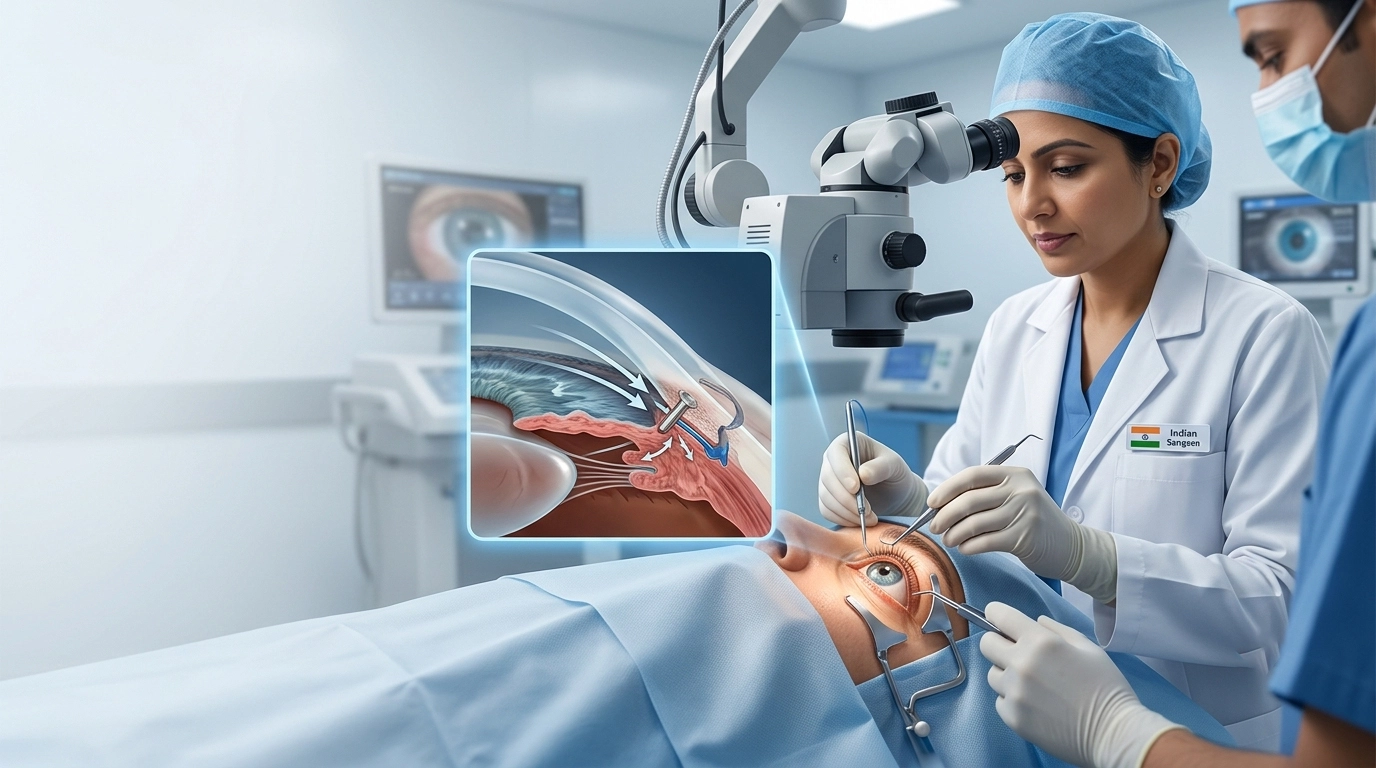
Inside the eye a clear fluid which is the aqueous humour is produced constantly and drained out. When the outflow is not efficient, pressure in the eye may increase. In people with glaucoma what we do is try to reduce this pressure which in turn helps to reduce the risk of further optic nerve damage. MIGS glaucoma is a set of procedures which we use to lower IOP with the help of very small surgical instruments, microscopic implants or we use special techniques that improve the eye’s drainage.
Some procedures do away with or take out part of the trabecular meshwork which is the primary area where resistance to fluid outflow takes place. Also we see that some open up Schlemm’s canal, create a different drain for the fluid or we reduce the production of aqueous humour.
Unlike a single set of procedures, minimally invasive glaucoma surgery has many different techniques. Which one the ophthalmologist chooses is based on the patient’s specific glaucoma picture.
Types of MIGS for Glaucoma
Modern MIGS procedures can be grouped according to how they lower eye pressure.
| Type of MIGS | How It Helps Lower Eye Pressure |
| Trabecular bypass procedures | Bypass resistance in the trabecular meshwork and improve natural drainage |
| Trabeculotomy or goniotomy | Open or remove part of the trabecular meshwork to improve aqueous outflow |
| Canal-based procedures | Widen or treat Schlemm’s canal to improve drainage |
| Subconjunctival procedures | Create an alternative route for fluid to drain beneath the conjunctiva |
| Cyclophotocoagulation-based procedures | Reduce aqueous humour production by treating the ciliary body |
Trabecular Bypass Stents
Tiny implants which go in through the eye’s natural drainage angle to go around the trabecular meshwork. We see that as a method of treatment which includes trabecular micro-bypass devices. Also some of these implants we find to be put in at the time of cataract surgery. For instance certain iStent systems which have been approved for use with cataract surgery in adults that have mild to moderate primary open angle glaucoma.
Goniotomy and Trabeculotomy
Instead of an implant the surgeon will make an access into or will take out a small part of the trabecular meshwork. We use the Kahook Dual Blade, Trabectome and a procedure which is Gonioscopy-assisted transluminal trabeculotomy also known as GATT for these. What these do is open up the path for aqueous fluid to the eye’s drainage canals.
Canaloplasty and Schlemm’s Canal Procedures
Another kind of minimally invasive glaucoma surgery works on Schlemm’s canal which is a key element of the eye’s natural drainage system. The surgeon may open up the canal with a small catheter or viscoelastic material. Also some procedures may include canal opening along with trabecular meshwork treatment.
Subconjunctival Drainage Procedures
Some micro incision glaucoma procedures create a new drainage which allows aqueous humor to flow into the tissue under the conjunctiva. In some cases they may provide greater pressure reduction, but their surgical approach, postop care and risk profile is different from that of conventional angle based MIGS. Also the terminology used for these procedures is an ever evolving field.
Cyclophotocoagulation-Based Procedures
Some of the more minimally invasive options do things differently. Instead of improving fluid drainage they target the ciliary body which is the producer of the aqueous humour. By reducing the production of this fluid these procedures may help to lower intraocular pressure in certain patients.
What Are the Benefits of MIGS Glaucoma Surgery?
One of the reasons for the growth of MIGS glaucoma is that they present a balance between pressure control and surgical safety. While traditional glaucoma surgeries still play a very important role especially in cases of high pressure which we require to be greatly reduced. However we see that procedures like trabeculectomy and tube-shunt surgery which although very effective do require a greater degree of surgical intervention and postop care.
MIGS (Minimally Invasive Glaucoma Surgery) procedures were designed to present surgeons with more options which also see less soft tissue disruption in the eye and in turn lead to a faster recovery post procedure. Some of the benefits from these procedures include reduction of intraocular pressure, in some cases elimination of glaucoma meds for certain patients, very small incisions, not as much disturbance to nearby tissue and the feature that they can be performed at the same time as cataract surgery.
It is true that which some may see as a benefit of fewer glaucoma treatments is in fact not a sure thing. Some do require one or more pressure point medications post surgery.
MIGS Versus Traditional Glaucoma Surgery
In most cases the decision between minimally invasive glaucoma surgery and traditional glaucoma surgery is based on what degree of pressure reduction is needed to protect the optic nerve.
| MIGS | Traditional Glaucoma Surgery |
| Generally involves smaller surgical interventions | Usually involves more extensive surgical intervention |
| Frequently considered in mild-to-moderate glaucoma | Often required when much lower target pressure is necessary |
| Many techniques use or enhance natural drainage pathways | May create a new external drainage pathway |
| Generally faster recovery for many procedures | Recovery and follow-up may be more intensive |
| Pressure reduction may be more modest | Can achieve greater pressure reduction in selected patients |
MIGS should therefore not be considered automatically “better” than traditional surgery. Its greatest advantage is often its safety-to-effectiveness balance.
Patients with which have advanced glaucoma or very low target IOP may still see better results from trabeculectomy, glaucoma drainage devices or a different treatment which is at the discretion of the glaucoma specialist. Present data indicates that MIGS reports a better safety profile but tends to produce less dramatic pressure reduction than that of conventional filtering surgery.
Who May Be Eligible for MIGS?
Patient choice is a very important element of MIGS glaucoma. Angle based MIGS procedures are put forth for patients with mild to moderate primary open angle glaucoma. Also we look at them in patients that have not reached the pressure we are targeting with medication, in which meds cause serious side effects, when we wish to reduce the number of daily glaucoma drops a patient has to take, or when we are able to combine glaucoma treatment with cataract surgery.
Eligibility can not be determined by eye pressure alone. Before we recommend minimally invasive glaucoma surgery we have to check the drainage angle, optic nerve, visual field, retinal nerve fibre layer, current IOP, past pressure records, what medications are in use, corneal health and also any previous eye surgery.
The patient’s target IOP is particularly important because two people with the same measured eye pressure may require very different treatment.
Who May Not Be an Ideal Candidate?
In not all cases of glaucoma do we see benefit from MIGS. Some patients with advanced optic nerve damage require a pressure which a given MIGS procedure is unable to achieve. Also certain procedures may not be appropriate when the drainage angle is not accessible or when other forms of glaucoma surgery may in fact provide better disease control.
The kind of glaucoma does play a role. For many angle based MIGS procedures what we have is mainly info regarding open angle glaucoma which at the same time does not tell the full story as far as which individual procedure is best. Thus a full glaucoma evaluation is very much recommended before going ahead with MIGS.
Can MIGS Be Done Along With Cataract Surgery?
Yes. This is a very frequent situation in which MIGS glaucoma is considered. In some people with cataract and glaucoma we may perform cataract removal and an appropriate MIGS procedure at the same time.
Cataract surgery does in fact lower IOP for some patients, also we see that adding a proper MIGS procedure may provide extra pressure control and at the same time may reduce medication requirements. Some MIGS devices are meant to be put in at the time of cataract surgery.
However, combining the procedures is not necessary or suitable for every patient.
What Happens During MIGS Surgery?
The exact steps vary considerably according to the technique.
In most angle based approaches the surgeon enters the eye through a small corneal incision and uses specialized micro equipment to view the drainage angle. A very small implant is at times put in or the trabecular meshwork or Schlemm’s canal is treated. As there are many procedures that fall within the MIGS category it is up to the patient to ask which procedure is recommended for them and what the expectation is for reduction of eye pressure.
Recovery After MIGS Glaucoma Surgery
Recovery from minimally invasive glaucoma surgery in most cases is faster than recovery from many traditional glaucoma procedures which we see today, though the timeline does vary by the procedure itself and if at the same time cataract surgery was done. Post op patients may have temporary blurry vision, mild irritation, tearing, redness or light sensitivity. The ophthalmologist will prescribe anti bacterial or anti inflammatory eye drops and will have a follow up schedule to check on the healing as well as the intraocular pressure.
Patients should take the postoperative medications as instructed and out of the operated eye’s contact which includes no pressure or rubbing. Also at this time heavy exercise, sports like swimming, dust filled environments and the use of eye make up may be best to avoid. Your surgeon will let you know when it is safe to go back to these. Also it is very important that patients do not discontinue their glaucoma eye drops which they may be on prior to the operation without first checking with their ophthalmologist.
Are There Risks With MIGS?
The term “minimally invasive” does not mean risk-free.
Possible issues will present differently depending on the specific procedure but may include instances of internal eye bleeding, inflammation, sudden changes in eye pressure, implant displacement or blockage, infection, corneal issues or inadequate pressure reduction. Some patients may also have time to use additional glaucoma treatments, laser procedures or a second operation.
Recent evidence continues to support the favourable safety profile of several tissue-sparing MIGS techniques, although complication patterns vary by procedure and longer-term outcomes remain an important area of study.
Does MIGS Cure Glaucoma?
No. MIGS glaucoma is a treatment which controls intra ocular pressure; we must note that it does not cure glaucoma. Also it does not reverse any permanent loss of optic nerve tissue or vision. What it does is to bring eye pressure to the patient’s target level which in turn reduces the risk of further glaucoma damage. Also our patients will still require lifetime monitoring even when their pressure is well controlled post surgery.
Regular examinations, optic nerve assessment, visual field testing and other glaucoma investigations remain important.
Choosing the Right Glaucoma Treatment
There is not a single MIGS procedure which will be best for all patients. It may depend on the type of glaucoma, stage of the disease, target intraocular pressure, drainage angle structure, cataract status, prior surgeries, present medications, and the rate in which the disease progressed.
At Vasan Eye Care we find that in depth glaucoma evaluation is what we do to determine which medicine, laser procedure, minimally invasive glaucoma surgery, conventional glaucoma surgery or a mix of them is right for you. We are into early and consistent glaucoma management which in turn is a matter of preserving what vision is left instead of trying to bring back what has permanently gone.
Conclusion
MIGS glaucoma has broadened which now includes a variety of medical options and laser procedures in addition to the traditional surgeries. What we have seen is that by way of very small incisions and more non-invasive methods, minimally invasive glaucoma surgery is able to report in terms of pressure reduction in the eye which also reports in terms of a better safety profile and faster recovery for those that are right for this type of procedure.
It’s true that the degree of that which is put forth is a function of the type of procedure and the eye in question. MIGS does not at present cure glaucoma, it does not reverse that which is done to the optic nerve and also does not see to it that we see a great pressure reduction in all patients. It is thus very important to have a full assessment by an ophthalmologist or glaucoma specialist. The right procedure is one which out of safety is able to achieve the pressure which in the patient’s case will protect what vision is left, at the same time taking into account the stage of the disease, the status of the cataract, the patient’s medication regime and long term control of glaucoma.
Frequently Asked Questions About MIGS Glaucoma
- Is MIGS better than traditional glaucoma surgery?
Neither is one option better than the other. In terms of MIGS glaucoma we see a better safety record and faster recovery but a lesser degree of pressure reduction. Conventional surgeries may be what is best in the case of very advanced glaucoma which requires very low eye pressure.
- How long does MIGS surgery take?
The time it takes varies by procedure and also if cataract surgery is included at the same time. Many MIGS techniques only add a small amount of extra surgery time, but patients should ask their ophthalmologist what will be done in their particular case.
- Will I still need glaucoma drops after MIGS?
Possibly. Minimally invasive glaucoma surgery see to it that some patients may no longer require as much pressure which in turn reduces the use of medications but we can’t say for sure that we will do away with them all. May still have to use drops if the target intra ocular pressure is not achieved post surgery.
- How soon can I return to normal activities after MIGS?
Many patients see improvement in a short amount of time after MIGS, although recovery may vary by the type of procedure and if cataract surgery was also a part of the treatment. Your ophthalmologist will determine when it is safe for you to return to the wheel, the gym, the office, the pool and your regular routines.
- Can MIGS restore vision already lost from glaucoma?
No. MIGS reduces eye pressure to which in turn protects the optic nerve from more damage. It does not bring back vision which has been forever lost due to glaucoma. That is why it is of great importance that diagnosis is prompt, the treatment is right and that we have regular follow ups.
- Can MIGS and cataract surgery be performed together?
Yes. In certain cases we see that MIGS glaucoma procedures go hand in hand with cataract surgery. In right patients this permits the ophthalmologist to address cataract and glaucoma at the same time which in turn we hope for better eye pressure control.