
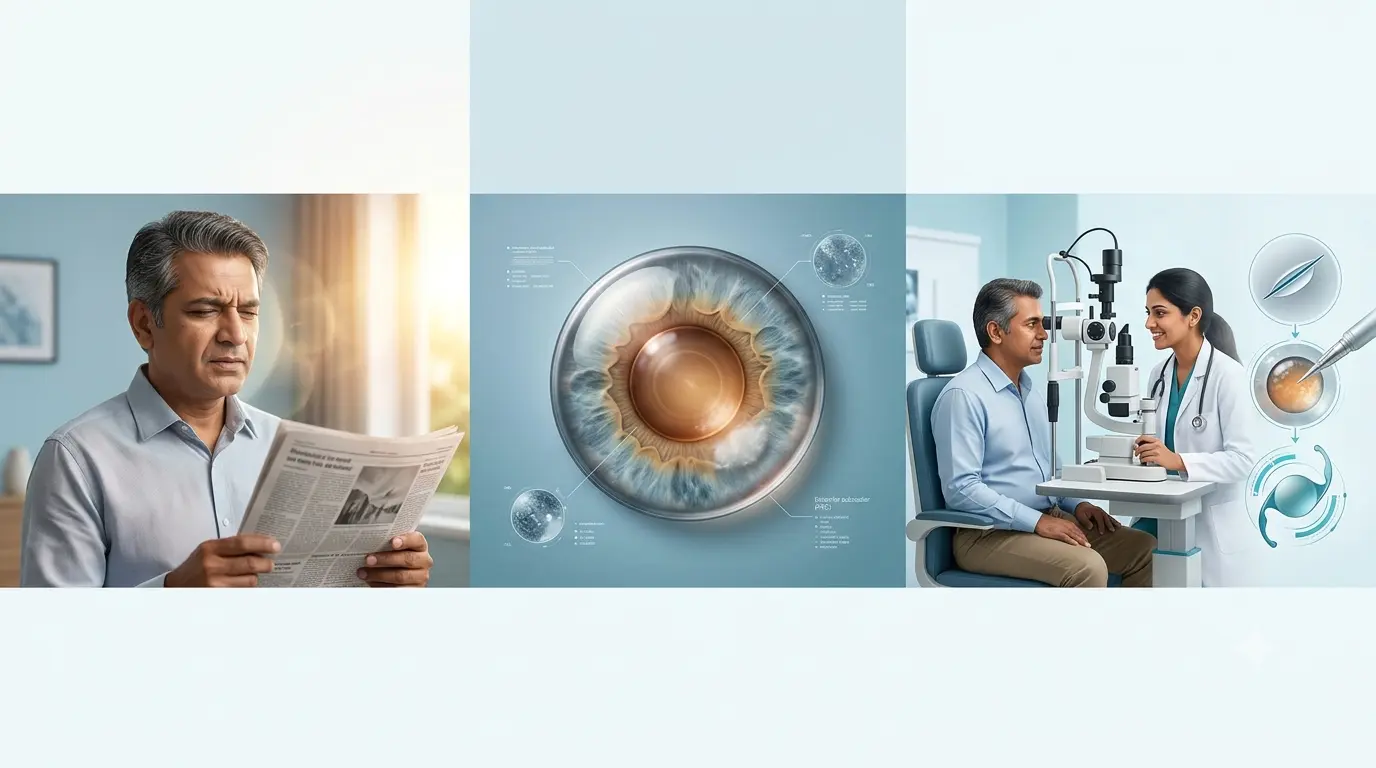
A cataract may not form in the same place in the eye’s natural lens. A type which can cause visible vision impairment even when the clouded area is rather small is the posterior subcapsular cataract.It forms at the back of the lens at the front of the posterior capsule.
Because we see this opacity to present itself near the center of the visual axis, what we often see is the onset of glare, halos, blurred vision and difficulty with bright light. Also some patients report issues with reading and night time driving. In general with cataracts patients report blurry vision, faded colors, glare, poor night vision and increased sensitivity to bright lights.
In some cases we see development of posterior subcapsular cataract in people younger than what is seen in the typical age related nuclear cataracts. Long term use of corticosteroids is a recognized risk factor.
What Is a Posterior Subcapsular Cataract?
In the middle of the eye behind the iris is the natural lens which plays a role in light focus to the retina. A cataract is a condition where part of this usually clear lens becomes opaque.
In a subcapsular cataract what we see is that the opacity forms near the lens capsule. A posterior subcapsular cataract, which is also known as PSC cataract forms at the back of the lens. Also in this area which is near the center light rays travel through even a small degree of opacity may affect visual quality.
This is the reason that PSC in eye may produce troublesome glare or issue with bright lights before a person reports that their vision has greatly deteriorated.
The National Eye Institute reports that we diagnose cataracts via an eye exam which usually includes pupil dilation and that at present surgery is the surest way to go in removing a cataract.
Common Symptoms of Posterior Subcapsular Cataract
Symptoms present in terms of the location and degree of the opacity. Also they may appear gradually and can affect one or both eyes.
| Symptom | What You May Notice |
| Blurred vision | Words, faces or distant objects may look less sharp |
| Glare | Sunlight, lamps and headlights may feel unusually bright |
| Halos around lights | Rings may appear around streetlights or headlights |
| Poor night vision | Driving after dark may become uncomfortable |
| Difficulty in bright light | Vision may sometimes feel worse outdoors in strong sunlight |
| Reduced contrast | Objects may appear less clearly separated from their background |
| Reading difficulty | Fine print may become harder to see comfortably |
Glare and halos are reported to be the main issues with central cataracts. Also under the category of general cataract symptoms are blurred vision, reduced night vision and frequent changes in spectacle prescription.
What Causes a Posterior Subcapsular Cataract?
Age is a factor which plays a role in the development of a posterior subcapsular cataract. Also reported is a link between PSC and diabetes, certain inflammatory eye conditions, past eye issues, exposure to radiation and use of corticosteroids.
Prolific amongst well studied associations is that of long term corticosteroid exposure. Corticosteroids which we use in treatment of inflammatory, autoimmune, respiratory and other medical conditions. It is a known fact that long term glucocorticoid use is a risk factor for posterior subcapsular lens changes.
This does not mean a person should discontinue prescribed steroids at the first sign of cataract. Suddenly stopping some steroid medications is unsafe. Those on steroids for the long term should go over the pros and cons and also arrange for proper eye checkups with the doctor that is prescribing them and an ophthalmologist.
Diabetes also is a recognized cataract risk factor. We do what we can to keep blood glucose at proper levels for the health of your eyes, also it is made clear that good diabetes management does not promise to completely prevent cataracts from developing.
Posterior Subcapsular Cataract vs Posterior Polar Cataract
The terms used for posterior polar cataract, polar cataract, PPC cataract and posterior subcapsular c it also happens that they are used interchangeably but do not always represent the same diagnosis.
| Feature | Posterior Subcapsular Cataract | Posterior Polar Cataract |
| Location | Immediately in front of the posterior lens capsule | Central posterior lens/capsular region |
| Typical pattern | Granular or plaque-like central opacity | Well-defined central polar opacity |
| Common associations | Ageing, corticosteroids, diabetes and some ocular conditions | Often developmental or inherited |
| Surgical consideration | Standard cataract planning depends on individual findings | Posterior capsule may be unusually thin, weak or adherent to the opacity |
| Common abbreviation | PSC | PPC |
From an early age a posterior polar cataract may present and at time is associated with a fragile posterior capsule. This is important as in the case of cataract surgery extra care must be taken to reduce the risk of posterior capsule rupture.
A patient may present with posterior polar changes in addition to PSC which is also a reason for an ophthalmologist to examine the lens and not to rely only on symptoms.
Is Posterior Subcapsular Cataract the Same as Cupuliform Cataract?
The term cupuliform cataract is used in older or traditional ophthalmology reports which described a saucer or cup shaped opacity at the posterior portion of the lens. Today’s clinical terminology is to report the relevant lens location more precisely which is to say posterior subcapsular cataract.
Also an anterior subcapsular cataract forms at the front of the lens capsule which is a different location from that at the back. This location issue is important to note as different cataract patterns may have different causes and visual effects.
Another in the eye related search terms is what we see of the sulcus subtarsalis .We do not talk of cataract here. This is a groove which is present in the inner surface of the eyelid which at times may hold foreign material. Anatomically it is separate from the lens hence has no relation to PSC at all.
How Is PSC Cataract Diagnosed?
An ophthalmologist reports most cases of PSC cataract at the time of a full eye exam. We check vision at various distances and also use a slit lamp to look at the lens. At times we may use dilating drops which help the doctor see the lens, the retina and the internal structures better.
A dilated eye examination is routinely used to detect cataracts and evaluate other potential causes of visual symptoms.
The issue of which is important because we see that glare, blurred vision and night time driving problems are not unique to cataracts. Corneal conditions, retinal diseases, refractive errors and other eye issues may present with the same symptoms.
Can PSC Eye Drops Cure a Cataract?
People reporting in for PSC eye drop may see products that promise to do away with or reverse cataracts. At present we don’t have any over the counter or prescription eye drop which has proven to remove a cataract as a replacement for cataract surgery.
The National Eye Institute reports that surgery is the treatment which removes a cataract. While early symptoms may at times be treated with a new spectacle prescription, better visual aids or changes in lighting these do not remove the cloudy lens.
Self use of steroids containing eye drops is a particular issue. Prolong term corticosteroid use may in fact cause posterior subcapsular cataract formation and other eye problems.
Treatment for Posterior Subcapsular Cataract
Treatment of posterior subcapsular cataract is based on the degree to which they impact daily vision. A small cataract which does not cause great issues may start out managed with regular eye exams.
An updated eye glass prescription can improve some of the symptoms at the very early stage of cataract. But it is to be noted that glasses do not bring back transparency to an opaque lens.
When a cataract related vision issue starts to affect reading, driving, work or any other important daily activity an ophthalmologist may put forth the recommendation for cataract surgery. In the operation the cloudy natural lens is removed and in its place is put in a clear artificial intraocular lens which is also known as IOL.
The time of surgery is very personal. What we do is we wait not just for the presence of a cataract but for it to affect vision, lifestyle, the results of our exams and the health of the rest of the eye.
Can Posterior Subcapsular Cataract Be Prevented?
Not all cataracts can be prevented. But some risk factors which we do modify do exist. Protection from excess ultraviolet light, quit smoking, proper management of diabetes and regular eye exams will support good long term eye health.
People on long term steroid regimens should not stop which is at the discretion of the medical team. Also we note that routine eye check ups will bring out steroid related eye issues early. The American Academy of Ophthalmology’s EyeWiki notes that ophthalmic monitoring is a growing issue for patients on long term corticosteroid therapy.
Conclusion
A natural lens based posterior subcapsular cataract appears at the back of the natural lens and may present early in the disease process before becoming large. Glare, halos, problems in bright light, blurry vision, and poor night vision often bring such cases to an eye doctor’s attention.
The condition also should be differentiated from a posterior polar cataract, which in fact may require a different approach in surgery.
Glasses and changes in daily routine may help at first, but they will not get rid of a cataract once it has appeared. If you notice your vision has blurred to the point that it affects your routine activities, an ophthalmologist can determine if surgery is right for you.
If you are presenting with cataract symptoms or are a long time user of corticosteroid medicines we advise that you schedule a comprehensive eye exam at Vasan Eye Care. Early evaluation will help us to determine the type of cataract you may have, also rule out other eye conditions which may be present and to determine the best step forward for your vision.
Frequently Asked Questions
- Is posterior subcapsular cataract serious?
A large degree of cataract development in the posterior subcapsular cataract area can cause great visual issues. Even a small amount of opacities may produce glare, halos or trouble in bright light. With an eye exam we can see what extent the cataract is playing a role in your vision.
- How fast does a posterior subcapsular cataract progress?
The rate of cataract progression varies between people. Some cataracts progress slowly, while in others they may go on to have a large visual effect early. Age, preexisting eye issues, diabetes, use of corticosteroids, and other factors may play a role. Routine exams enable the ophthalmologist to watch for changes instead of trying to predict progression by symptoms alone.
- Can glasses correct a PSC cataract?
Glasses can improve vision in early stages of PSC cataract which also may have refractive error. But they do not remove the cloudiness in the natural lens. When the cataract does have a great impact on day to day activities, cataract surgery may present a more permanent solution.
- Are posterior polar cataract and posterior subcapsular cataract the same?
No. A posterior polar cataract is a unique type of cataract that often has a genetic component. PSC forms right at the back of the lens capsule. Also a PPC may present with a fragile posterior capsule which in turn makes pre operative diagnosis very important.
- Can eye drops remove posterior subcapsular cataracts?
No routinely approved PSC eye drop has been shown to replace cataract surgery. Eye drops may be prescribed for other eye conditions or used around the time of surgery, but they should not be expected to dissolve an established cataract.
- When should I see an eye doctor?
Arrangements for an eye exam should be made if you notice persistent blurred vision, increasing glare, halos, difficulty with reading or that your night vision is going down. Sudden vision loss, new flashes, many new floaters, severe eye pain or marked redness require prompt medical attention as these may have causes other than cataract.