
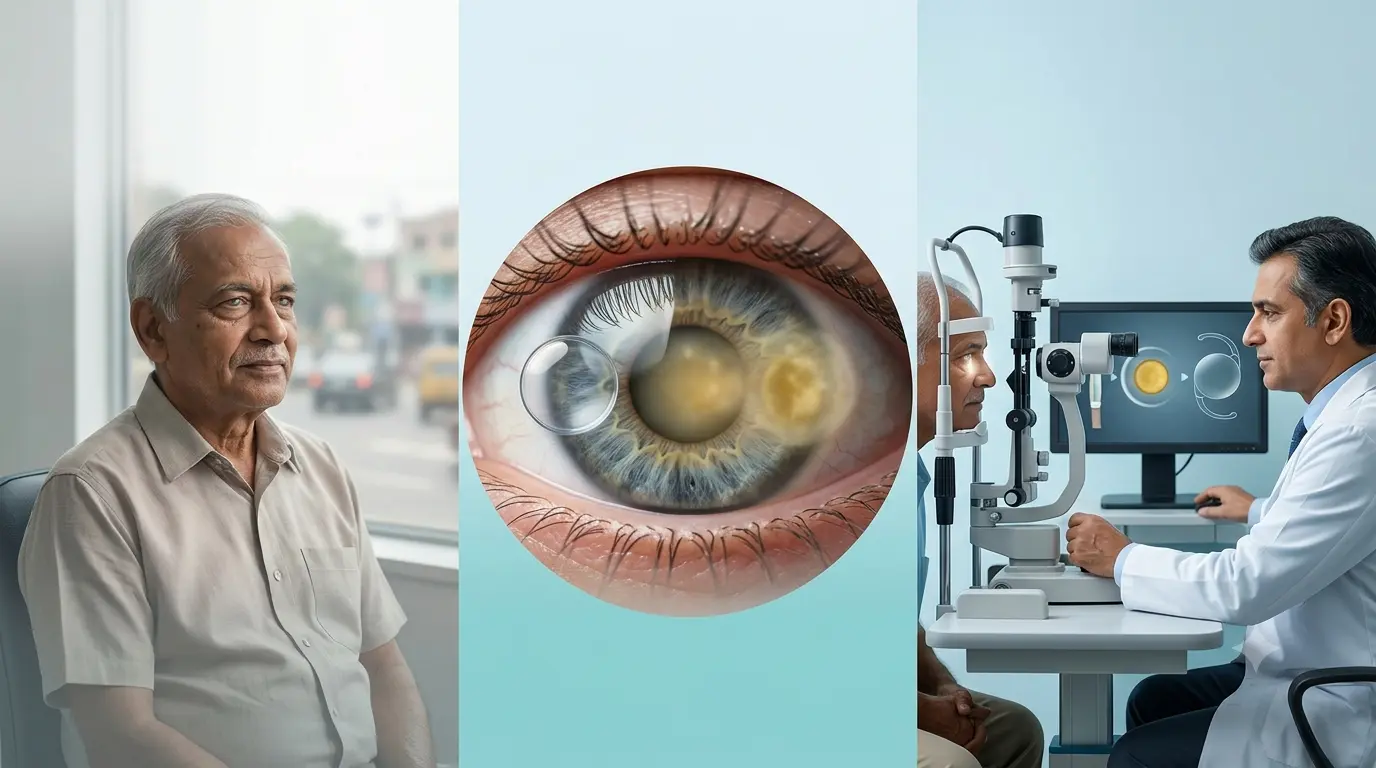
A progressive vision loss is often written off as a natural part of the aging process. You may notice that road signs do not stand out as well, colors appear more drab, or head lights bother you more at night. In some people these changes are a result of nuclear cataract, which is one of the more common types of age related cataract.
A nuclear cataract which is in the eye’s nuclear (central) zone of the lens develops over time to become harder, denser, and yellow in color, a process which we call nuclear sclerosis. If the issue becomes serious enough to affect vision then what is described is a nuclear sclerotic cataract. Nuclear sclerosis usually takes place slowly over a period of a few years.
Understanding this disease’s progression will help you to notice changes early which in turn will tell you when to seek out an eye exam.
What Is a Nuclear Cataract?
The natural lens which is located behind the colored portion of the eye plays a role in focusing light onto the retina. At the center of this lens is the nucleus. As we age new lens fibers develop around the older ones. Over time the nucleus may become more compact, hard and yellow.
This process of age related hardening is what we term nuclear sclerosis. At its early stages it may cause no noticeable vision problems. As the nucleus becomes more opaque though it may turn into a sclerotic cataract which in turn will interfere with light transmission to the eye.
The term ns cataract is also one which eye care professionals put forward as a short form of cataract.
Nuclear Sclerosis vs Nuclear Sclerotic Cataract
Although similar in some aspects the terms are not exactly the same.
Nuclear sclerosis is a term we use for age related hardening and yellowing of the central lens. To some degree this change may be present as we age. A nuclear sclerotic cataract reports a more advanced stage of that in which those changes produce enough lens opacity to affect vision.
The progression is usually a very gradual process which may not be sudden at all. The lens may go from clear to yellow and in advanced cases to a deep brown.
| Stage | What May Happen in the Lens | Possible Vision Changes |
| Early nuclear sclerosis | Mild hardening and yellowing of the nucleus | Few symptoms or changing spectacle power |
| Developing nuclear cataract | Increasing density and opacity | Blurred distance vision, reduced contrast |
| Moderate nuclear sclerotic cataract | More noticeable yellowing and hardening | Glare, difficulty driving at night, faded colours |
| Advanced nuclear cataract | Dense brownish central lens | Significant reduction in vision and daily functioning |
Progression is variable in each individual. An ophthalmologist may diagnose the severity of the issue which can also include a family history report, rather than based only on symptoms.
Common Symptoms of Nuclear Cataract
A nuclear cataract is the one which typically causes painless and gradual vision changes. At first it may be mild and go by unnoticed as the body adapts.
One out of the most common signs is progressive blurred vision which in turn may worse at distance vision. Night time driving may become a issue as head lights appear to brighten or produce that annoying glare. Also colors may appear more washed out due to the yellowing of the lens which in turn changes how light gets to the retina.
Frequent changes in spectacle prescription are also common.Nuclear sclerosis which is a hardening of the lens may increase its refractive power thus producing more nearsightedness. Some older people may for a while improve in their ability to read without the use of their usual reading glasses. This is what is known as “second site” but it does not mean the eye is improving in health. In fact it may be a sign of a nuclear sclerotic cataract. is developing.
General cataract symptoms may also involve poorer visual clarity, glare, halos around lights, trouble seeing in dim conditions, and changes in colour perception.
What Causes a Nuclear Cataract?
Ageing is the primary cause of age related nuclear cataract. Over time the proteins and fibres in the lens change which in turn reduces its transparency.
Certain factors may increase a person’s likelihood of developing age-related nuclear cataract.. These include diabetes, smoking, a family history of cataracts, prolonged exposure to ultraviolet radiation, previous eye surgery and the use of some steroid medicines.
Having one in a group of risk factors does not mean that a person will in fact get a visually significant cataract. Also it is possible for a nuclear cataract to develop as part of the aging process in a person which may not have what we consider to be traditional risk factors.
How Does Nuclear Cataract Progress?
Compared to some other cataract types nuclear changes tend to progress slowly. The process may take years.
At first nuclear sclerosis which is that the center of the lens has become subtly hard. As the process continues the lens nucleus also turns more yellow and at the same time grows more cloudy. Vision may also deteriorate over time, and at greater speed change in spectacle correction may be required.
As in the case of nuclear sclerotic cataract which becomes more dense the nucleus may turn from yellow to orange or brown. In advanced nuclear cataracts this may become very dense which in turn greatly reduces vision.
There isn’t any way to tell for sure how a person’s cataract will progress. At regular intervals of eye exams an ophthalmologist is able to compare vision and lens changes over time.
How Is a Nuclear Cataract Diagnosed?
Diagnosis is achieved via an eye exam. An ophthalmologist will check visual acuity, determine the current spectacle prescription and look at the lens with a slit lamp.
A dilated eye exam also which in turn allows the doctor to check out the lens and also other eye elements. That is important because issues affecting the retina, optic nerve, or other eye elements may cause signs and symptoms which are the same as that of cataract. The National Eye Institute reports that older adults have routine dilated eye exams which in particular from age 60 forth.
The choice to go ahead with a nuclear cataract is based not only on the appearance of the lens but also on the degree to which it impacts the patient’s vision and daily activities.
Nuclear Cataract Treatment
In the beginning of nuclear sclerosis, development surgery may not be required. Updated glasses, more light for reading and methods to reduce glare may help people function well for a while.
At present we have no methods which do away with cataract. It is true that what has been put out is the use of surgery for the removal of a visual cataract.
Doctors will opt for surgery when the nuclear cataract is causing problems for the patient which can include reading, writing, working, seeing faces, and other daily tasks.
During the course of cataract surgery the cloudy natural lens is taken out and we put in an artificial intraocular lens which is also known as an IOL. As to what time the surgery should take place, that is a very individual issue which should be discussed with your ophthalmologist regarding the expected results, what the risks are, the state of your eye health and your visual needs.
A patient may bring up the question of treatment prior to the nuclear sclerotic cataract in a mature stage.
Nuclear Cataract, Cortical Cataract and Coronary Cataract Are Different
Some cataract related search terms cause confusion.
The eye cortex is affected in the course of an online search by the term cortical sclerosis of the eye but in fact it does not stand for nuclear sclerosis. In the case of a cortical cataract what we have is the outermost cortex of the lens affected and which in turn produces wedge shaped or spoke-like opacities. A nuclear cataract on the other hand mainly affects the lens nucleus.
Also a coronary cataract is not what is meant by an age related nuclear cataract. Coronary cataract is a rare cataract type which has been reported in relation to juvenile or inherited cataracts. Thus do not use those terms interchangeably.
| Term | What It Generally Refers To |
| Nuclear sclerosis | Age-related hardening and yellowing of the central lens |
| Nuclear sclerotic cataract | Nuclear sclerosis associated with visually significant lens opacity |
| Sclerotic cataract / NS cataract | Common shorthand referring to nuclear sclerotic cataract |
| Cortical cataract | Cataract affecting the outer cortical layers of the lens |
| Coronary cataract | A separate, uncommon cataract pattern; not a synonym for nuclear cataract |
Nuclear Sclerosis ICD 10: What Do the Codes Mean?
People looking for nuclear sclerosis icd 10, age related nuclear cataract icd 10 or senile nuclear sclerosis icd 10 may find different codes in different coding systems and countries.
In the U.S. ICD-10-CM system CMS reports H25.11 for age related nuclear cataract in the right eye, H25.12 for the left eye and H25.93 for bilateral age related nuclear cataract.
The international ICD-10 classification also includes senile nuclear cataract and nuclear sclerosis cataract in category H25.1.
These are the codes for medical documentation which you should not use for self diagnosis. Also coding practices do vary between health care systems and jurisdictions.
The term nuclear senile cataract which is an older expression may still be used in medical settings or searches, but we prefer the term age related nuclear cataract for use with patients.
Can Nuclear Cataract Be Prevented?
At present there is no proven medicine or eye drop which does in fact reverse a developed cataract.
As for prevention of cataracts do what is sensible for your eye health that includes protection from excessive ultraviolet exposure, which is to say wear sunglasses, and also to not smoke and to manage diabetes. Also have your eyes checked by a professional regularly because cataracts can develop very gradually and may not cause noticeable symptoms at first.
Conclusion
A nuclear cataract is a typical age related issue which develops when the central part of the eye’s natural lens slowly hardens, yellow and becomes cloudy. In early nuclear sclerosis only mild changes may present itself, in advanced nuclear sclerotic cataract reading, driving and other daily activities become very difficult.
Because it is a slow process, it is also easy to adapt and do not realize the degree that vision is worsening. Routine extensive eye exams can point out cataracts early, check for other health issues related to change in vision and help figure out best times for intervention.
If you have blurred vision, glare issues, or are noticing a change in the power of your spectacles which is affecting your daily life, come to Vasan Eye Care for a detailed eye evaluation and personalized advice on cataract care.
When Should You See an Eye Doctor?
Schedule an ophthalmic exam if you see that your vision is steadily getting blurrier, which light causes you more trouble, note that you are having to change your glasses very often, have trouble with night driving or notice colors as very dim.
Sudden loss of vision, severe eye pain, new flashes, a report of increased floaters or a curtain like shadow which is present in the field of vision should not be assumed to be that of a nuclear cataract. These symptoms may also present with other eye conditions which is why it is important to see a medical professional as soon as possible.
Frequently Asked Questions
1. Is nuclear sclerosis the same as a cataract?
Not at all. As we age we see a change in the natural lens which is hardening and yellowing at the center. If these changes in the lens become great enough to affect vision then the issue may be classified as a Nuclear sclerosis cataract.
2. How quickly does a nuclear cataract progress?
A nuclear cataract may develop slowly over several years which is to say the process of opaqueness in the lens does not have a set rate for all people. That may also depend on the person which is why it is important to have regular eye exams that note changes in the eye’s structure as well as report to you what stage your vision is affected at.
3. Can glasses correct a nuclear cataract?
A new eye glass prescription may improve vision in the early stages which is true when nuclear sclerosis changes the refractive index of the lens. While glasses do not remove the cataract they may also see their benefit diminish as the lens becomes more cloudy.
4. Does nuclear sclerosis cause short-sightedness?
It is so. Growth in the lens nucleus density may alter its refractive power which in turn produces a shift towards myopia or short sightedness. This at times improves near vision at the expense of distance vision.
5. Does everyone with nuclear cataract need surgery?
No. Surgery is to be done when cataract related vision loss impacts daily life or there is a health issue related to which the lens must go. As for the mild cataracts that do not cause much of a problem they may just be watched at the routine eye exams.
6. Can nuclear cataract come back after surgery?
The natural cataract does not return as the cloudy lens has gone. Some people do develop clouding of the capsule behind the artificial lens which is a condition also known as posterior capsule opacification. This is a different issue from the original cataract and in most cases may be treated with a laser procedure.