
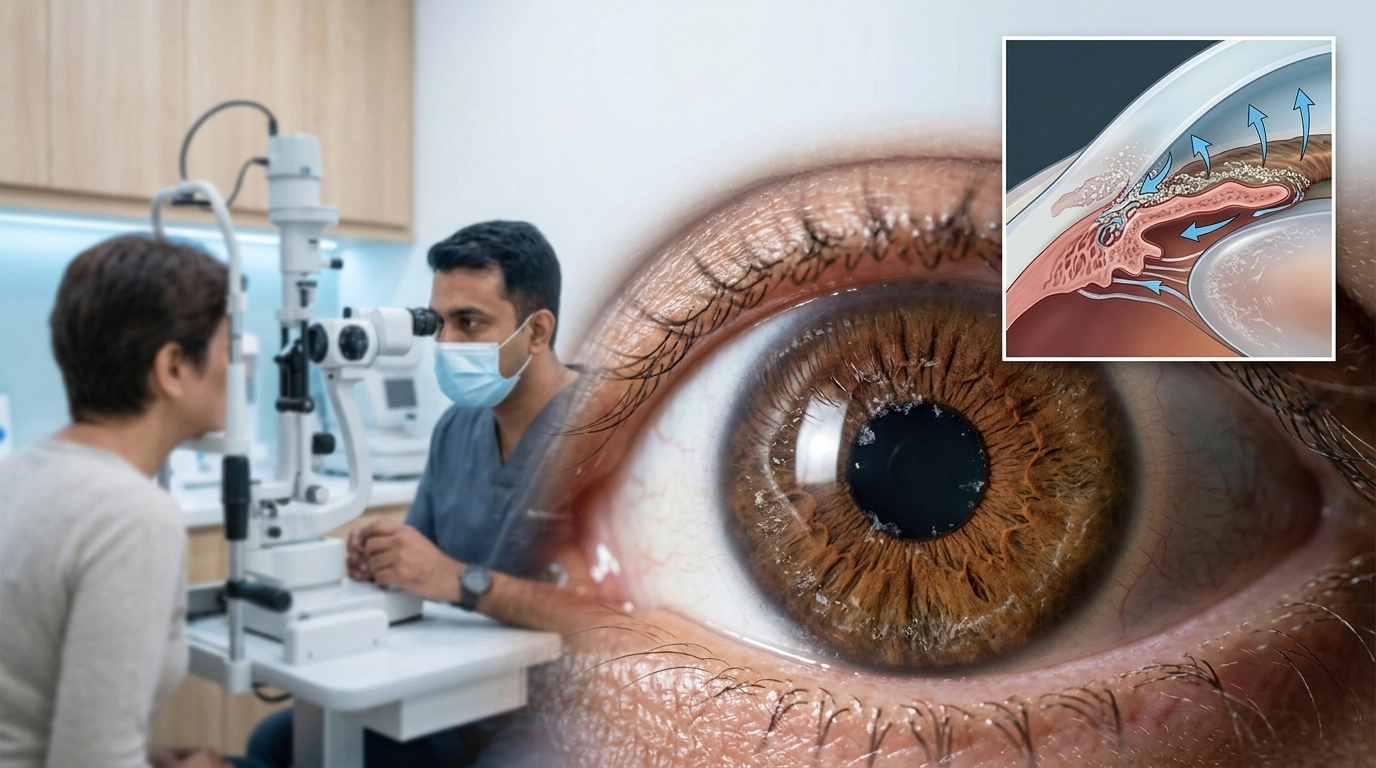
A during which the eye is examined we often see changes that may have gone unnoted by the person. Pseudoexfoliation syndrome is a disease which as it’s named does produce abnormal microscale material to build up in the front structures of the eye and which also tends to run in a more common pattern as we age.
A person which has pseudoexfoliation syndrome may at first have no symptoms of discomfort and may report normal vision. But the disease does require for its early detection as it affects the eye’s drainage system which in turn may cause an increase in intraocular pressure and a greater risk of glaucoma.
Pseudoexfoliation also damages some of the elements which support the natural lens. This is of great importance in a person that is to undergo cataract surgery.
Early detection of glaucoma, proper screening at the onset of symptoms and routine follow up care is key for doctors to identify issues which may cause loss of vision before it becomes severe.
What Is Pseudoexfoliation Syndrome?
Pseudoexfoliative syndrome which is an age related issue in which abnormal fibrillar material builds up in various eye tissues.
During a course of a full eye exam this material may present as grey white deposits in the lens’ front surface, at the pupil edge and in the drainage angle.
The issue may present more in one eye than the other. Also pseudoexfoliation is usually a condition which sees both eyes require care over time.
Finding out pseudoexfoliation in eye structures is not a sure sign of glaucoma. What it does mean is that the ophthalmologist has to closely watch eye pressure and the optic nerve as the risk is higher.
What Causes Pseudoexfoliation?
Researchers are still looking into what exactly causes pseudoexfoliation syndrome.
At present we see that age, genetic tendency and environment play a role in the abnormal production or accumulation of extracellular materials.
The issue we see more of in elderly people. That said age is not the only factor in who gets it.
Because the cause is so complex we do not have a simple treatment which removes pseudoexfoliation from the eye. Instead eye care is directed toward early detection and management of complications like elevated intraocular pressure, glaucoma and issues related to cataract surgery.
What Are the Signs of Pseudoexfoliation in the Eye?
Many patients don’t see any early signs of pseudoexfoliation syndrome. The condition usually is diagnosed by an ophthalmologist at the time of a slit-lamp exam.
Characteristic features of pseudoexfoliation eye may present as deposits on the lens surface or around the pupil, increased pigmentation in the drainage angle, reduced pupil dilation and weakness of the fibers which hold the natural lens in place
These lens-supporting fibres are called zonules. If they become weak, the lens can become less stable.
| Eye Finding | Why It Matters |
| Whitish-grey deposits | May indicate pseudoexfoliation material |
| Elevated eye pressure | Can increase the risk of optic nerve damage |
| Increased angle pigmentation | May accompany obstruction of aqueous drainage |
| Poor pupil dilation | Can make cataract surgery technically more challenging |
| Weakened zonules | Can reduce stability of the natural lens |
| Optic nerve changes | May indicate development of glaucoma |
Because these findings require specialised examination, regular comprehensive eye checks are especially important in older adults.
How Does Pseudoexfoliation Syndrome Increase Glaucoma Risk?
Fluid which is the aqueous humour constantly goes through the eye. It mostly drains via a tissue which is known as the trabecular meshwork.
In pseudoexfoliation syndrome that abnormal material and pigment accumulates in the drainage area. This in turn may cause reduced aqueous outflow which in total can result in higher intraocular pressure.
In certain cases where high pressure plays a role in optic nerve damage and also we see characteristic visual field loss, this is known as pseudoexfoliation glaucoma.
Not in all cases of pseudoexfoliation does glaucoma present. While the association is large enough for that which is seen in pseudoexfoliation to require we do regular eye pressure and optic nerve assessment.
What Is Pseudoexfoliation Glaucoma?
Pseudoexfoliation glaucoma is also a secondary type of glaucoma which is associated with pseudoexfoliation syndrome.
It is a fact that in some patients eye pressure may be higher and fluctuate more than what is seen in primary open angle glaucoma. Also we see that in some cases the damage to the optic nerve may progress very fast.
For that which is we see that treatment and care may have to be more in depth when pseudoexfoliation glaucoma does present itself. Also the disease may first show up in a single eye but at which point the other should still be checked.
How Is Pseudoexfoliation Syndrome Diagnosed?
Ophthalmologists report that they usually notice pseudoexfoliation syndrome at the time of a full eye exam.
The ophthalmologist uses a slit lamp to examine the eye’s anterior section and may also dilate the pupil to see material which is out of the ordinary in the area of the lens.
Eye pressure is measured and we may do a gonioscopy which is a test to look at the drainage angle.
If glaucoma is a possibility we will order other tests which look at the optic nerve and retinal nerve fiber layer. Visual field testing we use to see if function of the vision has been impaired.
| Examination | Purpose |
| Slit-lamp examination | Identifies characteristic pseudoexfoliation deposits |
| Tonometry | Measures intraocular pressure |
| Gonioscopy | Examines the drainage angle |
| Dilated eye examination | Assesses the lens and optic nerve |
| OCT | Measures optic nerve and retinal nerve fibre structures |
| Visual-field test | Detects glaucoma-related areas of vision loss |
Diagnosis of pseudoexfoliation eye is a wide term and should be more than just identifying the material. We also have to look into the fact that it is beginning to affect pressure and the optic nerve.
How Is Pseudoexfoliation Syndrome Treated?
Pseudoexfoliation syndrome disease may not need pressure reducing treatment when eye pressure is normal and the optic nerve health is preserved.
Instead at each visit we check for signs of ocular hypertension and glaucoma.
If you get pseudoexfoliation glaucoma treatment is directed at reducing intraocular pressure. In each case we may use glaucoma eye drops, laser or surgery.
The individualized target eye pressure is determined by the amount of optic nerve damage, present pressure levels, rate of progression and other clinical factors.
Patients should take their prescribed glaucoma medications as directed. Not taking the full dose may work which in turn may affect the pressure.
Does Pseudoexfoliation Affect Cataract Surgery?
Yes. Pseudoexfoliation syndrome is an issue in the case of cataract surgery. Yes. Pseudoexfoliation syndrome is an issue in which cataract surgery is planned.
The degree of dilation may not be what is expected and the zonules which support the lens may be weak. These issues may make cataract removal a technical challenge.
This is not to say that a person with pseudoexfoliation doesn’t go on to have cataract surgery. Many do very well. It means the surgeon should be aware of the condition prior to the procedure and to prepare for it.
In some eyes it is necessary to use additional surgical techniques and/or devices which will in turn support pupil size and lens capsule support.
Carefully at preoperative evaluation we do see to do when pseudoexfoliation in eye structures is present.
Can Pseudoexfoliation Syndrome Cause Blindness?
Pseudoexfoliation syndrome in itself does not cause blindness.
The primary issue with respect to vision is glaucoma. In the case of pseudoexfoliation glaucoma which goes untreated or is only poorly controlled, damage to the optic nerve will progress and in that case the damage is permanent.
Cataracts also cause issues with vision which may include clouded vision, also it is also true that cataracts in most cases may be treated with surgery.
Regularly at which we have our eye check ups is the best time to detect increasing eye pressure or early signs of optic nerve damage which in turn may cause great visual loss.
How Often Should Someone With Pseudoexfoliation Have an Eye Examination?
Follow up frequency is based on eye pressure, optic nerve appearance and if glaucoma is present.
In some cases of pseudoexfoliation syndrome a patient may present for routine checkups, in the case of raised intraocular pressure or pseudoexfoliation glaucoma we usually see them in the office more often.
Your ophthalmologist should develop a care plan which is specific to each patient’s needs instead of a set schedule for all.
Conclusion
Pseudoexfoliation syndrome typically is brought to notice during a routine eye exam before the patient reports any change in vision. While the disease may run a stable course in some individuals it is associated with high eye pressure, development of pseudoexfoliation glaucoma,weakened lens supporting fibers and cataract surgery which in turn makes long term eye care very important.
Finding out that you have pseudoexfoliation in eye does not mean that you will go blind. Early diagnosis allows ophthalmologists to report intraocular pressure, look at the optic nerve and to start treatment if glaucoma develops.
If you have pseudoexfoliation syndrome, high intraocular pressure or glaucoma we at Vasan Eye Care recommend you come in for routine exams which in turn will help us to catch any changes early and we may adjust your treatment as your eye health changes.
Frequently Asked Questions About Pseudoexfoliation Syndrome
- Is pseudoexfoliation syndrome the same as glaucoma?
No. Pseudoexfoliation syndrome is a term for which we see that there is present an atypical material in the eye. In some people this leads to Pseudoexfoliation glaucoma in which we see increased intraocular pressure and damage to the optic nerve. Not all people with pseudoexfoliation will go on to develop glaucoma.
- Can pseudoexfoliation syndrome affect both eyes?
Yes. Pseudoexfoliation may present more in one eye at diagnosis but the other should still be monitored. The condition is asymmetric which means the degree and extent of the disease may differ between the two eyes.
- Is pseudoexfoliation syndrome curable?
At present there is no cure which removes or permanently eliminates pseudoexfoliation syndrome. We focus on regular follow up and treatment of complications like raised intraocular pressure, pseudoexfoliation glaucoma or cataract related issues as they present.
- Does pseudoexfoliation cause cataracts?
People who present with pseudoexfoliation syndrome may also have cataracts. This is of great importance at the time of cataract surgery as it may cause poor pupillary dilation and also weakens the zonules which support the lens. Careful surgical planning is a help to ophthalmologists in managing these issues.
- How serious is pseudoexfoliation glaucoma?
Pseudoexfoliation glaucoma at times does not respond well to treatment which is characterized by very high or very variable eye pressure. If glaucoma goes untreated it will cause permanent damage to the optic nerve which is why early diagnosis, proper pressure reducing treatment and regular follow up is of great importance.