
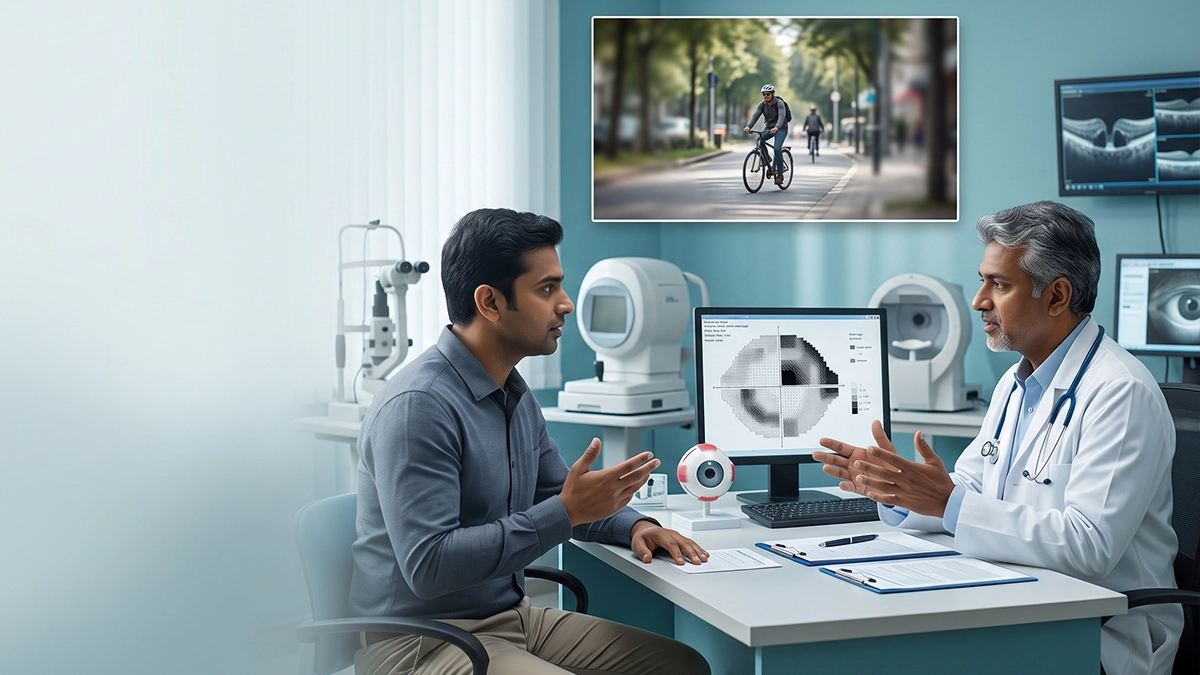
Peripheral vision is what we use to see things out of the corner of our eye, movement and change. It plays a role in safe walking, driving, balance and awareness of your environment. Peripheral vision may be impaired with glaucoma, retinal disease, optic nerve issues or neurological conditions. If you notice sudden or unexplained changes get an eye exam.
What Is Peripheral Vision?
Peripheral vision, what they also refer to as side vision, comes in mostly from the retinal areas outside the central macula. Central vision which is fine for reading and recognizing faces also has the job of identifying details. Peripheral eyesight may not be as detailed as the central eye but it does a great job of alerting us to motion and which objects are in our environment.
The visual field is all which is seen while the eyes are fixed on a single point. Each eye has its own field which in part also includes the field of the other eye. Central and peripheral vision together present us with a wide scope of our environment.
Why Is Peripheral Vision Important?
Peripheral vision, also known as the out of the corner of your eye kind of vision, allows a person to note approaching cars from the side, to avoid barriers, to navigate through crowded places and to move safely down stairs. Also it is what alerts you to motion before you actually turn your eyes toward an object.
Because they have poor detail in our peripheral vision as opposed to our central sight, which is very detailed, gradual changes go unnoticed. Also the brain may put in extra effort to make up for it which is especially true in the case of one eye having a better visual field.
| Everyday function | Role of peripheral vision | Possible effect of loss |
| Walking | Detects obstacles beside the path | Bumping into furniture or door frames |
| Driving | Notices vehicles and movement from the sides | Reduced awareness of surrounding traffic |
| Mobility | Supports spatial awareness | Difficulty moving through crowded areas |
| Low-light activity | Helps detect surrounding movement | Greater difficulty navigating dim spaces |
What Can Cause Loss of Peripheral Vision?
Several ophthalmic and neurological issues that affect peripheral vision. Glaucoma is a major player in this as the damage to the optic nerve may present before there is any noticeable impairment of central vision.
According to the National Eye Institute, glaucoma may show no symptoms at first; as it progresses, it can take away side vision. An analysis of India’s National Blindness Survey 2015–19 found that the disease caused visual impairment in 59.6 per 10,000 adults aged 50 years or older.
Retinitis pigmentosa has a progressive course which causes narrowing of the visual field. Retinal detachment may present as a sudden shadow or curtain, on the other hand optic nerve and brain disorders may present with specific areas of vision loss. It is also important for people that notice a sudden shadow to understand that a dark curtain in the field of vision is a matter which requires prompt attention.
Some less common causes relate to the nervous system or optic nerve. Relevant information includes vitamin B12 deficiency, vitamin B12 deficiency and vision, unilateral mydriasis causes and retrobulbar neuritis.
What Are the Warning Signs of Peripheral Vision Loss?
A person will begin to have trouble with spatial awareness; they may not see people approaching from the side or have issues with navigation and parking which in turn may also cause them to report that driving is a less enjoyable task. Also some report that their peripheral vision is shrinking or they are having black spots in their vision.
It is the case that a person may do well on a detail oriented visual test of the central vision at the same time they are losing peripheral vision. Sudden loss of side vision is a health emergency also when associated with flashes, new floaters, a curtain like shadow, severe headache, weakness, numbness, double vision or a drooping eyelid.
How Is Peripheral Vision Tested?
An ophthalmologist will often start with what is called confrontation testing which is a basic assessment of different parts of the visual field. For a more in depth map they will do a formal perimeter. In automated field testing the patient looks at a central target and reports when they see lights at various locations. Vasan Eye Care has a guide to the visual field test for glaucoma which details how repeat tests are used to identify and track field changes.
| Test | What it checks | Why it may be recommended |
| Visual field test | Central and peripheral light sensitivity | Detects missing or reduced areas of vision |
| Tonometry | Intraocular pressure | Supports glaucoma assessment |
| OCT | Retina and optic nerve structure | Identifies structural nerve or retinal changes |
| Dilated retinal examination | Peripheral retina and optic disc | Checks for retinal and optic nerve disease |
Testing may also include a glaucoma eye test or a detailed retina test, depending on the suspected cause.
Can Peripheral Vision Loss Be Treated?
Treatment varies by the base disease. Vasan eye care does not have a single treatment which reverses all types of peripheral vision loss. For glaucoma vasan eye care aims to stop further damage to the optic nerve. Retinal tears or detaching may require urgent retinal surgery. Neurological or optic nerve issues are best managed per their specific cause. Patients with unexplained field defects may require a neuro-ophthalmology assessment.
Early diagnosis matters because permanent damage to the retina or optic nerve may not be reversible.
Eye Care at Vasan Eye Care
Vasan Eye Care does a study of peripheral vision and visual field. From the reports of symptoms and what we find during the exam we may recommend perimetry, OCT, eye pressure measurement, retinal exam or other tests.
Persistent, sudden or atypical changes in peripheral vision should be reported to a doctor. An ophthalmologist may identify the issue to be with the retina, the optic nerve, eye pressure or the visual pathway and will recommend proper care.
Frequently Asked Questions
1. Can peripheral vision be improved?
Normal peripheral vision does not usually improve. If a treatable condition is the cause of lost side vision early treatment may help save what is left of the function. What happens in terms of recovery depends on the cause and if permanent retinal or optic nerve damage has occurred.
2. Is peripheral vision the same as the visual field?
They are related but not the same. The visual field is what is seen when they look straight ahead. Periphery vision mainly reports to the outer areas of that field which is used less for detail sight.
3. Why can glaucoma affect side vision first?
Glaucoma attacks the optic nerve and also at first shows in the form of specific visual field defects which may present before there is an issue with central vision. You may have good vision in the center and yet be losing your peripheral vision that is the reason why routine glaucoma screening is so important.
4. When is loss of side vision an emergency?
Sudden vision issues which include flashes and many new floaters, a curtain like shadow, severe headache, weakness, double vision and other neurological symptoms require immediate assessment which may be a sign of retinal or neurological disease.
References
- National Eye Institute — Glaucoma
https://www.nei.nih.gov/eye-health-information/eye-conditions-and-diseases/glaucoma? - Glaucoma Blindness and Visual Impairment in India: Findings From the National Blindness Survey
https://pubmed.ncbi.nlm.nih.gov/42611182/?