
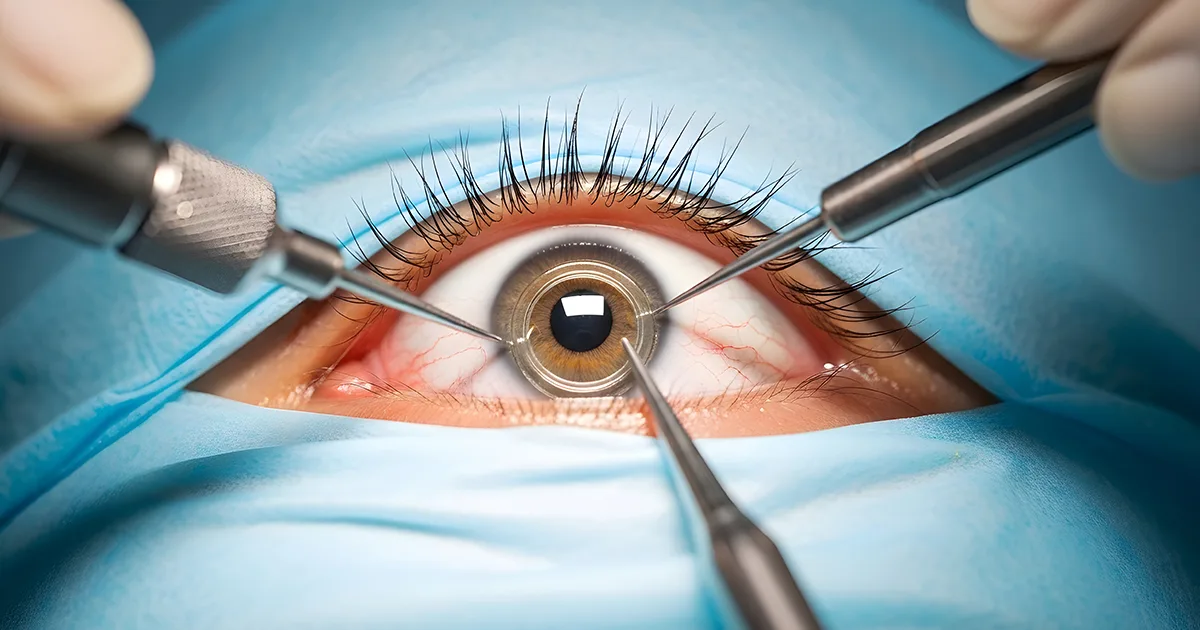
Cataract surgery restores clear vision for most people within a day or two. Sometimes, months or years later, patients notice that their vision has become hazy again, much like the original cataract. The usual explanation is not a “recurrence” of cataract, but a condition called posterior capsular opacification, often shortened to PCO. It is the single most common late “complication” of cataract surgery, and the treatment is a quick, painless laser.
This guide walks you through what PCO is, why it happens, and how it is treated.
What Is Posterior Capsular Opacification?
During cataract surgery, the cloudy natural lens is removed and a clear intraocular lens (IOL) is placed inside the thin natural capsule of the lens. The back surface of this capsule, called the posterior capsule, is left in place to hold the new lens.
Over time, residual lens epithelial cells can migrate and multiply on this posterior capsule, causing it to become cloudy. The clouded capsule blocks light reaching the retina, making vision feel hazy, just like a cataract.
PCO is not a return of the original cataract. It is a separate, usually easily treatable process.
What Are the Symptoms of PCO?
- Gradually worsening blur
- Glare and halos around lights, especially at night
- Dull colours
- Reduced clarity for reading or screens
- Prescription changes feeling less effective
- Sense that “the cataract has come back”
- Difficulty with night driving
- Fluctuating vision
The feel is often very similar to the original cataract.
How Long Does It Take for PCO to Develop?
PCO can appear:
- A few months after surgery
- Most commonly between 1 and 5 years
- Occasionally more than 10 years later
- Sometimes earlier in certain IOL designs and in younger patients
The rate varies with IOL material, design, surgical technique, and individual factors.
Can PCO Happen Suddenly?
Not usually. PCO develops gradually as cells accumulate. Some patients feel that it appears “overnight” because small changes can be imperceptible until they reach a certain level. If vision suddenly worsens significantly, other causes such as retinal detachment, macular oedema, or inflammation should be considered, and a prompt review is essential.
What Does PCO in the Eye Feel Like?
- A gentle return of the cloudy feel from before cataract surgery
- Colours look a little dulled
- Bright lights start to scatter
- Fine detail becomes harder
- Reading may need stronger light
- Night driving becomes less comfortable
- No pain or redness
- No flashes or floaters (those would suggest a different issue)
What Causes PCO?
- Residual lens epithelial cells growing on the capsule
- Surgical technique
- IOL material and design
- Younger age at surgery
- Diabetes
- Certain systemic conditions
- Ongoing mild intraocular inflammation
Modern IOL designs have reduced PCO rates significantly, but the condition remains common over years.
How Is PCO Diagnosed?
A short visit at an eye hospital confirms the diagnosis:
- Visual acuity
- Slit-lamp examination
- Dilated examination of the lens and capsule
- Retinal assessment to rule out other causes of blur
- OCT of the macula in selected cases
- Comparison with previous visit records
How Is PCO Treated?
YAG laser capsulotomy
The standard treatment.
- Painless
- No incision
- No injection
- Done in outpatient clinic
- Takes 5-10 minutes
- Patient sits at a slit lamp-like device
- Laser creates a small clear opening in the cloudy capsule
- Vision often improves within hours
Procedure steps
- Numbing eye drops
- A contact lens placed on the eye to focus the laser
- Laser pulses open the cloudy capsule centrally
- Contact lens removed
- Brief rest
- Short-term anti-inflammatory drops
After the laser
- Mild floaters may appear in the first week
- Occasional mild eye pressure rise (usually self-limited; managed with drops)
- Most patients return to normal activities the next day
- Glasses prescription may need minor refinement
Risks and precautions
- Very low risk of retinal detachment, more relevant in highly myopic patients
- Rare rise in eye pressure
- Small chance of macular oedema
- Very rare IOL damage
These risks are low, and the procedure is considered safe for most patients.
Can PCO Clear Up on Its Own?
No. PCO does not clear on its own. It tends to remain stable or worsen gradually. YAG laser capsulotomy is the reliable treatment. Supportive eye treatments such as lubricating drops do not remove the opacification.
PCO in Special Situations
Diabetic patients
- Higher incidence
- Treat any underlying retinopathy first
- Careful follow-up after laser
Young patients
- Higher PCO rate because of more active epithelial cells
- Timing of laser is judged carefully
Post-retinal surgery eyes
- Laser timing and settings are adjusted
- Coordinated decision with the retinal surgeon
Post-vitrectomy eyes
- Careful laser technique
- Assessment of remaining vitreous
Patients with glaucoma
- Eye pressure is monitored closely
- Follow-up drops may be adjusted
Prevention
Complete prevention is not possible, but several factors reduce PCO:
- Modern square-edge IOL designs
- Hydrophobic acrylic lenses
- Thorough cortical cleaning during surgery
- Proper capsular polishing
- Well-controlled systemic conditions
Talk to your surgeon about the most appropriate IOL for your eyes.
When Should You See a Doctor?
Book a review if:
- Vision is dulling months or years after cataract surgery
- Glare and halos are returning
- Prescription is shifting
- You feel cataract “has come back”
- You have diabetes with stable retina and notice blur
- You are preparing for second-eye surgery and have PCO-like symptoms in the first eye
Urgent review if you notice sudden vision loss, flashes, or curtain-like shadow, as these suggest other conditions.
PCO Care at Vasan Eye Care
Vasan Eye Care has been looking after patients across India since 2002, now as part of ASG Enterprises. With more than 150 super-speciality centres, 500+ ophthalmologists, and over 5,000 trained eye care staff, the team handles PCO diagnosis and YAG laser capsulotomy daily. A typical visit includes examination, laser procedure (where indicated), and short follow-up. For patients who also need cataract surgery in the other eye, combined planning is seamless. Supportive laser cataract surgery and cataract eye surgery discussions are integrated into the same visit where needed.
Key Takeaways
- PCO is a clouding of the thin membrane behind the intraocular lens after cataract surgery.
- Symptoms mimic cataract (blur, glare, dullness) but develop gradually.
- It typically appears months to years after surgery.
- Treatment is a quick YAG laser capsulotomy in the outpatient clinic.
- The laser is painless, takes minutes, and improves vision within hours.
- PCO does not clear on its own and is not a recurrence of cataract.
Frequently Asked Questions (FAQs)
PCO usually develops gradually as cells migrate and multiply on the posterior capsule. Some patients feel it has appeared suddenly when gradual changes finally cross a threshold and affect daily vision. If vision drops quickly and severely, a prompt review is needed to rule out other issues like retinal detachment, macular oedema, or inflammation rather than PCO alone.
It feels much like the original cataract: gradual blur, glare and halos around lights, dullness of colours, reduced detail for reading, and fluctuating clarity. There is no pain, redness, flashes, or floaters. If any of these serious symptoms appear, the cause is likely something different and needs urgent review.
PCO most commonly appears between 1 and 5 years after cataract surgery, though it can occur within a few months or many years later. Modern hydrophobic IOL designs with a square edge have reduced the overall rate, but PCO remains common. The timing also depends on age, diabetes, and individual biology.
No, PCO does not clear up on its own. The cloudy capsule remains or gradually worsens. A short YAG laser capsulotomy is the standard treatment. It is outpatient, painless, takes only a few minutes, and typically improves vision within hours. Skipping treatment leaves vision dull and unnecessarily reduced.
References
- American Academy of Ophthalmology. Posterior Capsular Opacification. https://www.aao.org/eye-health/diseases/posterior-capsule-opacification
- National Center for Biotechnology Information. Posterior Capsule Opacification. https://www.ncbi.nlm.nih.gov/books/NBK585085/
- National Eye Institute. Cataracts. https://www.nei.nih.gov/learn-about-eye-health/eye-conditions-and-diseases/cataracts
- WebMD. Life After Cataract Surgery. https://www.webmd.com/eye-health/cataracts/life-after-cataract-surgery