
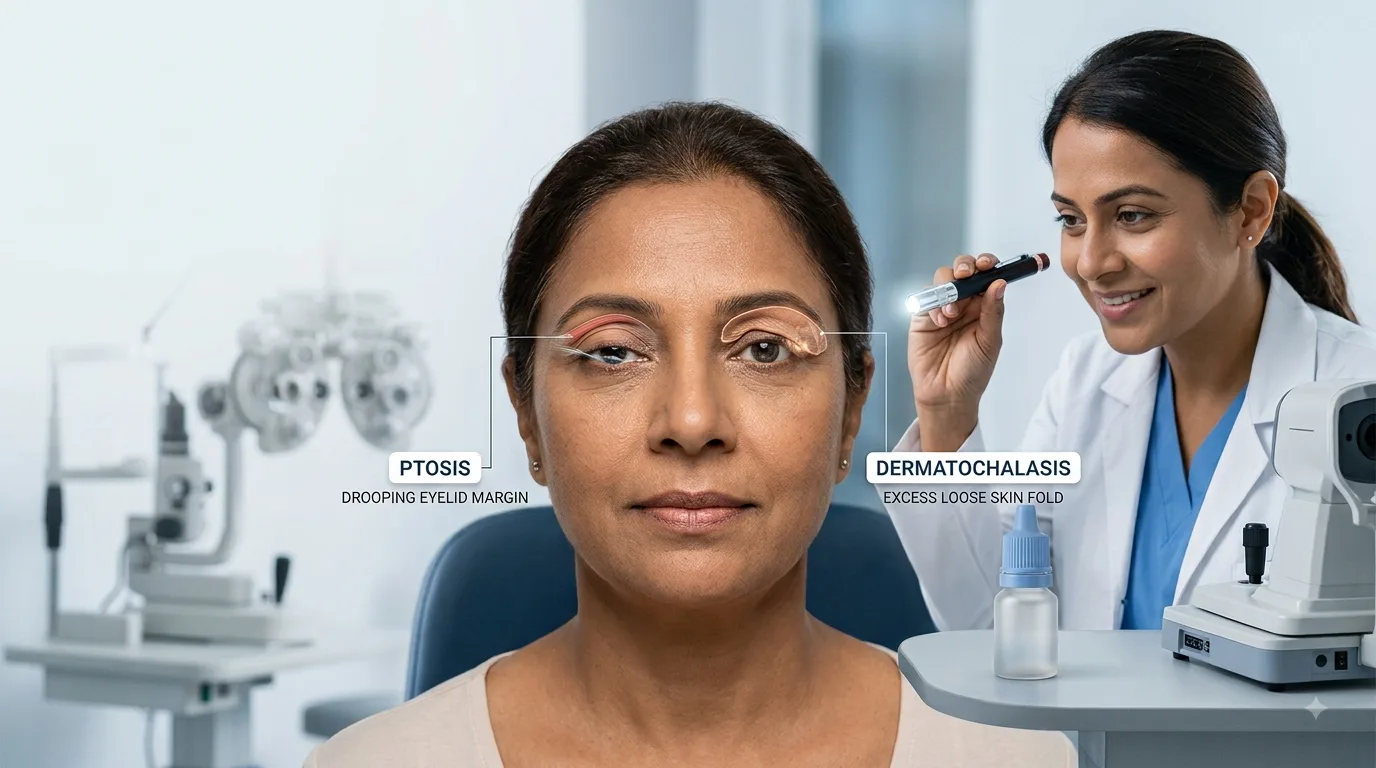
A term which is used for what we see as a “droopy eyelid” is in fact a group of two different conditions. In ptosis the issue is with the muscle of the upper eyelid which causes it to sit too low. In dermatochalasis we see over-folds of skin which may or may not be associated with the eyelid muscle which is otherwise in a normal position. Also because the causes and which in turn determine the treatment for each condition are different, an accurate eye exam is a must.
What Is Ptosis and What Is Dermatochalasis?
Ptosis of eyelid is what we use to describe an abnormally low upper-eyelid margin. This usually comes up when the muscle which raises the eyelid, the tendon, or the control nerves are not working right. Ptosis may affect one or both eyes and it also may be present from birth or develop at a later time. MedlinePlus reports that muscle weakness, nerve damage, aging, injury, and certain diseases can cause eyelid drooping:
https://medlineplus.gov/ency/article/001018.htm
Dermatochalasis is a term for which we see loose and redundant eyelid skin and at times the underlying muscle play a role. The lid margin may still be at it’s normal position but in many cases we see an overhanging appearance or impairment of the upper field of vision. While age is a large factor in the loss of elasticity which brings this about, also in play are genetic factors and repeated rubbing. The National Library of Medicine gives out a clinical overview at.
https://www.ncbi.nlm.nih.gov/books/NBK537078/
Both conditions may occur together. Removing excess skin alone will not fully correct a low lid margin, while lifting the eyelid may not resolve substantial skin hooding.
| Feature | Ptosis | Dermatochalasis |
| Main problem | Weak or stretched eyelid-lifting mechanism | Loose, excessive eyelid skin |
| Typical appearance | Lid margin sits low and may cover the pupil | Skin folds over the eyelid crease |
| Possible visual effect | Pupil blockage or reduced upper field | Hooding reduces upper or side vision |
| Common procedure | Ptosis surgery | Upper-eyelid blepharoplasty |
Causes and Risk Factors
Congenital ptosis is a result of abnormal development of the eyelid lifting muscle. As for acquired ptosis it may present when the levator tendon stretches due to age or after trauma or eye surgery. Also it may be associated with nerve or muscle disorders which include third nerve palsy, Horner syndrome or myasthenia gravis. Urgent assessment is required in the case of sudden drooping.
Dermatochalasis is a sign of age and reduced skin elasticity. Also at play may be genetic factors, chronic swelling, eye rubbing, and changes around the brow which in turn may impact the extent of the condition. Report to your eye doctor if you have dry eye, thyroid issues, are on blood thinners, had prior eyelid procedures, or have had LASIK or cataract surgery as these will play into the treatment plan.
Recognising Ptosis Symptoms
Common ptosis symptoms are a dropped lid, difficulty in keeping the eye open, a reduction in upper field of vision, raised eyebrows, forehead strain, or head tilted back. In kids, large scale ptosis may impede visual development and cause amblyopia when the visual axis is blocked.
Dermatochalasis which in most cases produces heavy or hooded upper lids, skin which covers the eyelashes, trouble with seeing over top of things, irritation in the folds, or a tired look. Also as both of these and that which is present at birth can affect vision, appearance is not in itself enough for a diagnosis.
How Is the Difference Diagnosed?
An ophthalmologist will ask at what point the drooping started, what time of day it varies, and if there is a presence of double vision, headache, weakness, unequal pupils, or prior surgery. The exam may include evaluation of eyelid height, levator function, brow position, pupils, eye movements, tear film, and visual fields. Past photos may be looked at to determine if the change is recent.
Children should be tested for refractive errors, squint, and amblyopia. In adults present with sudden unilateral drop in muscle tone, a dilated pupil, new double vision, severe headache, facial weakness, arm weakness, or speech difficulty take to the emergency to rule out a neurological cause.
Ptosis Treatment and Dermatochalasis Care
Appropriate ptosis treatment is based on the cause, severity, muscle function, age, and degree of visual impact. In the case of mild and stable ptosis we may choose to just monitor. Should a secondary health issue be the reason then that is to be addressed first. For structural ptosis which produces visual or functional issues surgery is often the approach.
During ptosis surgery the surgeon will improve or reposition the eyelid lift mechanism. For dermatochalasis we usually perform blepharoplasty which is removal of precisely what is excess skin and also when needed works on the underling tissue. When both present we may recommend combined or staged surgery.
| Clinical finding | Usual management approach | Key consideration |
| Mild, stable ptosis | Monitoring and review | Watch for progression or new symptoms |
| Ptosis affecting function | Ptosis surgery after evaluation | Technique depends on levator function |
| Excess skin with normal lid height | Blepharoplasty | Dry eye and safe lid closure must be assessed |
| Ptosis with dermatochalasis | Combined or staged correction | Both lid position and skin excess need attention |
Recovery, Follow-Up, and Management
Temporary puffiness, discoloration, tightness, tearing, or dryness may present after eyelid surgery. Follow the instructions for use of cold compresses, head elevation, prescribed drops or ointment, wound care and at which to rest. See immediate return to your doctor if you have severe pain, sudden loss of vision, very marked redness, or widespread swelling.
Age related ptosis and dermatochalasis does not always have preventable causes. We can manage irritation, advise against repeat rub of the eyes, recommend sun protection, and report back at follow up visits which in turn supports health of the lid but we do not see reversal of the muscle weakness or skin excess once they are present.
When Should You See an Eye Specialist?
Book in for an assessment of eyelid drooping which is new, worsening, uneven, related to reading or driving or which causes forehead strain. In children with drooping an early exam is recommended. A specialist at an eye hospital will be able to tell the difference between ptosis and drooping from skin or brow issues and will put together a personal eye treatment in India.
Conclusion
Ptosis and dermatochalasis may appear the same but they really differ in which they affect the lid position vs. excess skin. Proper diagnosis is key to better care. See a certified ophthalmologist or go to a reputable eye hospital for a personal lid and vision assessment.
Frequently Asked Questions
Some cases improve with treatment of the base medical issue, while mild and stable drooping may only require watchful waiting. However we see that creams, exercises, and home remedies do not in fact reverse structural ptosis or established dermatochalasis. An ophthalmologist should be consulted to determine if non surgical options are a go.
Ptosis is also not the result of stroke in many cases. As for the report of sudden eyelid droop with which also the facial or arm weakness is present, difficulty in speaking, very bad headache, unequal pupils, or double vision — that is an emergency. Go to the emergency room right away instead of waiting for a routine appointment.
Yes. Ptosis of eyelid which may cover part of the pupillary area or reduce the amount of the upper visual field that is seen. Kids may raise their eyebrows or tilt their head in an attempt to see, also severe congenital ptosis may interfere with normal visual development.
Ptosis which may present at any age. At birth or in infancy we see congenital ptosis which is present from birth or in early life, on the other hand acquired ptosis which is more so in adults is due to aging, injury, surgery, or neurological and muscular conditions.
The cost varies with the cause, which in turn may be one or both eyelids, the surgical approach used, hospital resources, tests ordered, anesthetic type, and insurance coverage. A personal evaluation is required before we may give a reliable estimate for ptosis surgery.