
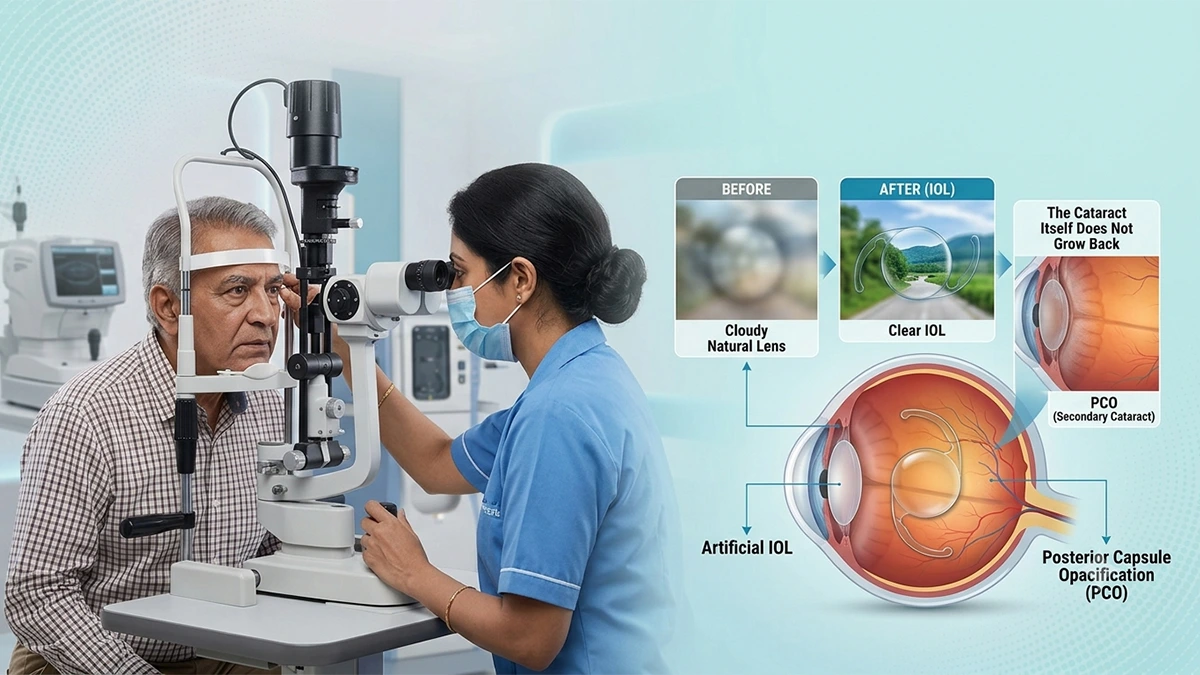
Cataract surgery does in fact greatly improve vision by removing the eye’s cloudy natural lens and putting in a clear artificial intra ocular lens also known as IOL. Post op many people report they see more clearly, colors are more vivid and they have less trouble with day to day activities.
However some people report to see that their vision has gone blurry again after a while which in turn brings up an issue of: can cataracts come back after surgery?
The answer is no. Upon removal of the cloudy natural lens the same cataract will not return. But some patients do experience what is in common use a secondary cataract. The medical term for this is posterior capsule opacification or PCO.
Although it may present like a cataract after surgery, a secondary cataract is a different entity which usually responds well to treatment.
Why Cataracts Cannot Grow Back
A cataract forms when there is a change in the eye’s natural lens’ proteins which in turn causes the lens to become cloudy. In cataract surgery an Eye specialist removes that cloudy lens and puts in an artificial lens.
Since the natural lens was removed that issue does not present itself again.
However during surgery we leave in place some of that which was the original thin capsule which held the natural lens. This capsule also plays a role in securing the artificial intraocular lens in the eye.
Over time what may happen is that the cells surrounding this capsule will grow over its posterior surface which in turn will cause clouding. This is PCO or secondary cataract.
What Is a Secondary Cataract?
A secondary cataract does not in fact present as a new cataract. It is a clouding of the posterior capsule at the back of the artificial lens.
The artificial lens does for the most part stay clear. What we see is a problem when the capsule behind it which is what is supposed to protect the lens, fails to do so and instead interferes with the light which is meant to go to the retina.
This may present with symptoms which are very much like those of pre op state.
The National Eye Institute reports that which we know as posterior capsule opacity is a condition which may present itself post cataract surgery. It usually may be treated with a YAG laser procedure.
Cataract vs Secondary Cataract
| Feature | Original Cataract | Secondary Cataract / PCO |
| What becomes cloudy? | Natural lens of the eye | Capsule behind the artificial lens |
| When does it occur? | Usually develops gradually before cataract surgery | May develop months or years after cataract surgery |
| Is it a new cataract? | Yes, it involves the natural lens | No, it is posterior capsule opacification |
| Common symptoms | Blurred vision, glare, faded colours and poor night vision | Cloudy vision, glare, reduced contrast and blurred vision |
| Common treatment | Cataract surgery with artificial lens implantation | YAG laser posterior capsulotomy |
| Is another cataract operation usually needed? | Surgery is used to remove the cataract | Usually no; laser treatment may be sufficient |
What Are the Symptoms of PCO?
Symptoms of PCO may present slowly. Post procedure a person may experience 20/20 vision but at a later date notice which changes to a blurry vision.
Common symptoms are blurred out of focus vision, increased sensitivity to light, night time vision impairment, reduced color definition and difficulty with visual acuity in bright settings.
Some report having a second cataract after surgery which in turn presents with the same type of symptoms that they had with their first cataract.
However in many cases of blurred vision post cataract surgery it is not a result of a secondary cataract. Dry eye, changes in spectacle power, retinal issues, corneal problems, glaucoma and other eye diseases may also play a role.
For this reason any person with persistent vision changes should see an Eye doctor instead of assuming that the cataract has returned.
How Soon Can Secondary Cataract Develop?
There is not a set timeline for PCO. It may present itself months post cataract surgery or may develop over several years.
Some patients do not experience clinically significant posterior capsule opacification.
The American Academy of Ophthalmology reports that at times after cataract surgery the posterior capsule which is behind the artificial lens may cloud over.
Regular Eye care exams are indeed a good idea, in particular when vision begins to drop after what had been a successful cataract surgery.
How Is PCO Diagnosed?
An ophthalmologist at the time of a full eye exam is usually able to diagnose PCO.
May the doctor test visual acuity and look at the artificial lens and the posterior capsule with the use of special equipment. At times the retina, the optic nerve, the cornea and eye pressure also are looked at.
How Is Secondary Cataract Treated?
When a secondary cataract which is affecting vision appears the most used treatment is of the type Nd:YAG laser posterior capsulotomy.
During the procedure an ophthalmologist will use a special laser to make a small incision in the cloudy posterior capsule that is a product of the cataract development. This in turn opens a clear passage for light to reach the retina.
The process does not include the out removal of the artificial lens and is a different thing from a second cataract operation.
Most folks go home after the procedure, though for some the recovery instructions will be different.
The National Eye Institute reports that YAG laser capsulotomy is used to create an opening in the cloudy capsule which is a result of secondary cataract which in turn affects vision.
Is YAG Laser Treatment Safe?
YAG laser posterior capsulotomy is a routine procedure that also is very much so for the treatment of symptomatic PCO.
Also, all medical procedures carry some risk. Issues may present as inflammation, raised eye pressure and the growth of new floaters. Less common are issues with the retina or artificial lens.
An Eye specialist will perform an exam beforehand to determine if you are a candidate for laser treatment.
Patients should follow up with their ophthalmologist post treatment and report in to emergency for a sudden increase in floaters, flashes of light, a floater like shadow over the vision, severe pain or a large scale vision loss.
Can PCO Return After YAG Laser Treatment?
After we achieve an adequate opening with the YAG laser in the cloudy central part of the posterior capsule, that area generally does not cloud up again in the same way.
If vision does become blurred at a later date a full eye exam is important.
The cause may have nothing to do with the original secondary cataract. As for the retina, cornea, optic nerve, eye pressure, or spectacle prescription issues which also play a role in how well one sees.
Your Eye doctor is able to determine the root cause and will present appropriate Eye treatments options when necessary.
When Should You Visit an Eye Doctor?
If you notice that your vision is gradually deteriorating after cataract surgery which at one point improved, you should have your eyes checked.
It also sees that you take in medical help at the early stage which is reportable for sudden vision loss, flashes of light, a large increase in floaters, eye pain or a dark shadow in your field of vision.
At Vasan Eye care if you are a patient which has had a change in your vision post cataract surgery you may see an ophthalmologist in for an appropriate eye exam. The doctor is able to determine if the symptoms are from PCO, another post op issue or an unrelated eye condition.
Conclusion
A cataract does not in fact come back after the cloudy natural lens is removed via surgery. If some time later your vision does become impaired again it may be a secondary cataract, known in the medical field as PCO.
Unlike what we see with primary cataract, in the case of posterior capsule opacification it is the capsule which has the artificial lens that is affected instead of the natural lens. When this greatly impacts vision, we may recommend YAG laser posterior capsulotomy.
If you see blurred or cloudy vision post cataract surgery, we recommend you see an Eye specialist rather than assume your cataract has returned. It is also important to have a proper exam in which the cause can be determined and which will help to set out the best plan of action.
Frequently Asked Questions
1. Can cataracts come back after cataract surgery?
No. Once after removal of the cloudy natural lens during cataract surgery the same cataract will not return. As for later development of cloudy vision that may present it is instead a secondary cataract, also known as posterior capsule opacification.
2. What is a secondary cataract?
A secondary cataract which is the clouding of the thin capsule that is behind the artificial lens post cataract surgery. This is also known as posterior capsule opacification or PCO. It is not a true regrowth of the original cataract.
3. How long after cataract surgery can PCO develop?
PCO may present itself a few months to several years post cataract surgery. The time frame is variable for each individual and in some patients it may not be an issue at all.
4. Does PCO require another cataract operation?
Usually not. When PCO affects vision what we see is that it is often treated with YAG laser posterior capsulotomy. The procedure which we perform is to create an opening in the cloudy capsule at the same time the artificial intra ocular lens which in most cases is still in place.
5. Is blurry vision after cataract surgery always PCO?
No. A cataract after surgery is just one reason for blurred vision. Dry eye, retinal issues, glaucoma, corneal conditions and changes in spectacle prescription also play a role. An ophthalmologist will determine the exact cause.