
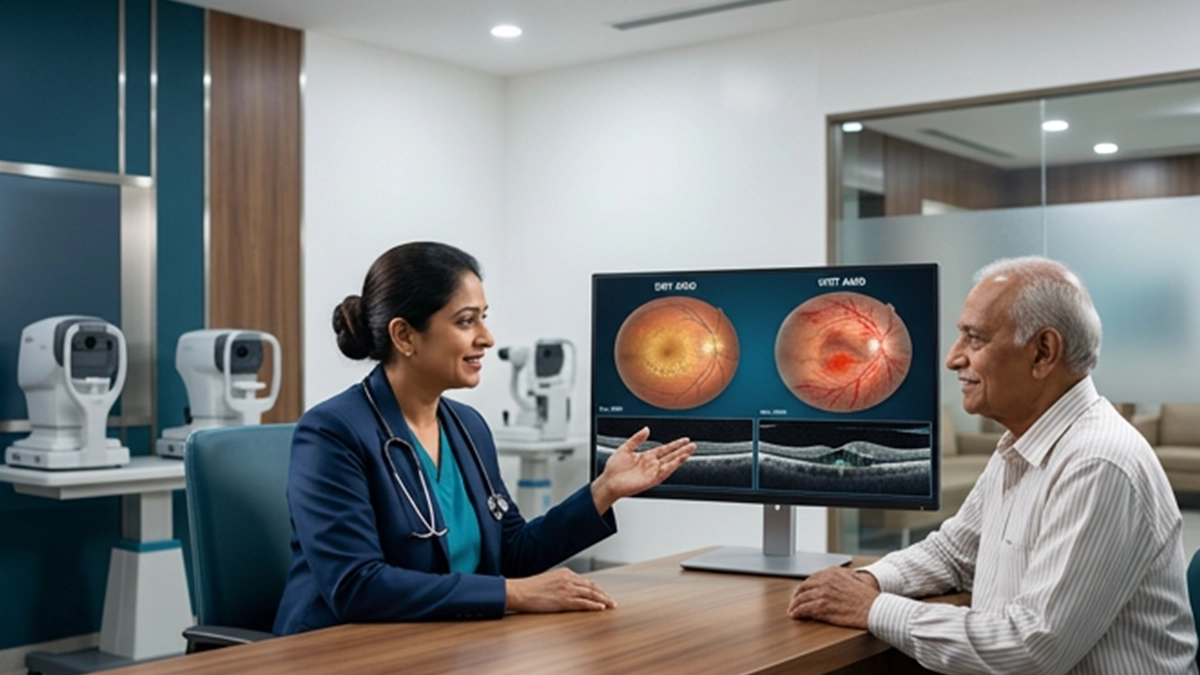
Wet vs dry macular degeneration are terms which describe the two types of macula damage. In dry form the disease progresses slowly, in wet form there is a more rapid loss of central vision. New onset of distortion, a dark spot, or sudden changes in vision which require immediate evaluation by an ophthalmologist.
What Is the Difference Between Wet and Dry Macular Degeneration?
Age related macular degeneration (AMD) which affects the macula and may cause issues with reading, recognizing faces and with driving. AMD eye disease may present in one or both eyes. Also your age increases risk of this; some studies also point to smoking and a family history as risk factors.
In terms of wet vs dry macular degeneration the dry form includes changes in the macular tissue and deposits of drusen under the retina. The wet form develops when abnormally blood vessels grow under or in the retina and cause leakage of fluid or blood.
Around 75% of people report having the dry form of AMD which is reported by the American Academy of Ophthalmology. In early stages symptoms may not present at all which is why regular eye exams are very important. Also the wet vs dry macular degeneration present differently in the retina and also in what treatment is required.
Symptoms and Macular Degeneration Stages
Dry macular degeneration symptoms early stages may not present with any symptoms. As the disease progresses central vision may blur, you may require more light for reading, and colors may appear more dull. These changes may happen slowly and go unnoted.
Wet forms of disease present with rapid progress. Straight lines may have a wavy appearance and letters may be distorted, also a grey out or blank spot may appear at the center of vision. At first sign of these symptoms a prompt assessment is needed.
Macular degeneration stages in dry AMD are early, at which point it progresses to intermediate and finally late. Any stage of dry may progress to wet AMD. Knowing the macular degeneration stages is what allows an ophthalmologist to determine monitoring and treatment.
| Type or stage | Common features | Usual management |
| Early dry | Often no symptoms; drusen may be present | Retinal examination and monitoring |
| Intermediate dry | Mild central blur or difficulty seeing in dim light | Follow-up; discuss AREDS2 supplements if suitable |
| Late dry | Central vision difficulties; geographic atrophy may occur | Low-vision support and specialist assessment |
| Wet | Leaking abnormal vessels, distortion or faster vision loss | Prompt retinal assessment and possible anti-VEGF injections |
How Is Macular Degeneration Diagnosed?
An ophthalmologist does a vision test and will look at the retina which at times requires to dilate the pupils. They also have Optical Coherence Tomography (OCT) which produces very detailed retinal images and which in turn may show up fluid, swelling or tissue changes. Also use retinal photography or angiography which also play a role in diagnosis.
An accurate diagnosis between wet vs dry macular degeneration is what guides appropriate care. Also other conditions affect central vision. In case of cystoid macular edema the retina experiences fluid related swelling which in turn may cause blurred vision. A specialist is able to distinguish it from AMD through exam and imaging.
A nuclear cataract which affects the central portion of the natural lens and may gradually cause blurring of vision. A cortical cataract which affects the lens periphery may cause glare. Sudden vision loss is a sign of an emergency which includes eye stroke and requires prompt medical attention.
Treatment Options for Wet and Dry AMD
Dry AMD often includes a regimen of monitoring and adopting a healthy lifestyle which may involve the control of risk factors like smoking and high blood pressure. In some cases of intermediate AMD which present with certain symptoms an ophthalmologist may bring up the topic of AREDS2 formula supplements. It is not for all. At the advanced stage it may be that use of low vision aids and support is required.
Wet macular degeneration treatment is usually by means of anti-VEGF medications which are injected into the eye. see reports of repeated doses and follow up visits. Also reported is that treatment of Wet macular degeneration treatment which does what it can to stop further damage and may in some cases stabilize or even improve vision, yet full recovery is not a given.
Treatment of wet vs dry macular degeneration is based in what they see in the retina, the stage of the disease and the patient’s vision. For wet disease that usually see in to the retina right away with treatment, for dry which do stage by stage monitoring.
When Should You Seek Medical Attention?
Seek out prompt ophthalmic care if you notice that straight lines are appearing bent, your central vision is changing, or a new dark spot has appeared. Dry macular degeneration symptoms may present with other conditions which is why an eye exam is required for diagnosis.
Sudden loss of vision is a medical emergency. As for age related macular degeneration some may use an Amsler grid to monitor each eye as recommended by an ophthalmologist but that does not take the place of regular exams. Giving up smoking, eating a healthy diet, staying active and controlling blood pressure supports in overall health but does not guarantee to prevent AMD eye disease.
Eye Care at Vasan Eye Care
Vasan Eye Care which provides ophthalmic assessment for vision issues. They have retina services which come into play when symptoms point to a retinal condition. An ophthalmologist will go over the diagnosis, talk about macular degeneration stages and present a follow up plan. Patients may bring up what options are available after the retinal assessment.
Frequently Asked Questions
1. Can dry macular degeneration turn into wet macular degeneration?
Yes. Dry AMD may progress to wet AMD although this is not the case for all. Symptoms may include wavy vision, central blind spot or a blank field which should see you seek out an eye specialist right away.
2. Does dry macular degeneration always cause symptoms?
No. Early in the course of the disease there may be no symptoms. Routine eye exams can identify changes which if left untended may affect your daily vision.
3. Is there a cure for wet macular degeneration?
There is no definitive cure, but in the case of wet macular degeneration treatment they see that anti-VEGF injections may slow the leak and save vision. Ongoing care is important because the disease may reappear and also it will require more treatment.
4. How often should someone with AMD have an eye examination?
The interval is based on the type, stage, symptoms and treatment plan. An ophthalmologist determines the schedule. Sudden or worsening vision changes require prompt assessment.
References
- National Eye Institute — Age-Related Macular Degeneration
https://www.nei.nih.gov/eye-health-information/eye-conditions-and-diseases/age-related-macular-degeneration - American Academy of Ophthalmology — Understanding Macular Degeneration
https://www.aao.org/eye-health/diseases/amd-macular-degeneration