
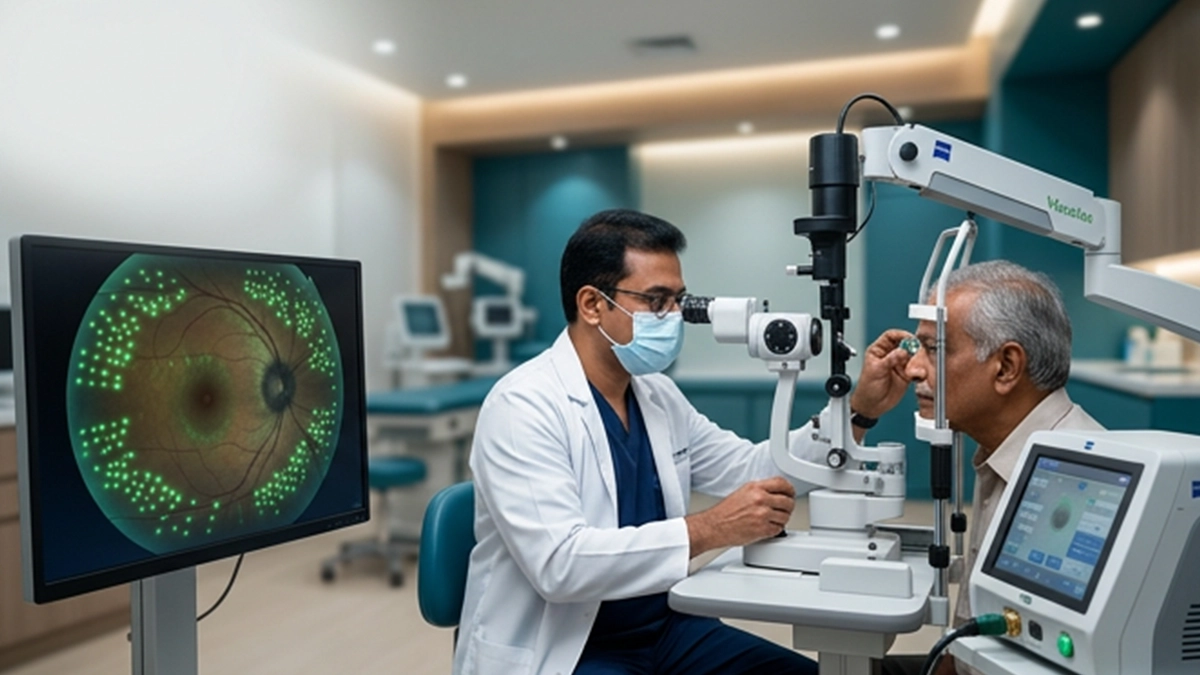
Panretinal photocoagulation (PRP) is a retinal laser procedure that we use for PDR which is a late stage of diabetic retinopathy at which point there are very fragile new blood vessels growing on the retina or optic disc. What the treatment does is put many laser spots in the periphery of the retina. This in turn helps to reduce the growth of abnormal vessels and also reduces the risk of serious bleed and retinal tears.
What Is Panretinal Photocoagulation?
Panretinal photocoagulation also goes by scatter laser treatment. In the course of the procedure an ophthalmologist will apply a controlled series of laser spots to wide areas of the peripheral retina which at the same time will protect the central macula.
This form of retinal laser photocoagulation decreases the oxygen demand of retinal tissue which has poor perfusion. Also it reduces production of factors which stimulate abnormal blood vessel growth which includes vascular endothelial growth factor (VEGF).
A PRP laser eye procedure may require multiple sittings. The number and timing of the treatments depends on the stage of retinal disease and the patient’s response.
Why Is PRP Laser Used in Diabetic Retinopathy?
Long term diabetes may produce retinal damage of the tiny blood vessels. At the early stage of the disease we may see NPDR, microaneurysms, bleeding, exudation and decreased retinal circulation.
As the disease progresses abnormally new vessels may form. At this stage we call it proliferative diabetic retinopathy. These fragile vessels may bleed into the vitreous or cause scar tissue and tractional retinal detachment. Panretinal photocoagulation is mostly used when proliferative changes put at risk the vision. In some severe cases of nonproliferative which may progress to proliferative retinopathy the ophthalmologist may also use a retina laser for diabetes based on the risk of progression and individual patient’s condition.
India’s in 2015 19 had 16.9% of adult diabetics which they studied at 50 years and over with diabetic retinopathy. Also 3.6% of study participants reported sight threatening diabetic retinopathy.
| Diabetic retinal stage | Typical retinal finding | Role of PRP |
| Mild–moderate NPDR | Microaneurysms or retinal haemorrhages | Usually not required |
| Severe NPDR | Extensive vascular damage or ischaemia | May be considered in selected cases |
| PDR | Abnormal new blood vessels | Major indication for PRP |
| Diabetic macular oedema | Fluid affecting the macula | Other treatments often take priority |
How Is Panretinal Photocoagulation Performed?
Before the panretinal photocoagulation, an ophthalmologist uses dilated pupils to look at the retina. OCT or fluorescein angiography also can be used in evaluation of macular swelling, retinal circulation, and abnormal vessels. During the PRP laser eye procedure we use anesthetic eye drops which also ease pain. Also a contact lens is used for better laser focus. The patient will see repeat flashes as the ophthalmologist treats the peripheral retinal areas.
The National Eye Institute reports that out at office based settings is where scatter laser treatment takes place and may be over several sessions. As for the laser treatment for diabetic retinopathy it is mostly for the purpose of which is to prevent that which is more severe in terms of vision loss instead of reversing damage done to the retina by the advanced disease.
Patients seeking more information about the technique can also review Vasan Eye Care’s guide to retinal laser photocoagulation and its overview of retina laser treatment.
What Are the Benefits and Limitations of PRP?
The results of the Diabetic Retinopathy Study showed that large scale scatter photocoagulation reduced by 50% or more the risk of severe visual loss in eyes with high grade proliferative disease. As to panretinal photocoagulation it is known that there are trade-offs. Widespread treatment may improve central vision at the expense of peripheral and night vision. Also some people report a change in color perception or contrast.
| Treatment | Main purpose | Important consideration |
| Panretinal photocoagulation | Controls widespread retinal neovascularisation | May affect side or night vision |
| Anti-VEGF injections | Suppress VEGF and abnormal vessels | Often requires ongoing follow-up |
| Focal/grid laser | Targets selected areas of leakage | Different from PRP retina treatment |
| Vitrectomy | Treats haemorrhage or tractional complications | Requires intraocular surgery |
A PRP retina treatment may therefore form only one part of diabetic eye care. Anti-VEGF injections or treatment for macular oedema may also be required.
What Happens After PRP Laser Treatment?
After a PRP laser eye treatment temporary blurred vision, glare or mild discomfort may present. It is at the discretion of the patient that driving may have to be put on hold until vision improves to a safe level.
Follow up is very important as panretinal photocoagulation does not cure the underlying diabetes. Also it is possible that you may require further retina laser for diabetes, injections or surgery if abnormal vessels are still active. Sudden vision loss, many new floaters or a curtain like shadow requires prompt assessment. These may be signs of vitreous bleeding or retinal detachment.
Other retinal disorders can produce different patterns of retinal damage. Information about retinal degeneration and solar retinopathy can help distinguish these conditions from diabetic retinal disease.
Eye Care at Vasan Eye Care
Vasan Eye Care does also retinal evaluation of patients with diabetic eye disease. As per the results which may be of early stage, a patient may be made to undergo a dilated eye exam, get an OCT scan, have an angiographic study done, undergo laser treatment for diabetic retinopathy, get injections, or have a surgical intervention. Also very much so is the role played in putting blood sugar, blood pressure and cholesterol into good control which is best done in association with PRP retina treatment. Also that regular follow up of the retina can do a great job of identifying progress which in turn may help in the prevention of major complications.
Frequently Asked Questions
1. Is PRP laser eye treatment painful?
A PRP laser eye procedure is known to use an anesthetic eye drop. Some report mild stinging, pressure or discomfort during the procedure. Experience may differ between patients which also plays a role when we have extensive panretinal photocoagulation that requires many laser applications.
2. Can panretinal photocoagulation restore lost vision?
Panretinal photocoagulation is primarily for the reduction of the risk of additional severe vision loss. It does not restore vision which is already damaged by retinal ischaemia, macular damage, long term vitreous hemorrhage or tractional retinal detachment.
3. Is retinal laser photocoagulation the same as PRP?
PRP is also a form of retinal laser photocoagulation. PRP which in turn affects large areas of the peripheral retina, as opposed to focal or grid laser which in turn does what is required at the point of leakage. The appropriate method to use is determined by the disease in question and the goal of the treatment.
4. Can PRP retina treatment be combined with injections?
Yes. PRP retina treatment may be used in conjunction with anti-VEGF injections when there is need for additional control of macular edema or in cases of proliferative diabetic retinopathy. The choice of which treatment modality injection or laser or a combination of both is determined by the eye specialist based on what is seen in the retina.
References
- National Eye Institute — Laser Treatment for Diabetic Retinopathy
https://www.nei.nih.gov/eye-health-information/eye-conditions-and-diseases/diabetic-retinopathy/laser-treatment-diabetic-retinopathy - Vashist P, et al. Prevalence of Diabetic Retinopathy in India: Results from the National Survey 2015–19
https://pubmed.ncbi.nlm.nih.gov/34708747/