
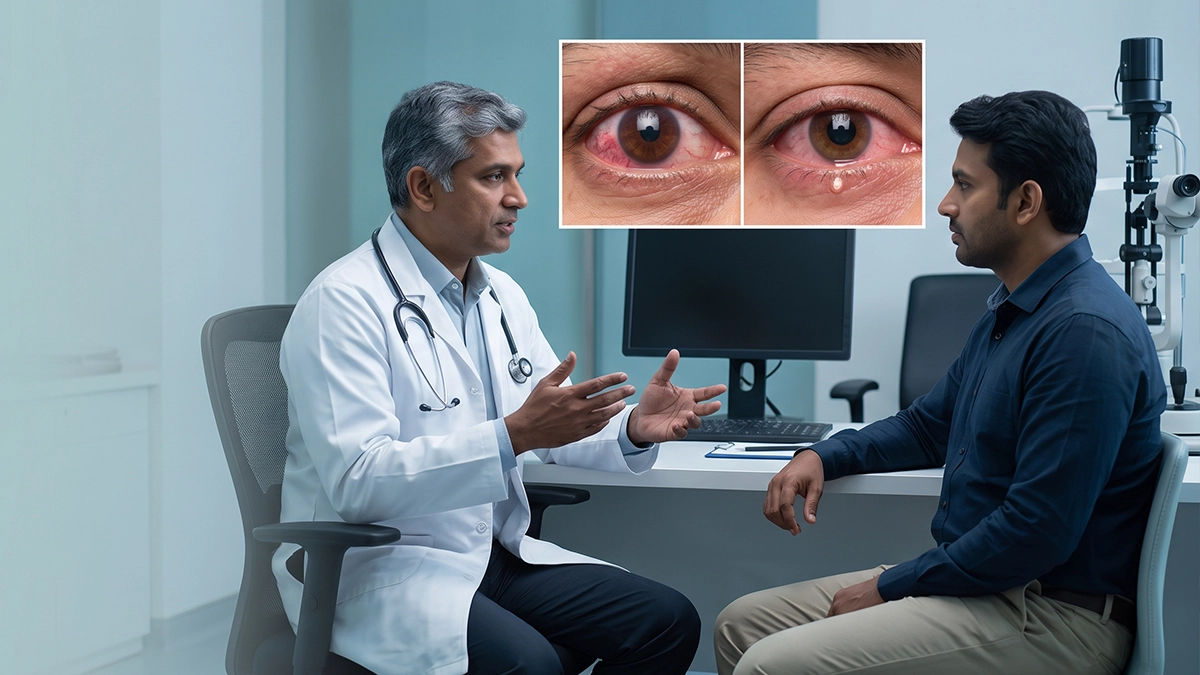
Episcleritis vs conjunctivitis is a common issue which presents when only one eye is red. In the case of episcleritis what Vasan Eye Care sees is mild inflammation of a very thin layer of tissue underneath the conjunctiva and at most it may include some redness that for the most part does also not go along with much discharge. As for conjunctivitis what affected is the conjunctiva itself which in turn produces discharge, a sandiness, foreign body sensation and redness may also present in the whole eye. At any point that you notice pain, blurred vision or sensitivity to light you should see a health care professional.
How Do the Two Conditions Differ?
The episclera is a thin blood rich layer which is between the conjunctiva and the white sclera. At times this layer may become inflamed thus producing a red look to the eye when no infection is present. Also known as pink eye, conjunctivitis has viral, bacterial, or allergic causes.
Both of these present with red eye, which is how they are alike, and thus episcleritis vs conjunctivitis is easy to mistake for conjunctivitis. A red eye not conjunctivitis is common, and episcleritis is a cause. Sectoral redness of the eye points to episcleritis, and redness that is total across the eye points to conjunctivitis.
What Causes Each Condition?
Doctors do not determine what causes episcleritis in most people. In some reports, it is seen in rheumatoid arthritis, lupus and other inflammatory diseases. The MSD Manual notes that episcleritis causes are linked to systemic rheumatic disease in 36% of cases. A study that looked at 100 patients in the journal Ophthalmology reported that 28 had recurrences.
Conjunctivitis as a diagnosis is in fact easier in terms of what is causing it when compared to the episcleritis causes which discussed before. Viruses and bacteria are the cause of the infectious forms.Allergies including eye allergy cause itchy and watery eyes in all eyes. Vernal conjunctivitis which is a recurring allergic form affects mostly kids and teens.
How Do Symptoms and Redness Patterns Compare?
Typical episcleritis symptoms present as a bright red or pink area, mild tenderness, and also at times some watery discharge. Sectoral redness eye, which is to say redness in a segment of the white, is a very telling sign. Vision usually does not go down.
Conjunctivitis causes redness in the whole eye and discharge on the lashes. The table gives a quick comparison of episcleritis vs conjunctivitis.
| Feature | Episcleritis | Conjunctivitis |
| Redness | Often one sector | Usually the whole eye |
| Discharge | Little or none | Watery, sticky, or pus-like |
| Discomfort | Mild tenderness | Itching, grittiness, or burning |
| Eyes affected | Usually one | One or both |
| Contagious | No | Viral and bacterial types |
How Is the Cause Diagnosed?
Distinguishing between episcleritis vs conjunctivitis is mostly a clinical judgment. An ophthalmologist will test vision and examine the eye with a slit lamp which is a microscope that uses bright light. Phenylephrine drops are used to help superficial episcleral vessels usually resolve while deeper in the sclera they do not. Sectoral redness eye with severe pain indicates a possible case of scleritis. Persistent episcleritis symptoms may also bring up the issue of doing blood tests for some underlying disease.
| Test | What It Checks | Why It May Be Advised |
| Visual acuity | Sharpness of vision | Vision loss suggests a deeper problem |
| Slit-lamp examination | Conjunctiva, episclera, sclera, cornea | Locates the inflamed layer |
| Phenylephrine drops | Whether redness fades | Separates episcleritis from scleritis |
| Swab or culture | Infecting organism | Persistent or severe discharge |
Treatment: Episcleritis vs Conjunctivitis
Episcleritis treatment generally is support based as the condition tends to resolve in 1 to 2 weeks. Cold compresses and lubricating drops for relief of symptoms. In persistent cases an ophthalmologist may prescribe corticosteroid drops. Identifying the causes of episcleritis which cause repeat flares also plays a role in treatment.
Conjunctivitis treatment varies with the cause. In the case of management of bacterial conjunctivitis, they see that antibiotics in the form of eye drops are a common approach, but in viral cases they usually resolve on their own. Oral antibiotics for eye infection are a choice in only some situations, which is why self-medication is out of the question.
When Should You Seek Urgent Care?
Sudden loss of vision requires urgent medical assessment. Seek prompt ophthalmic evaluation for:
- severe or deep eye pain
- reduced or blurred vision
- marked light sensitivity
- halos around lights with nausea
- redness after injury or contact lens wear
These may present as signs of scleritis, corneal infection, or acute glaucoma instead of what is a simple red eye not conjunctivitis. Corneal issues require specialist care through corneal services. Redness which persists beyond 2 weeks, or episcleritis symptoms that keep coming back, also requires reevaluation. Telling episcleritis vs conjunctivitis safely may only be done at the time of examination, not by what they look like.
Eye Care at Vasan Eye Care
Vasan Eye Care provides care for red, irritated, or painful eyes. At Vasan Eye Care they have ophthalmologists who do a full assessment of a red eye not conjunctivitis, which in turn may or may not be conjunctivitis, and they determine which of the options of watchful waiting, medication, or further tests is right for what you don’t find. Vasan Eye Care looks at the difference between episcleritis and conjunctivitis based on the exam and for recurrent episodes of episcleritis they may include a systemic review.
Frequently Asked Questions
1. Is episcleritis contagious like pink eye?
No. Episcleritis causes are inflammatory rather than infectious, which means it doesn’t spread between people. Viral and bacterial conjunctivitis are contagious. An eye exam is what you’ll need to determine which condition you have.
2. How long does episcleritis last?
In most cases resolution is seen within one to two weeks. For episcleritis symptoms do well with the use of cold compresses and lubricating drops and they may also prescribe anti inflammatory drops. If redness persists or comes back see an ophthalmologist.
3. Does localised redness always mean episcleritis?
Sectoral redness eye is a tell tale sign of episcleritis which is true but also scleritis or a corneal issue may present in a similar fashion. Pain, light sensitivity, or blurred vision should be evaluated as a matter of urgency.
4. Can home checks separate episcleritis vs conjunctivitis?
Home assessment is often of little value. Itching, discharge, and pain are reported symptoms but a red eye that is not from conjunctivitis may have a problem with the cornea or other internal layers. An ophthalmologist will do an exam to determine the cause.
Persistent, continuous or atypical redness should be noted. An ophthalmologist can determine the issue between episcleritis vs conjunctivitis and will advise on if follow up or urgent care is required. Patients may book an eye exam at a Vasan Eye Care center.
References
- Episcleritis – MSD Manual Professional Version
https://www.merckmanuals.com/en-ca/professional/eye-disorders/conjunctival-and-scleral-disorders/episcleritis - Severity of episcleritis and systemic disease association. Ophthalmology, 1999
https://scholars.duke.edu/publication/1823142