
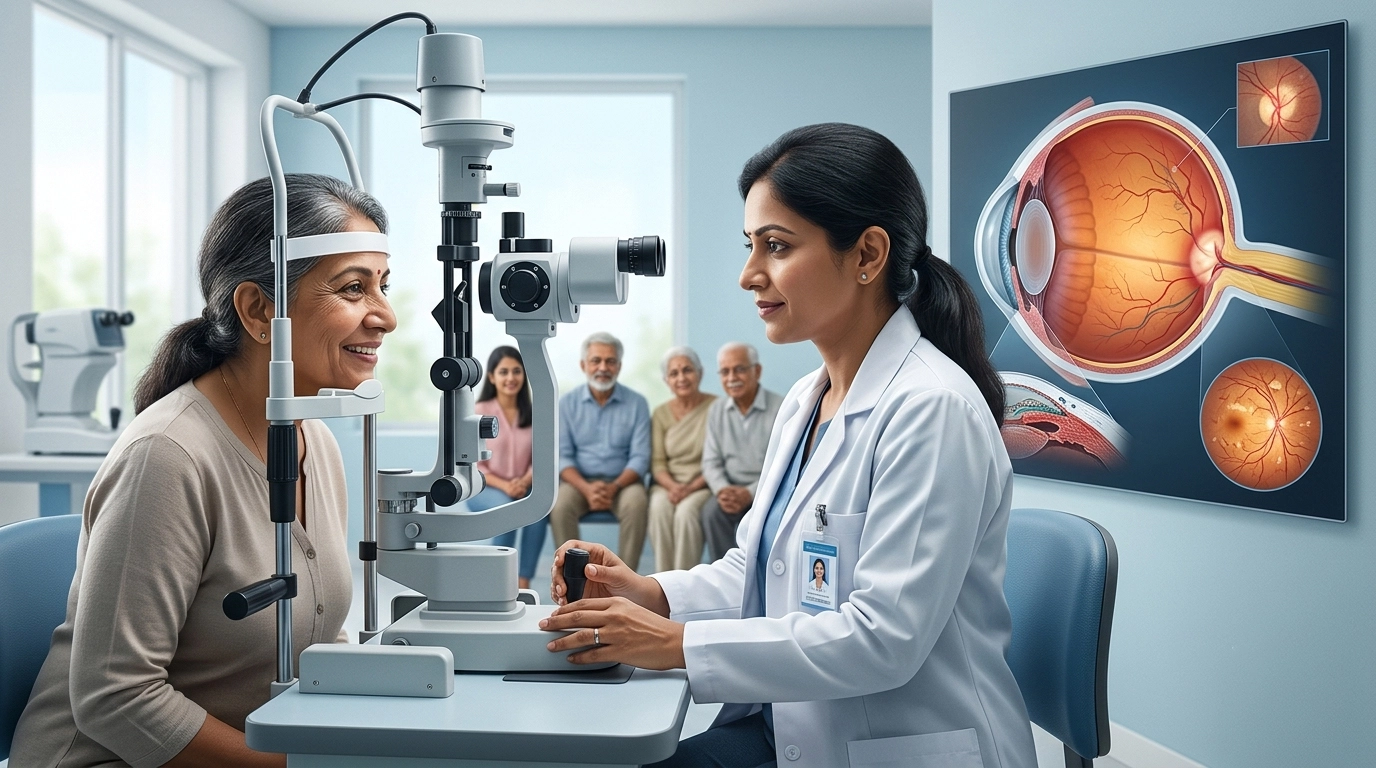
Glaucoma is at times referred to as a “silent” eye disease which is for a good reason. In it’s early stages the disease may present no pain, redness or change in what a person does every day. By the time a person notices they have lost peripheral vision the nerve damage may already be done.
Understanding the glaucoma risk factors is important even if your eyesight appears to be fine. Some people are at a greater risk of developing glaucoma due to their age, family history, intraocular pressure, health conditions, eye structure, drug use, or past eye issues.
Knowing that you have a risk increases what an ophthalmologist will do in terms of timing for when you should be glaucoma screening which may be sooner and more frequent in comparison to that of a person that has no family history of the disease. Also according to the National Eye Institute, in many cases glaucoma presents with little to no symptoms in its early stages and thus a full dilated eye exam is a very important tool in diagnosis before the issue develops into that of large scale vision loss.
What Is Glaucoma?
Glaucoma is a term for a set of eye diseases which affect the optic nerve that transmits visual info from the eye to the brain. This nerve damage may progressive[ly] affect side vision and if left untreated may also eventually attack central vision.
Raised intra ocular pressure which is also called high eye pressure is a key risk factor. But also it is not the case that glaucoma is simply a disease of high eye pressure. Some people do in fact develop optic nerve damage even when their measured eye pressure is within a typical range.
Also it is not true that high eye pressure means a person has glaucoma. An ophthalmologist looks at a number of factors which may include eye pressure, what the optic nerve looks like, results of visual field tests, corneal thickness also we may perform optical coherence tomography or OCT.
That is why an appropriate glaucoma test involves more than checking pressure alone.
Why Knowing Your Glaucoma Risk Factors Matters
Many glaucoma risk factors do not produce symptoms. You won’t notice if your cornea is thin, if your drainage angle is narrow, or if early changes are present in the optic nerve. This is why risk based screening is so valuable.
People at high risk may need to have regular exams which they begin earlier and more often. Those with no great risk may have a different schedule. The aim of screening is not to diagnose each high risk individual as having glaucoma. It is to see early signs of change that we may put out a treatment or watchful eye to.
Major Glaucoma Risk Factors You Should Know
Increasing Age
Age is one of the better-established glaucoma risk factors. While glaucoma can present at any age it is more common as people get older. The National Eye Institute reports that which adult over 60 is at greater risk but some populations may see glaucoma at a younger age. Aging is not a guarantee for glaucoma. It just means that which is why regular in depth eye exams are very important.
Family History of Glaucoma
If a parent, sibling or another close blood relative has glaucoma, tell your eye doctor.
Family heritage is a very large glaucoma risk factors which we see in some forms of the disease which have a strong hereditary element. A diagnosis within a family unit may thus be a sign for close relatives which at present do not show symptoms.
If glaucoma runs in your family, do not wait for blurred vision before arranging an examination.
High Eye Pressure
Raised intraocular pressure is one of the most important modifiable risk factors for glaucoma.
Fluid in the form of aqueous humour is in constant movement inside the eye. When drainage isn\’t enough, pressure may go up. Over time this may lead to affected optic nerves. Also the extent of the relationship is not the same for all. Some people do well with relatively high pressures which don\’t develop into glaucoma, while in some others damage to the optic nerve appears at what is not very high pressure.
A pressure reading should therefore always be interpreted alongside other examination findings.
Thin Central Cornea
Corneal thickness does play a role in glaucoma risk assessment and interpretation of eye pressure measurements. In the center of the cornea, being thin has a greater association with development of primary open angle glaucoma in some patients with ocular hypertension. Also it plays a role in how we interpret measured eye pressure.
Your ophthalmologist may recommend pachymetry, a simple test that measures corneal thickness, when assessing your overall glaucoma profile.
High Myopia or Significant Refractive Error
People which have very high myopia, or short sightedness, may see they are at a greater risk for certain types of glaucoma. Also reports of greater risk in people with prominent farsightedness and certain eye anatomy in particular that which affects the angle closure.
This does not mean that all those who wear strong glasses will get the disease. Refractive error is a variable which an ophthalmologist takes into account along with eye pressure, family history, age and optic nerve appearance.
Diabetes and Other Medical Conditions
Diabetes is linked to a higher risk of several eye conditions and is also recognised as a factor associated with glaucoma. The CDC lists people with diabetes among those at increased risk of glaucoma.
High blood pressure and other vascular conditions may also matter when an ophthalmologist evaluates a person’s overall eye health.
Patients which have diabetes should get in the habit of having full eye exams as diabetic retinal disease may progress without any change in vision.
Previous Eye Injury or Eye Surgery
A serious eye injury may produce damage to the elements which put out fluid from the eye. Also in some cases glaucoma may present itself months to even years after the initial injury. Also past eye surgeries or inflammatory eye diseases may play a role in causing glaucoma. It is important to report to your ophthalmologist past injuries, accidents, inflammation of the eye or prior surgeries which may have seemed to be resolved at the time.
Long-Term Corticosteroid Use
Corticosteroids are a type of drug which we use for many inflammatory and health issues. But in some people who are more sensitive to it, long term use of these drugs may cause an increase in intraocular pressure. This may present especially with the use of steroid eye drops, though other forms of corticosteroids may also play a role.
Do not discontinue prescribed steroid medications due to worries of glaucoma risk factors. Instead report your medication history to your prescriber and ophthalmologist which will in turn arrange for the proper monitoring.
Ethnicity and Eye Anatomy
Glaucoma doesn’t affect all populations in the same way. We see that certain ethnic groups have a report of different risks for which types of glaucoma they may get or at what age they may develop it. For instance people of Asian ancestry may have a greater tendency to certain forms of acute angle closure glaucoma, while other groups may report higher rates of primary open angle glaucoma.
Individual eye anatomy remains more important than ethnicity alone, so personal assessment is preferable to assuming risk based only on background.
Glaucoma Risk Factors at a Glance
| Risk factor | Why it matters | Possible screening implication |
| Increasing age | Glaucoma becomes more common with age | More regular comprehensive eye examinations |
| Family history | Some forms of glaucoma have strong hereditary links | Earlier assessment may be appropriate |
| High eye pressure | Increases stress on susceptible optic nerves | Pressure and optic nerve monitoring |
| Thin cornea | Can influence risk and pressure interpretation | Pachymetry may be recommended |
| High myopia | Associated with increased open-angle glaucoma risk | Regular optic nerve evaluation |
| Diabetes | Associated with glaucoma and other eye diseases | Regular dilated eye examinations |
| Steroid exposure | Can increase eye pressure in susceptible patients | Pressure monitoring may be necessary |
| Previous eye trauma | Can damage the eye’s drainage structures | Long-term follow-up may be advised |
Who Should Consider Earlier Glaucoma Screening?
Some people should talk to an ophthalmologist about early glaucoma screening if a parent or sibling has glaucoma, past exams report high eye pressure, they are very myopic, they have diabetes, they used corticosteroids for long term, or they had serious eye trauma.
People which have multiple glaucoma risk factors do require special attention. For example a person that is of an age at which glaucoma tends to appear, which also has a parent with the disease and which is told they have high eye pressure may require a more intensive level of surveillance than another person of the same age which does not present those risk factors.
How Often Should You Get Screened for Glaucoma?
There is no set glaucoma screening frequency which applies to all. The National Eye Institute reports that people at higher risk which at present do not have glaucoma may be tested every 1 to 2 years and also we see that more frequent eye exams are recommended by an ophthalmologist when the risk of optic nerve damage is great.
Your personal schedule should therefore be based on your examination findings rather than age alone.
| Situation | General approach |
| Younger adult with no known risk factors | Routine comprehensive eye examinations as advised |
| Adult entering middle age | Establishing a baseline comprehensive examination becomes increasingly useful |
| Family history or another significant risk factor | Consider earlier and more regular glaucoma assessment |
| Multiple glaucoma risk factors | Follow-up may be required more frequently |
| Ocular hypertension or glaucoma suspect | Individual monitoring schedule determined by the ophthalmologist |
| Diagnosed glaucoma | Regular follow-up based on disease severity, treatment and eye-pressure control |
These are general guidelines and we are not to present them as a personal medical plan. Your ophthalmologist may recommend that you come in for check ups more or less frequently based on the health of your eyes.
What Tests Are Used During Glaucoma Screening?
An in depth glaucoma eye test is typically more in scope as a single measurement of eye pressure. What an oculist does is look at the fluid pressure inside the eye with a procedure called tonometry. Also included in the exam is an evaluation of the optic nerve for signs of structural damage. We also do visual field tests which will point out areas of peripheral vision loss that may not be apparent during usual daily activities. Also we use OCT to obtain detailed measurements of the retina’s nerve fiber layer and the optic nerve structures.
Pachymetry is done to check corneal thickness and in gonioscopy we look at the eye’s drainage angle as part of an ophthalmic exam. Not all patients have the same tests at each visit. What is ordered is based on each person’s particular case and past results.
Can Normal Eye Pressure Rule Out Glaucoma?
No.
One of the main issues with glaucoma risk factors is that we tend to think a normal pressure reading means the eye is healthy. Some patients develop normal tension glaucoma which is a case where we see characteristic damage to the optic nerve without the presence of high measured pressure.
For this reason, screening should include evaluation of the optic nerve and other appropriate tests rather than depending entirely on tonometry.
Can Glaucoma Be Prevented?
Not in all cases can we prevent this due to the fact that some primary glaucoma risk factors like age, genetics and eye anatomy are out of our control. What we can do is to prevent or at least reduce avoidable vision loss from glaucoma which goes undetected or is poorly managed.
Regular eye checkups also play a role in early identification of glaucoma. In cases that treatment is required, we may use medicine, laser treatment or surgery which in turn helps to reduce the risk of more optic nerve damage. It is also important to note that vision which may have been lost to glaucoma doesn’t usually return.
When Should You See an Eye Specialist?
Do not put off till you see symptoms if you have serious glaucoma risk factors. Go in for a full eye exam if glaucoma is in your history, you were told in the past that you have high eye pressure, you have diabetes, very high myopia, prior eye injury, use of steroids for long term, or you have another issue which the doctor brought up.
Sudden onset of very severe eye pain, redness, blurred vision, colored halos around lights, headache, nausea or vomiting is seen in acute angle closure glaucoma. These symptoms require immediate eye care evaluation instead of a routine screening appointment.
Conclusion
Understanding your personal glaucoma risk factors gives you a chance to protect your vision before issues become apparent. Age, family history of the disease, high eye pressure, thin corneas, large refractive errors, diabetes, use of steroids and past eye injury may play a role in how closely your eyes should be monitored. It is true that you may have one or more of these risk factors and still not have glaucoma but it may be that delay in symptoms is not a safe wait and see strategy.
A full eye exam is a tool which ophthalmologists use to study your optic nerve, eye pressure and other key indicators which in turn determine what we recommend for your glaucoma screening frequency.
If you are unsure whether you fall into a higher-risk group, consult an eye specialist at Vasan Eye Care for an individual assessment and advice based on your eye health, family history and medical history.
Frequently Asked Questions
- What are the most important glaucoma risk factors?
Important glaucoma risk factors include advanced age, family history, high intraocular pressure, thin corneal thickness, severe myopia, diabetes, prior eye injury and long term use of corticosteroids. The degree to which each factor plays a role is variable in each person which is why a full exam is very important.
- At what age should glaucoma screening begin?
There isn\’t a set age at which we all should have our first eye exam. As adults get into middle age they should do more frequent eye checkups. Also people with a family history of glaucoma, high eye pressure or other large risk factors may require glaucoma screening considerably earlier.
- How often should a high-risk person be screened for glaucoma?
Higher risk individuals without a diagnosis of glaucoma may at times be examined yearly or every other year, also we see that their ophthalmologist may recommend more frequent visits which may include every 6 months or as often as every 3 months based on the patient’s eye pressure, how the optic nerve appears, corneal thickness and other test results.
- Does having a parent with glaucoma mean I will develop it?
No. Family risk does play a role in glaucoma but does not determine that you will get the disease. Also if you have a parent or sister brother with glaucoma it is a good idea to discuss earlier glaucoma screening with an eye specialist.
- Is checking eye pressure enough to detect glaucoma?
No. Eye pressure is a component of a glaucoma test. Also we may do an exam of the optic nerve, visual field testing, OCT, corneal thickness measurement and evaluation of the eye’s drainage angle.
- Can glaucoma occur when eye pressure is normal?
Yes. Normal tension glaucoma may present with typical damage of the optic nerve at levels of intraocular pressure thought to be normal, thus a full work up is of more worth in diagnosis rather than a stand alone eye pressure reading.