
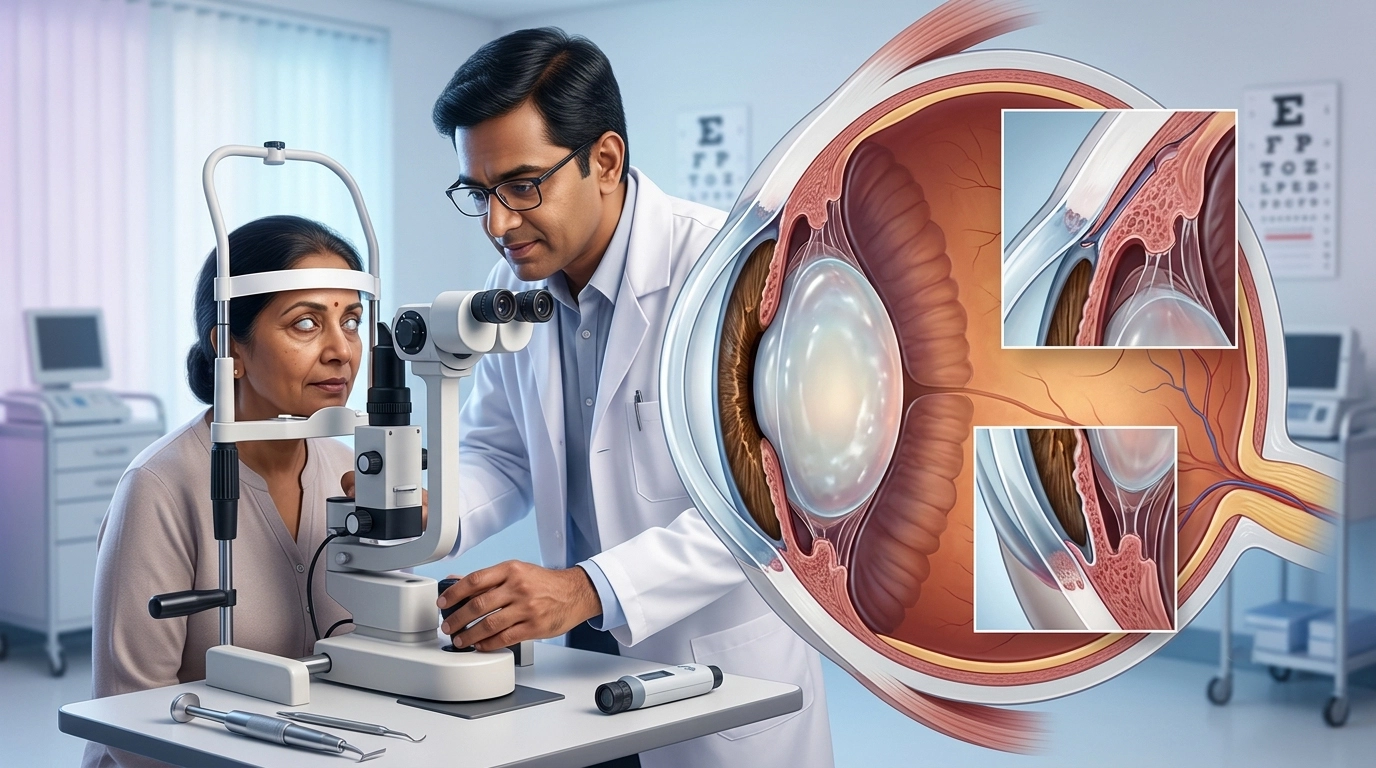
A cataract will usually develop slowly over the course of many months to years and will cause a clouding of the vision. In some cases however a cataract may produce a more acute issue. As the lens becomes large enough to impede the normal flow of fluid in the eye, intraocular pressure can rise suddenly. This is called phacomorphic glaucoma.
Unlike most types of glaucoma which develop slowly, phacomorphic glaucoma presents with severe eye pain, redness and a sudden drop in vision. It is classified as an ophthalmic emergency because of the risk of permanent vision loss from extended high intraocular pressure which may also cause damage to the optic nerve.
Prompt evaluation by an ophthalmologist is therefore very important. We aim at reducing eye pressure and stabilizing the affected eye. As for the base cause which is the cataract we must go in for cataract surgery which is the usual treatment. Also from research on lens induced glaucoma we see that early diagnosis and treatment play key role in better visual and pressure control results.
What Is Phacomorphic Glaucoma?
Phacomorphic glaucoma is a kind of secondary angle closure glaucoma that results from changes in the natural lens of the eye. As a cataract matures, the lens may take in fluid and grow in size. At times doctors will report this as an intumescent or swollen cataractous lens. In the eye which has limited space, the enlarged lens may push the iris forward.
The iris’ movement causes it to either close or reduce the drainage angle which is between the iris and the cornea. Also it may impede the flow of aqueous humor through the pupil. If aqueous humor does not drain properly pressure in the eye goes up.
This sudden increase in intraocular pressure is a cause of many of the pain symptoms seen in phacomorphic attack. Should the high pressure persist the optic nerve may suffer permanent damage. This is what sets phacomorphic glaucoma apart from a simple cataract. In cataracts the issue is mainly with the passage of light through the lens, in phacomorphic glaucoma we see a play of vision issues and also of internal eye pressure.
What Causes Phacomorphic Glaucoma?
The primary cause of phacomorphic glaucoma is a large, at typical late stage cataract. Usually the aqueous humor which is produced in the eye is in a constant state of circulation in the front part of the eye until it leaves through certain drainage structures. Abnormal thickness of a cataractous lens which has grown to a large size reduces space in the anterior chamber. The iris is pushed out of position and the drainage angle may become blocked.
A pupillary block process may also play a role. In this case we see that flow of fluid between the lens and the iris is impaired. Behind the iris pressure builds up which in turn forces the iris forward thus making angle closure more severe.
This is that some which put off treatment for very advanced cataracts may have a higher chance of lens related complications. Also not all mature cataracts develop into phacomorphic glaucoma, also this cannot be told from the cataract appearance itself. An ophthalmologist has to do an eye exam to see if cataract is at play in the drainage angle or eye pressure.
Symptoms of Phacomorphic Glaucoma
Symptoms usually come on very fast and are also much more serious than what is seen in a typical cataract. At first what little vision there is in a cataract may drop off. Then in and out of the affected eye severe pain may present. Also the eye may look very red and the light which before was not a problem may now be at issue.
Blurred vision and colored halos around lights is a symptom which appears when intraocular pressure rises causing corneal swelling. Also some people report headaches on the same side as the affected eye. When the pressure rises, nausea and vomiting may happen. These symptoms at times cause people to think they are having a migraine or stomach problem instead of an eye emergency.
Common symptoms of phacomorphic glaucoma are sudden or rapid onset of blurred vision, intense eye pain, redness, halos around lights, headache, sensitivity to light, nausea and vomiting. A red painful eye which also has an element of sudden vision loss should not be treated as a routine cataract sign. Emergency ophthalmic evaluation is recommended.
Is Phacomorphic Glaucoma an Emergency?
Yes. Phacomorphic glaucoma is an eye emergency.
The optic nerve which is responsible for taking visual info to the brain. Very high intra ocular pressure may cause permanent damage to that structure. As time goes on and the high pressure persists the more the issue of permanent optic nerve damage comes up.
Clinical reports out of which are patients with phacomorphic and other lens induced glaucomas have noted that which present earlier to be treated that do report better visual and IOP results. This is why it is important for a person that is experiencing sudden eye pain, redness and loss in vision to not wait for symptoms to go away on their own. At the first sign of an issue which may be related to the health of the eye one should see an ophthalmologist or emergency eye care service. This really does make a difference in the end visual result.
How Is Phacomorphic Glaucoma Diagnosed?
Diagnosis starts with a comprehensive eye exam. The ophthalmologist will test vision and also do tonometry which is a pressure measurement. In phacomorphic glaucoma the pressure in the affected eye may be very high.
Slit lamp exam is used to identify advanced or swollen cataracts, corneal swelling, inflammation and a shallow anterior chamber. During an acute attack the pupil may also react abnormally. The drainage angle may be assessed by gonioscopy if the cornea is in a suitable state. Also the doctor may compare the affected eye to the other eye which in turn may provide diagnostic information from the asymmetric lens enlargement and anterior chamber depth.
Additional imaging which includes use of ultrasound biomicroscopy at times is performed when the anatomy of the eye’s anterior segment requires it. Once pressure has stabilized and the cornea has cleared we are able to study the optic nerve in more detail to see if glaucoma damage has occurred.
Phacomorphic Glaucoma vs Primary Angle-Closure Glaucoma
Although both conditions involve closure of the drainage angle and increased eye pressure, their underlying causes are different.
| Feature | Phacomorphic Glaucoma | Primary Angle-Closure Glaucoma |
| Main cause | Enlarged cataractous lens | Anatomical crowding of the drainage angle |
| Cataract | Usually advanced or swollen | May or may not be present |
| Eye pressure | Can rise suddenly and significantly | Can rise suddenly or remain chronically elevated |
| Definitive treatment | Cataract/lens extraction | Depends on the eye and may include laser, medication and lens extraction |
| Urgency during acute attack | Emergency | Emergency |
Correct diagnosis matters because the cataractous lens itself is the underlying problem in phacomorphic glaucoma.
Emergency Treatment for Phacomorphic Glaucoma
Treatment generally takes place in two stages: controlling the acute pressure rise and treating the cataract responsible for the attack.
Lowering Eye Pressure
The first issue is to reduce intraocular pressure as soon and safely as possible. As per the severity of the attack and the patient’s health in general, an ophthalmologist may prescribe topical or systemic pressure lowering medicines. Carbonic anhydrase inhibitors, beta blockers, alpha agonists and hyperosmatic medicines may be considered in appropriate cases.
Treatment choices have to be tailored to the individual patient as some glaucoma medications do not do well in patients with certain heart, lung, kidney or other health issues. Also it is not wise for patients to try to manage an acute attack of glaucoma with someone else’s glaucoma drops or from old medication we have in the back of the cabinet.
Medical therapy may control the sudden pressure rise, however it also does not resolve the issue of the swollen cataract that caused the attack. Present in current clinical reports is that lens extraction is the surest option for treating glaucoma that is a result from a lens.
Controlling Inflammation
An acute phacomorphic attack also reports of great inflammation in the eye. To that we see that ophthalmologists may order up treatment which will reduce that inflammation and in turn make other treatments go more smoothly. Corneal swelling may also see relief as eye pressure goes down which in turn gives the surgeon a better view of the eye’s internal structures.
Laser Treatment in Selected Cases
In certain patients laser peripheral iridotomy is an option for relief of pupillary block. But laser treatment does not cure the enlarged cataractous lens. It may thus help with acute pressure management in selected cases instead of as a replacement for definitive cataract treatment. The exact approach varies by the anatomic makeup of the eye, pressure level, corneal clarity and also the ophthalmologist’s assessment.
Cataract Surgery for Phacomorphic Glaucoma
Once acute pressure and inflammation have been brought under control, removal of the cataract is the primary treatment. Removal of the enlarged lens which in turn creates more space in the anterior part of the eye and at the same time removes the cause of angle closure. As per the type of cataract, eye anatomy and surgeon’s assessment cataract removal may be done via phacoemulsification or some other appropriate cataract extraction technique.
Surgery for an eye with phacomorphic glaucoma may present more challenges than routine cataract surgery. The anterior chamber is very shallow, the cornea may be swollen, inflammation may present and the cataract may be very far along. Thus careful surgical planning is very important.
Studies of patients who have had cataract surgery for phacomorphic glaucoma report large decreases in intraocular pressure post lens removal although it is also true that results for vision may vary which is in turn based on the length of the attack and the state of the pre-existing optic nerve and retina health.
Can Vision Recover After Treatment?
Many patients report an improved quality of vision with prompt treatment which is not the case for all. If blur was a result of cataract and transient corneal swelling vision may improve greatly once the pressure is reduced and the cataract is removed. But vision lost due to permanent damage to the optic nerve does not always return.
Other eye issues such as retinal disease, long term glaucoma or age related changes may also play a role in the final visual result. In a study of patients with acute phacomorphic glaucoma it was found that early cataract removal after first symptoms appears to have better results. This is yet another reason for immediate evaluation when one experiences severe pain and sudden vision loss.
Can Phacomorphic Glaucoma Be Prevented?
Not all cases may be predicted, but in time that we do see some cases of cataracts which do go on to become very advanced we are able to delay that by way of timely assessment. Do not wait until your vision has almost disappeared before you seek out what options there are for treatment of cataract. Today it is thought that modern cataract surgery should be sought out when the cataract is starting to really impact daily life which is what we call meaningful interference, though the exact time that is right for each person will differ.
Regular eye tests are of great importance to the elderly and to people who already have cataracts or glaucoma. If a cataract is very dense or the lens is causing increased pressure in the eye, an ophthalmologist may put forth the option of early cataract surgery.
When Should You See an Eye Doctor?
Immediate ophthalmic care is required for sudden severe eye pain which is accompanied by blurred or reduced vision, also pay attention if the eye is red or you see halos around lights. Also report if you have nausea, vomiting or a severe headache which present with these eye symptoms.
When a person has a known cataract which is in the process of routine development, sudden pain is not a typical sign of that. An ophthalmologist can determine if the symptoms are from phacomorphic glaucoma which is another type of angle closure, inflammation, infection or some other eye issue that requires immediate care.
Conclusion
Phacomorphic glaucoma is a result of late stage cataract in which the natural lens enlarges and the drainage angle closes which in turn causes a rise in intraocular pressure. Severe eye pain, redness, sudden onset of vision loss, halos, headache, nausea or vomiting should be heeded to in a person which has an existing cataract.
Emergency care is first to reduce eye pressure and stabilize the affected eye. We then address the base issue with cataract extraction. That said, the length of time pressure is high plays a role in visual recovery which is why early diagnosis and treatment is very important.
If you or a family member has advanced cataracts or experiences sudden painful changes in vision, come to Vasan Eye Care for a full eye exam and appropriate treatment plan.
Frequently Asked Questions About Phacomorphic Glaucoma
- What is phacomorphic glaucoma?
Phacomorphic glaucoma is a type of secondary angle closure glaucoma which is brought about by an enlarged cataractous lens. The enlarged lens causes the iris to shift forward which in turn interferes with the eye’s fluid outflow. As a result the intra ocular pressure may rise very quickly and may put the optic nerve at risk.
- Is phacomorphic glaucoma caused by cataract?
Yes. The issue which usually presents with an advanced, swollen or intumescent cataract. The enlarged lens crowds the front of the eye and may close the drainage angle. Also it is noted that most cataracts do not progress to phacomorphic glaucoma.
- What are the first symptoms of phacomorphic glaucoma?
Symptoms may present as a quick degeneration of vision, eye pain, redness, halos around lights and headache. Severe attacks also cause nausea or vomiting. If you have sudden vision loss which is accompanied by a painful red eye you should seek urgent assessment by an ophthalmologist.
- Is phacomorphic glaucoma curable?
The rapid increase in intraocular pressure is generally treated; also removal of the cataract will address that which is related to the lens but at the same time it is of note that if permanent damage to the optic nerve had already occurred before treatment that may persist into vision issues. Hence early diagnosis is very important.
- Is cataract surgery necessary in phacomorphic glaucoma?
In most cases cataract extraction is the definitive treatment which is performed due to the fact that the affected lens is the cause of angle closure. Pressure reducing medicines may help at first to stabilize the eye but they do not address the root cause.
- Can phacomorphic glaucoma cause permanent blindness?
It may result in permanent vision loss when very high intraocular pressure causes damage to the optic nerve or when treatment is delayed. Prognosis also depends on the degree and length of the attack as well as the state of the optic nerve and retina.
- Can phacomorphic glaucoma affect both eyes?
An acute presentation of phacomorphic attack is seen in the eye which has the large cataract. The other eye while seemingly unaffected should still be examined in detail as it may also have cataract, glaucoma risk or other anatomic features which require treatment or close follow up.