
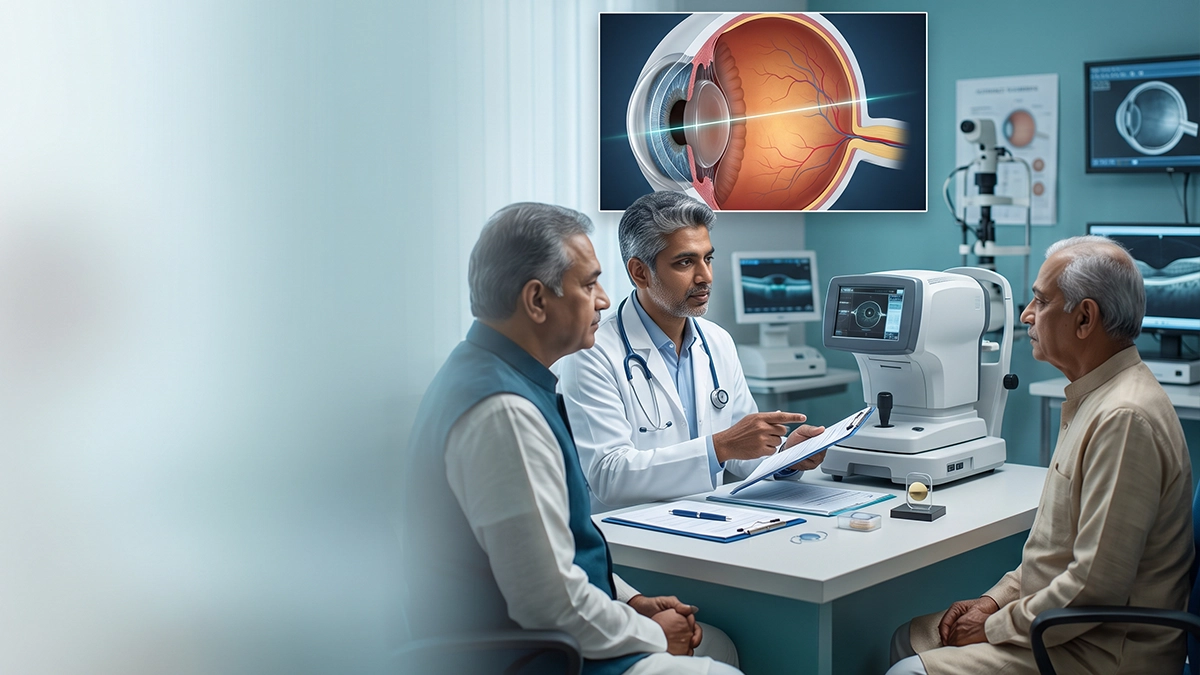
Before cataract surgery there is a IOL power calculation which is done to determine the power of the artificial intraocular lens that will take the place of the clouded natural lens. For accurate results in this pre op test we measure eye length, corneal curvature and other eye structures this information is used by the ophthalmologist to choose the right lens power and to achieve the planned post op focus. This preop measurement process is called biometry.
What Is IOL Power Calculation?
During cataract surgery the cloudy natural lens is taken out and we put in an Intraocular Lens or IOL. The IOL’s power has to be right for that eye which is why iOL power calculation is a key part of the surgery as opposed to just picking from different lens brands.
People considering the best lens for cataract surgery should therefore understand that lens type and lens power are separate decisions. A monofocal, toric or multifocal lens still requires accurate power calculation.
In cataract lens power calculation we use eye measurements and a math formula. From research we see that both precise biometry and right formula choice play a role in post cataract surgery refraction results.
Why Is the Biometry Test for Cataract Important?
A biometry test for cataract which measures anatomical features that affect how light focuses in the eye. Axial length, which is the distance from the front of the cornea to the retina, is the most important of these measures. Keratometry determines corneal curvature and also gives an estimate of the cornea’s focusing power. Also included may be anterior chamber depth, lens thickness and corneal diameter which will vary based on the biometry device and IOL calculation formula used.
| Measurement | What It Assesses | Why It Matters |
| Axial length | Length of the eye | Strongly influences required IOL power |
| Keratometry | Corneal curvature | Helps estimate corneal focusing power |
| Anterior chamber depth | Space in front of the natural lens | Assists some modern calculation formulas |
| Lens thickness | Thickness of the natural lens | May improve predictions with selected formulas |
A biometry test for cataract should report the same results time and again. Dry eye, poor fixation, atypical corneal shape or past refractive surgery may at times affect results which in turn may require a separate assessment.
Patients exploring the best lens after cataract surgery should therefore complete their preoperative measurements before making final lens decisions.
Optical Biometry Test vs A-Scan Biometry
An optical biometry test which uses light based technology to measure the eye non-invasively. Today we see many modern optical systems which do this very quickly and reproducibly. Also optical measurement has for the most part taken over from ultrasound in routine iOL power calculation which is when we get reliable readings.
A-scan biometry that uses ultrasound to measure eye structures, mostly axial length. It is a useful tool when optical equipment fails to get reliable results which in some cases may be at issue with very dense cataracts.
| Method | How It Works | Common Role |
| Optical biometry | Uses light to measure ocular dimensions | Preferred for many routine cataract assessments |
| A-scan biometry | Uses ultrasound echoes | Useful when optical measurement is difficult |
| Keratometry | Measures corneal curvature | Required for lens-power planning |
| Corneal topography/tomography | Maps corneal shape | Helpful in astigmatism or complex corneas |
Neither is a standalone interpretation of an optical biometry test nor a scan to be had. The ophthalmologist looks at measurement quality, eye anatomy and surgical history before doing the cataract lens power calculation.
How Does an IOL Calculation Formula Work?
An IOL calculation formula which puts together eye data with what is to be the intraocular lens’ parameters. Present day formulas may include axial length, corneal power, anterior chamber depth, lens thickness and also what the IOL will do post surgery.
Different which are used include Barrett Universal II, Haigis, Holladay, SRK/T and the more recent developments. No single formula is best for all eyes. What works may not be ideal in some individual cases especially in those with very short or long eyes and after having previous corneal refractive surgery. In a report out of a systemic review that looked at European registry data 3 out of 4 patients (73.7% saw within ±0.5 dioptres after cataract surgery. That which it is presented, that improving measurement and also formula accuracy is of large clinical import.
What Can Affect IOL Power Calculation Accuracy?
Accurate iol power calculation is a complex process which requires multiple parameters. Irregular corneal astigmatism, unstable tear film, prior LASIK or any other corneal procedure, very short or long axial length, and dense cataracts play a role in making surgical planning more difficult.
People undergoing cataract surgery lens replacement may therefore need repeat measurements or additional corneal assessment. An ophthalmologist may also compare more than one IOL calculation formula when an eye falls outside typical measurement ranges.
The presence of a posterior subcapsular cataract or another dense lens opacity may also influence which biometry technique provides dependable readings.
Does the Calculated Lens Power Guarantee Glasses-Free Vision?
No. IOL power calculation is for achieving the preop planned target correction post op, but does not guarantee a certain visual result. Residual refractive error, astigmatism, corneal health, retinal disease and the type of IOL used will play a role in post surgical vision. According to the National Eye Institute’s cataract surgery info which reports that in the U.S. about 9 out of 10 people report better vision after cataract surgery although many still require glasses.
Recognising cataract symptoms and obtaining a complete eye assessment also helps identify other conditions that could affect expected vision.
Planning Cataract Surgery
Once cataracts interfere with useful daily vision, an ophthalmologist can assess whether cataract surgery is appropriate. The evaluation commonly includes visual acuity, slit-lamp examination, retinal assessment and biometry.
Lifestyle factors and visual goals then guide lens-type discussions. Understanding cataract prevention is useful for long-term eye health, although an established cataract cannot currently be removed with diet, supplements or eye drops.
Eye Care at Vasan Eye Care
Vasan Eye Care provides cataract assessment and surgical planning based on what we find for each eye. Prior to surgery an ophthalmologist will go over a biometry test for cataract, overall eye health, your visual needs and what IOL options are available before we do the final iOL power calculation. In some cases of atypical eye measures, prior refractive surgery or other eye conditions we may require additional tests before determining the lens type.
Frequently Asked Questions
1. Is IOL power calculation painful?
No. IOL power calculation does not require surgery. An optical biometry test is a non-contact test, some ultrasound based A-scan biometry techniques may use a probe or immersion. The clinical team will go over which method is used.
2. How long does a biometry test for cataract take?
The present of the measurements is that they are usually a short time which is good to know, at the same time appointment length may vary. Also we may have to do additional testing or to repeat the readings if we see inconsistent results, the cataract is severe or the corneal surface is an issue which affects the quality of the measurement.
3. Why might IOL power measurements need to be repeated?
Repeat testing is recommended when initial results don’t agree. Issues of tear film, poor eye fixation, contact lens induced corneal changes or atypical anatomy may play a role in cataract lens power calculation and call for reevaluation before surgery.
4. Can the same IOL power be used for both eyes?
Not always. Each eye has its own IOL power calculation which at times will differ between the eyes. Anatomical variances as small as they are may change the lens power that is needed to achieve the target refraction.
Persistent issues related to cataracts which do not improve should have an eye evaluation by a professional instead of consulting online for lens info. For patients that are thinking of having surgery we recommend they come in for an eye exam at one of our Vasan Eye Care centers to go over biometry, IOL options and also for proper surgical preparation.
References
- National Eye Institute — Cataract Surgery
https://www.nei.nih.gov/eye-health-information/eye-conditions-and-diseases/cataracts/cataract-surgery - Intraocular Lens Power Calculation Formulas—A Systematic Review
https://pmc.ncbi.nlm.nih.gov/articles/PMC10640516/