
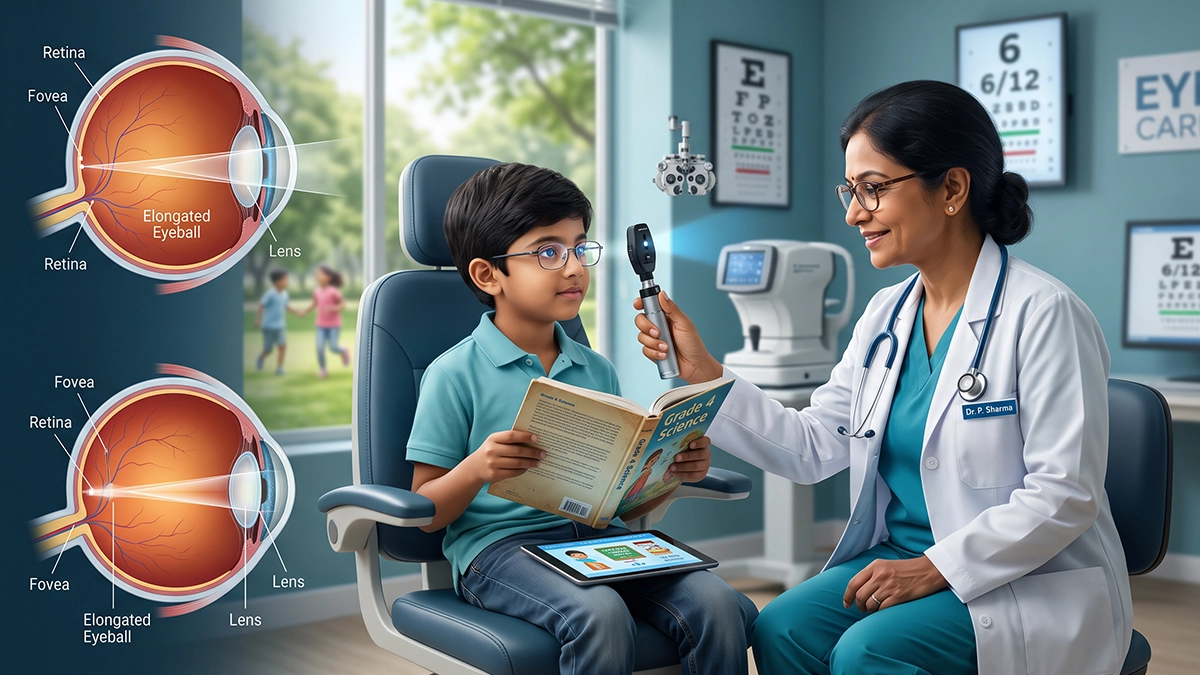
Many parents see that their child’s glasses prescription is going up yearly. Also adults may notice it. This issue of short sightedness is called myopia. What happens is people with myopia see nearby things very well but distant things appear blurry. By knowing what causes myopia you can protect your family’s eyes from a young age. In this guide we explain the seven most common causes of myopia in plain terms. Also we look at the difference between myopia and hypermetropia and put forth easy tips which may help slow down the change. We will start with the basics.
What Is Myopia and Hypermetropia?
Many parents put out what is myopia and hypermetropia. To explain myopia we must look at how the eye focuses. Light comes into the eye and is supposed to hit the retina which is the screen at the back of the eye.
- Myopia (short-sightedness): The eye is of a length which is a bit excessive, or the front section of the eye is very curved. What results is light focus which is in front of the retina. Distance objects appear blurred.
- Hypermetropia (long-sightedness): The eye is very small. Light falls behind the retina. Near objects appear blurry, and the eyes may become tired.
That is my definition of myopia and hypermetropia in simple terms. In the US and many other countries hypermetropia is referred to as hyperopia. So when you see myopia vs hyperopia online it is the same thing.
Myopia vs Hyperopia at a Glance
| Point | Myopia | Hypermetropia (Hyperopia) |
| Common name | Short-sightedness | Long-sightedness |
| What looks blurry | Far things | Near things (sometimes far too) |
| Eyeball shape | Too long | Too short |
| Glasses power | Minus (–) | Plus (+) |
| Common in | School children, young adults | Young children, people over 40 |
In this table we present the main differences between myopia and hypermetropia. Both these issues are very common, and they may be corrected with the use of glasses or lenses.
7 Reasons for Myopia Getting Worse
Doctors are still learning what makes the eyeball grow longer. But research points to some clear myopia causes.
1. Family Genes
If one or both parents have myopia, the child has a higher chance of getting it. Genes are one of the strongest reasons for myopia.
2. Long Hours of Close Work
Reading, writing and studying for many hours at a short distance may push the eye to grow longer.
3. Too Little Time Outdoors
Children who spend more time outside in daylight seem less likely to develop myopia. Many experts see less outdoor time as one of the key myopia causes today.
4. Heavy Screen Use
Phones, tablets and laptops have us at a close range for large chunks of the day. Finding a balance between screen time and outdoor time is important for growing eyes. Also a daily cause of blurred vision is our excessive use of screens which leaves the eyes tired and dry.
5. Early Start in Childhood
My very young myopic patients tend to see their condition progress for many more years. It usually is a dynamic issue through school years and then slows in the early 20’s. Parents often ask how fast a number can change. It is different for every child, so regular checks matter.
6. Old or Wrong Glasses Power
If glasses are out of date the child reports seeing distant objects blur. This doesn’t cause myopia but it does make day to day life harder. It is one of the more common causes of blurred vision in class.
7. Health Changes in Adults
In grown ups high blood sugar or early cataract can cause myopia. These are less common causes of myopia but do require a medical evaluation.
Common Reasons for Blurred Vision to Watch For
Myopia is just a piece of the puzzle when it comes to blurred vision. Also included are dry eyes, tired eyes from screens, hypermetropia and astigmatism. That is why a full eye test is better than guess work. Looking at myopia and hyperopia separately is not enough. While knowing the difference between myopia and hypermetropia is useful, a proper eye exam is a must.
Signs in Children and What They May Mean
| What You Notice | What It May Mean |
| Sitting too close to the TV | Far vision may be blurry |
| Squinting to see the board | Possible myopia |
| Rubbing eyes, headaches after reading | Possible hypermetropia or eye strain |
| Holding books very close | Possible myopia |
| Poor marks or losing interest in class | Hidden vision problem |
Knowing when a child needs a check helps you act early. Many of the reasons for myopia start in school years.
What May Help Slow Myopia
You cannot change your genes. But some habits may help control other myopia causes.
- Go outside daily: Daily 2 hours of outdoor play is what many experts recommend for kids.
- Follow the 20-20-20 rule: Every 20 minutes take a 20 second break to look at what is 20 feet away.
- Keep good distance: Hold off on reading that is up close, instead choose a little distance.
- Use good light: Read in a bright room and study. Also get
- regular eye tests for myopic children we recommend every 6 to 12 months.
Eye doctors also present solutions to slow myopia in kids. This includes low dose eye drops and special glasses and contact lenses. Your doctor will determine what is best for your child. In the case of myopia vs hyperopia it is myopia which tends to progress more during school age which is why it requires more attention.
Conclusion
Knowing which factors cause myopia may help you to identify simple actions that you can do early on. Genes, close work, screens and less outdoor activity are what make myopia worse. Also, knowing what myopia and hypermetropia are and the different signs between them may help you catch issues at an early stage. If still not sure of what is myopia and hypermetropia or your child’s number is increasing which may indicate progression of myopia book an eye check up at Vasan Eye Care.
Frequently Asked Questions
1. What are the main reasons for myopia in children?
Family genes, long hours of close work, heavy screen use and too little time outdoors.
2. What is the difference between myopia and hypermetropia?
Myopia makes far things blurry. Hypermetropia often makes near things blurry.
3. Is myopia vs hyperopia just about plus and minus power?
Partly. Myopia uses minus power and hyperopia uses plus power, but the eyeball shape is also different.
4. Can all myopia causes be controlled?
Not all, since genes play a role. But healthy habits and timely care may help slow it down.
References
- Nearsightedness (Myopia) – National Eye Institute (NIH)
- Farsightedness (Hyperopia) – National Eye Institute (NIH)
- Nearsightedness – MedlinePlus Genetics, U.S. National Library of Medicine
- National Programme for Control of Blindness & Visual Impairment – Ministry of Health and Family Welfare, Government of India