
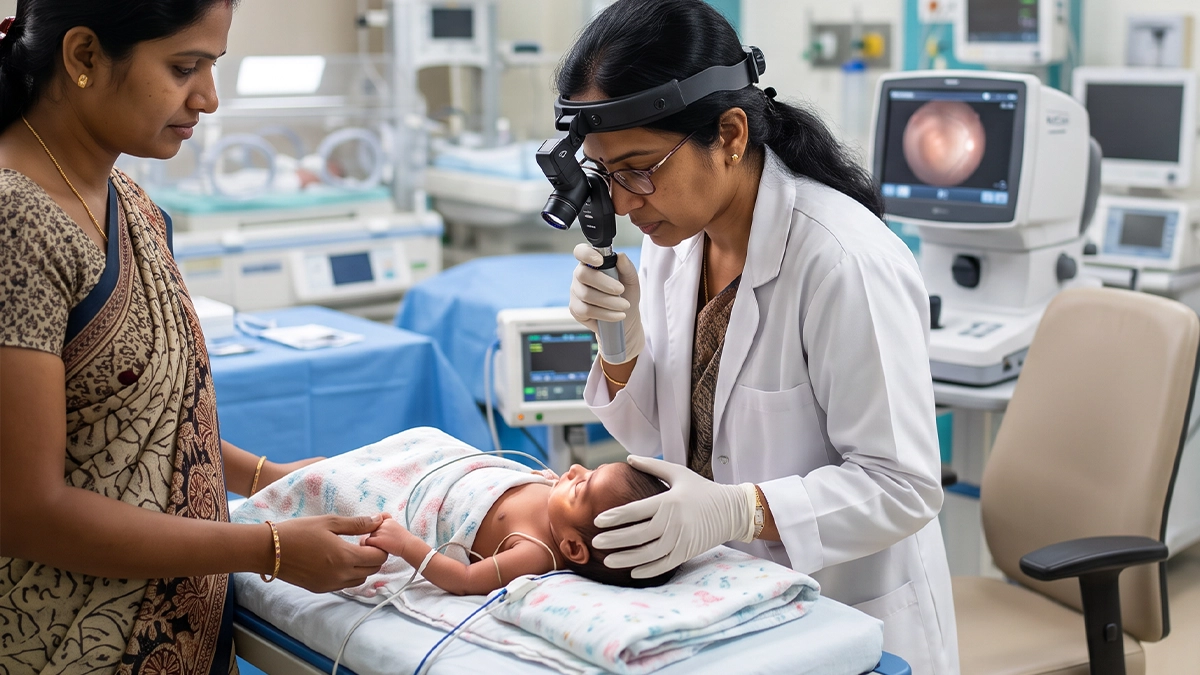
Parents of preterm babies may hear of medical terms they are not familiar with at the NICU. One of which is ROP. The ROP full form is Retinopathy of Prematurity which is an eye condition that affects some pre term born babies. Retinopathy of prematurity is a condition which develops when the retinal blood vessels do not develop properly after preterm birth.
Understanding the ROP full form is key, which is that in the early stages disease may not be noticeable by what you see in a baby’s eyes. A timely ROP screening exam allows an ophthalmologist to identify abnormal retinal development before it progresses to serious vision problems. The Government of India through the National Health Mission has identified ROP as an important cause of childhood blindness which is preventable and they recommend timed screening for at-risk babies.
What Is the ROP Full Form and Why Does ROP Develop?
The term ROP full form Retinopathy of Prematurity. The retina is the light sensitive tissue at the back of the eye. In a full term pregnancy retinal blood vessels grow until near the due date of birth. When a baby is born prematurely this growth may be interrupted.
The risk of ROP eye (retinopathy of prematurity) is very much a feature of prematurity and low birth weight. Also we see that respiratory illness, prolonged use of oxygen, sepsis, blood transfusions and poor post growth in the early days may also play a role in some pre term babies.
This is why parents should not wait for visible symptoms before consulting an eye specialist doctor.
When Should ROP Screening Be Done?
A scheduled ROP screening test is a key element of health care for preterm babies. In the Indian National Health Mission we see that screening is recommended for babies with a birth weight of less than 2,000 grams or a gestational age of less than 34 weeks. Also babies born between 34 and 36 weeks may require screening if they present with additional clinical risk factors.
| Baby’s Clinical Situation | Suggested Screening Timing |
| Birth weight below 2,000 g or gestational age below 34 weeks | ROP screening should be planned according to neonatal guidelines |
| Most eligible premature babies | First examination at about 4 weeks after birth |
| Born before 28 weeks or weighing below 1,200 g | First examination generally at 2–3 weeks after delivery |
| ROP detected on examination | Repeat assessment according to stage, retinal zone and disease activity |
The ROP full form may be basic but the timing of the exam is very important. According to the NHM report which we may take as a guideline for most babies the first ROP exam is at four weeks post birth, for very premature or very low birth weight babies we see an earlier assessment.
How Is an ROP Test Performed?
During the ROP test, the baby’s eyes are given what is put in the eye drops which in turn dilate the pupils thus allowing the ophthalmologist to see the retina. The ROP eye test is usually done with the use of special retinal exam equipment. In some settings retinal imaging also plays a role in the documentation and follow up.
The results of the rop screening test which is done by an ophthalmologist to determine if retinal blood vessels are developing properly and also to see if further exams are needed. Parents should bring their child to all scheduled follow up visits even when the first exam reports only mild or no disease.
Understanding ROP Staging
ROP staging is a term used to describe the progress of retinal changes. Also into account goes the location of ROP and whether or not “plus disease” is present which is abnormal blood vessel growth thus treatment does not base solely on stage.
| ROP Stage | General Meaning |
| Stage 1 | Mild abnormal boundary between vascular and non-vascular retina |
| Stage 2 | A raised ridge develops at the boundary |
| Stage 3 | Abnormal blood vessels begin growing beyond the retina |
| Stage 4 | Partial retinal detachment occurs |
| Stage 5 | Complete retinal detachment occurs |
Stage 1 ROP is found to be a mild case which in many cases does not require immediate treatment. The National Eye Institute reports that stages 1 and 2 usually improve without treatment which is a good thing, while stage 3 and beyond may require intervention.
How Is Retinopathy of Prematurity Treated?
Treatment is based on the severity, retinal location and presence of high risk features. In the case of ROP that requires treatment babies may be put forward for retinal laser treatment or anti-VEGF injections. In advanced cases which include retinal detachment surgery may be required.
At Vasan Eye Care we see to it that parents talk to us about the proper paediatric retina treatment and other specialized eye treatments they may require after we do an in depth ophthalmic assessment. We focus on early care which in turn is to identify diseases at a stage where we have the best chance to protect vision.
What Is the ROP Screening Test Price?
The ROP screening test price may vary by city, hospital, NICU setting, examination method and if specialized retinal imaging is required. Also an online ROP test price is only a rough estimate. Parents should contact the eye hospital they have chosen for the present examination fee instead of delaying screening to compare costs.
Why Timely ROP Screening Matters
Knowing the ROP full form is out there but what is important is that we act on the screening schedule. ROP may present no symptoms at all and also pre term babies may require many tests before the retina fully matures.
Parents of preemies, low birth weight babies or those that spent time in the NICU should ask the neonatologist if ROP screening is right for your baby. Timely assessment and consistent follow up will help ophthalmologists to identify changes early which in turn will help to determine between watchful waiting or treatment.
Frequently Asked Questions
1. What is the ROP full form in medical terminology?
The ROP full form Retinopathy of Prematurity, a retinal disease which we see mostly in pre term and low birth weight babies.
2. Is stage 1 ROP dangerous?
Stage 1 ROP is the early mild stage. Many cases will improve on their own but it is still required to schedule retinal follow up as ROP at time may progress.
3. Is the ROP eye test painful for a baby?
The ROP eye test requires dilated pupils and a specialized retinal exam. In babies the discomfort is temporary but the screening is brief and very important.
4. How many times is ROP screening required?
The number of exams is variable. For repeat ROP screening we look at retinal maturity, the stage and location of the disease, and what the ophthalmologist reports.
References
- National Health Mission, Ministry of Health & Family Welfare, Government of India – Guidelines for Universal Eye Screening in Newborns Including Retinopathy of Prematurity