
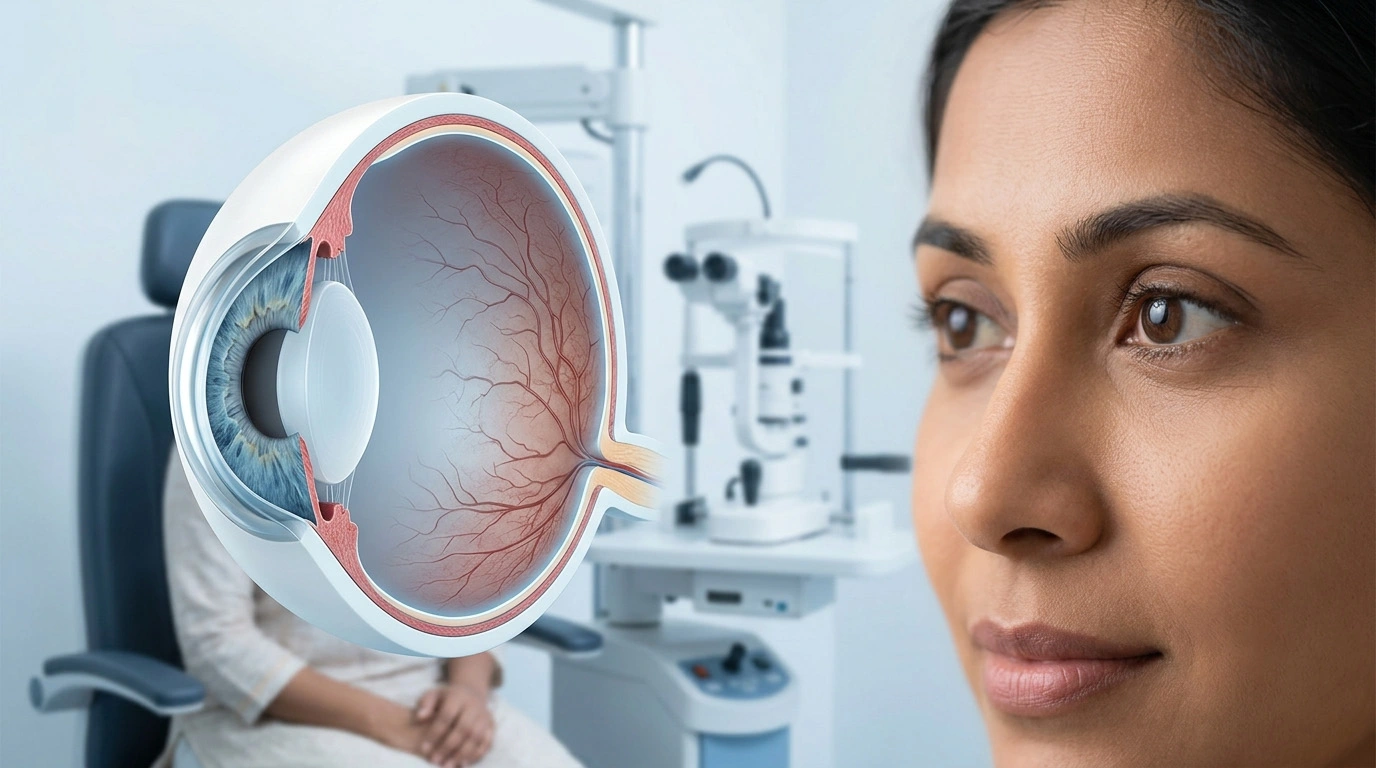
The human eye may be a small and simple organ but it has many specialized layers which work in unison to produce clear vision. Among these is the uvea. While most are aware of the cornea, the retina, the iris, and the lens, the uvea which is very much a part of eye health does not get as much attention.
The uvea which is also called the uveal tract is the vascular middle layer of the eye. It includes the iris, ciliary body, and choroid. These structures play a role in the amount of light that enters the eye, support the process of focusing, produce the fluid inside the eye and also provide blood to important eye tissues.
Knowing what is uvea, how it works, and which conditions affect it will help you to recognize symptoms that may require an eye exam.
What Is the Uvea?
If you are wondering about the uvea meaning, it is the middle vascular layer of the eye. The eye has 3 layers, the uvea is the middle layer in between the outer fibrous layer that includes the sclera and cornea, and the inner retina.
The uveal tract of eye consists of three continuous structures: the iris at the front, the ciliary body behind the iris, and the choroid toward the back of the eye.
In that which has many blood vessels the uveal tissue plays a role in putting in nutrients and supporting different functions which in turn allow for vision. We see that problems in the uvea may present in various parts of the eye and not just produce a superficial issue.
Uvea Anatomy: What Are the Three Parts?
Understanding uvea anatomy becomes easier when the uveal tract anatomy is divided into its three main components.
1. Iris
The iris is what we see as the colored area in eyes which may present itself in brown, black, blue, green or other colors based on the pigmentation. At the center of it is the pupil. The iris also has the task to control the size of the pupil and hence plays a role in the regulation of light which is let into the eye. In a bright setting the pupil will reduce in size. In a dark setting the reverse happens and the pupil will open wider which in turn allows in more light.
2. Ciliary Body
The ciliary body is behind the iris and also is another key element of the uveal tract. It has ciliary muscle and ciliary processes. The ciliary muscle plays a role in changing the lens’ shape which in term allows the eye to focus at various distances. The ciliary processes also produce the aqueous humour which is the clear fluid in the eye’s front section.
3. Choroid
The choroid is the rear element of the uvea and is between the sclera and retina. It has many blood vessels which in turn supply the outer retinal tissues with oxygen and nutrients. Also in the choroid are pigment producing cells. The iris, ciliary body and choroid together make up the full uveal tract of eye.
What Does the Uvea Do?
The uvea performs several functions that support healthy eyesight.
Through the iris, we also see that it controls which light gets into the eye’s inner structures. The ciliary body is also in charge of near and distance focus as well as producing aqueous humour. The choroid is a key component for the vascular supply to the eye in particular the outer retina. These points put forth that which uveal tissue is affected by inflammation or disease may in turn affect vision, light sensitivity, focusing ability and over all eye health.
Diseases That Can Affect the Uvea
Several types of eye diseases which affect the uveal tract. Some are due to inflammation, also they may result from infection, immune based conditions, injury, or abnormal cell growth.
Uveitis
Uveitis is a term we use for inflammation of the uvea which is the middle layer of the eye. It is what we primarily see in association with disease of the uveal tissue.
Uveitis causes redness, pain, blurred vision, sensitivity to light, and floaters in the eye. Symptoms at times may appear suddenly and progress fast. As per the location of inflammation ophthalmologists put uveitis into four categories anterior, intermediate, posterior, and panuveitis. Anterior uveitis which mainly affects the iris is the most common. Intermediate uveitis affects the middle of the eye which includes structures around the ciliary body and vitreous. Posterior uveitis affects the structures at the back of the eye which include the choroid and retina. In panuveitis there is inflammation of multiple parts of the uvea. Uveitis may result from infection, injury, inflammatory or autoimmune disease. In some patients the cause is not determined.
Iritis
Iritis is a term for iris inflammation which also comes under the head of anterior uveitis. A person may have pain in the eye, redness, light sensitivity, and reduced or blurred vision. Also it is a fact that these symptoms may present in a number of other eye issues which is why it is best to have persistent or sudden symptoms looked at by an ophthalmologist instead of doing a self diagnosis.
Choroiditis
In the medical field we report that which of the inflammation present in the choroid we term as choroiditis. As the choroid is near to the retina that in turn may see some retinal function issues. Symptoms which may present include blurred vision, floaters, or other visual disturbances. What the base cause is and which treatment is to be used may very between patients which is why we stress a thorough retinal and ophthalmic assessment.
Uveal Melanoma
Uveal melanoma is a type of cancer that comes from melanocytes in the uveal tract which includes the iris, ciliary body, or choroid. It is also a different type of melanoma from the more common skin based variety.
Some at diagnosis intraocular melanomas may present with no clear symptoms and are only noted in the context of an eye exam. In other cases we see changes in vision, flashes, floaters, or visual field issues. Any abnormal looking intraocular lesion should be evaluated by an ophthalmologist which may lead to a referral to an ocular oncology specialist.
Symptoms of Uveal Problems You Should Not Ignore
Problems that affect the uvea present in different ways based on which part of the eye is affected. Symptoms may include persistent redness in the eye, eye pain, increased light sensitivity, blurred or reduced vision, the appearance of new floaters, flashes of light, or changes in the visual field. Uveitis in particular may at times develop very quickly.
Sudden vision loss, severe eye pain, quick progression of vision problems, or a report of increased flashes or floaters should not be dismissed. Timely professional evaluation is key in which some inflammatory and retinal conditions may cause permanent damage with delay in treatment.
How Are Uveal Conditions Diagnosed?
There isn\’t a universal test that we use for all uveal tract conditions. An ophthalmologist will first take a very detailed look at your health history as well as a full eye history then will do a full exam.
Depending on the issue at hand we may perform visual acuity tests, slit lamp tests, dilated pupil examination, intraocular pressure measurement, and retinal and chroid assessment.
In some cases doctors may order for more in depth imaging or lab work when they suspect issues in the back of the eye, infection, an immune based disease, or a different underlying condition. The tests which we do will depend on what the patient is presenting with and what we see in the initial exam.
How Are Uveal Diseases Treated?
Treatment depends entirely on the condition affecting the uvea.
For uveitis what we do is aim to control inflammation, relieve symptoms, prevent complications, and if we identify it we will address the base cause. As per the type and degree of uveitis treatment may include anti inflammatory drugs and other therapies which will be put forth by an ophthalmologist. If the cause is infectious we will have a treatment that is directed at the cause of that infection.
Other types of uveal tract which include tumors have different treatments. That is why it is important to see a health care professional for eye redness which is unexplained, pain, floaters, light sensitivity, or vision changes.
When Should You Visit an Eye Doctor?
Consider arranging for an eye exam if you have red eyes which come out of the blue, are a recurring issue, see new light sensitivities, note the appearance of floaters, or if there are changes in your vision.
Seek prompt ophthalmic care when symptoms come on suddenly, vision drops off greatly, eye pain increases greatly, or visual disturbances change quickly. Early evaluation will help to determine what in the uvea, retina, optic nerve, or other eye structure is at issue.
At Vasan Eye Care an ophthalmologist performs eye evaluation and puts forth appropriate tests and care based on the health of your eye.
Conclusion
The uvea though not as familiar a term as cornea or retina is very important in normal eye function. The iris, ciliary body, and choroid which together make up the uveal tract play a role in the regulation of light, focus at various distances, maintenance of the eye’s internal environment and also support important intraocular structures.
Conditions which involve the uvea, especially uveitis, may progress very fast with the effect on your vision. Symptoms like unexplained red eyes, pain, light sensitivity, floaters, or blurred vision that present suddenly or persist over time may indicate the disease is present at an early stage. If you see persistent or sudden changes in your eyesight, go to an ophthalmologist for an evaluation rather than trying to sort out what may be the cause yourself.
Frequently Asked Questions About the Uvea
- What is uvea in the eye?
The uvea is that which of the eye’s three layers has blood supply. It includes the iris, ciliary body, and choroid. These elements play a role in light control, focus and production of aqueous humor also they supply blood to important internal structures of the eye.
- What is another name for the uvea?
The uvea is also to be known as the uveal tract or vascular tunic of the eye. This refers to the continuous middle layer which consists of the iris, ciliary body, and choroid.
- What are the three parts of the uveal tract?
In the eye we have three elements of uveal tract anatomy which are the iris, ciliary body, and choroid. The iris which is the visible colored part is at the front, the ciliary body and choroid are internal elements which are more toward the back of the eye.
- Is uveitis the same as uvea?
No. The uvea is a component of eye anatomy, and uveitis is used to report for inflammation of the uvea and related intraocular elements. Uveitis also includes a variety of forms which are put into categories based on which area is inflamed.
- Can uvea problems affect vision?
Yes. Because of the role the uveal tissue plays in light regulation, focusing, fluid production, and vascular support, diseases which affect it cause blurred vision, floaters, light sensitivity, eye pain, or other visual changes. The effect on vision depends on the specific disease and its severity.
- Is uveitis an emergency?
Not in all cases is urgency the same, but we see that at the first sign of uveitis timely evaluation by an ophthalmologist is recommended. Sudden vision loss, severe eye pain, a quick rise in symptom severity, or any new and significant visual disturbances requires prompt medical care.