
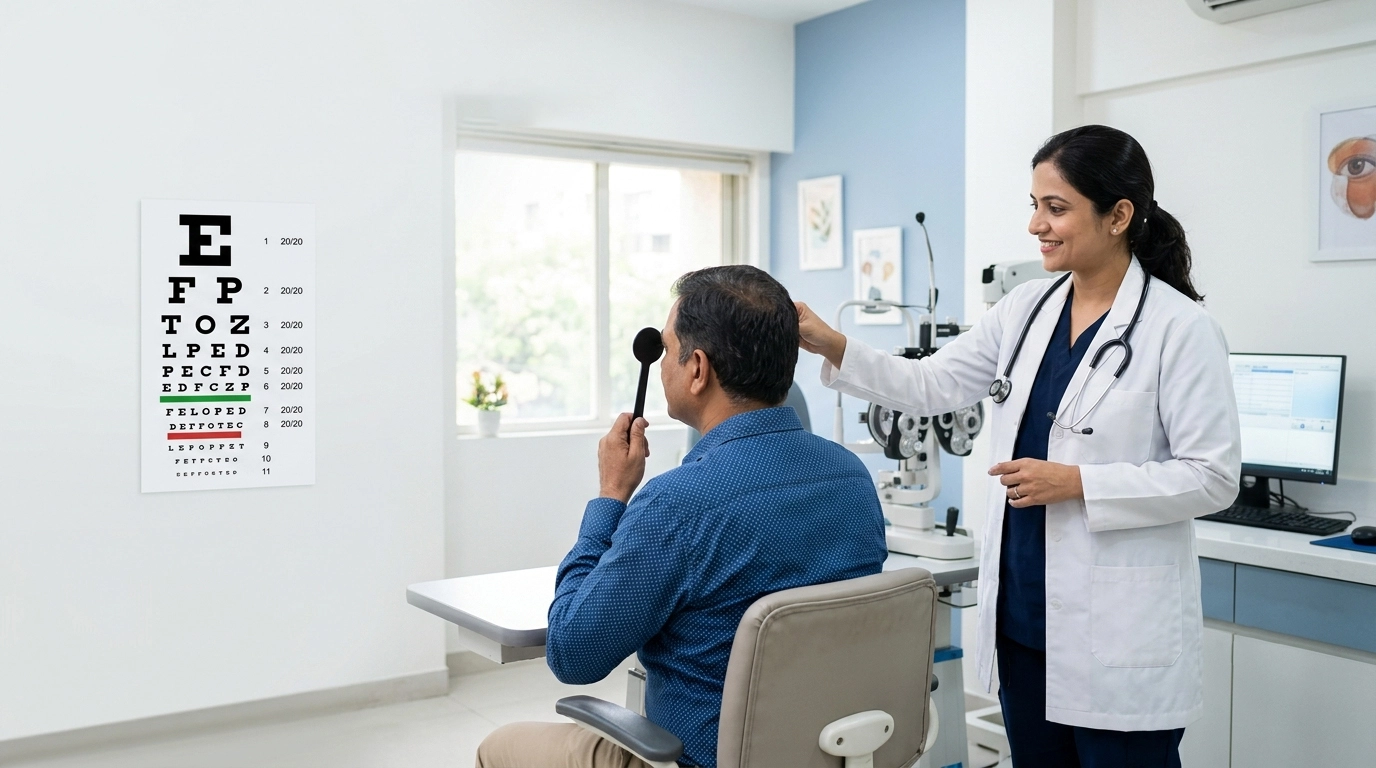
Can you read this line? It may be simple, but what you see here gives your eye doctor info on how well you see. We also call this a visual acuity test, which we use to measure both what you see at a distance and near vision.
For distance vision you may be asked to read successively smaller letters which will be displayed at a distance. For close up vision your doctor may use a near vision chart which is held at a comfortable reading distance. These tests in total will point out any changes in visual acuity and will also determine if we require a more in depth exam or vision correction.
Understanding what the difference is between a near vision test and a distance vision test will make your next eye exam go more easily.
What Is a Visual Acuity Test?
A visual acuity test determines how well you see at a distance which in turn measures what you are able to make out in terms of letters, numbers, symbols or shapes. It is a standard element of an eye exam.
Distance visual acuity is usually determined with a Snellen style chart. The American Academy of Ophthalmology reports that the Snellen chart is the most used tool for visual acuity.
Near visual acuity instead measures your ability to see things that are up close like text in a book, medicine label, mobile phone or newspaper.
During a full exam the doctor will go over each eye separately and also look at how they work together. Also we check visual acuity of each eye out of glasses and in with your current correction when that is appropriate.
What Is a Near Vision Chart?
A near vision chart which includes letters, words, numbers or short passages in various sizes is what a near vision chart is. It is designed to test clarity of vision at normal reading distance
During the near vision test, we see that the chart is at a comfortable close working distance. That distance may change according to the chart, clinical method and patient’s usual visual needs. We usually test from a range of 25 to 40 cm, with 33 cm being the most common.
You then read the smallest print that you can comfortably identify.
This issue of the near eye test is very relevant when people report they have trouble with small print, have to hold their phone at a distance to see it, require more light while reading or develop headaches from close work.
What Is the Near Vision Chart Name?
People report that they are in search of the near vision chart name, which is like the Snellen chart used for distance testing. In fact we have many types of near vision charts.
The Jaeger chart is a popular traditional chart. Also which is used is the reduced Snellen chart and near charts that use N notation. In clinical settings Snellen, Times New Roman and Jaeger formats are described for near vision assessment.
| Near Vision Chart | How It Is Used |
| Jaeger chart | Uses differently sized printed text for close-reading assessment |
| Reduced Snellen chart | Uses smaller versions of Snellen-style optotypes for near testing |
| N-notation chart | Uses print sizes identified by values such as N5, N6 or N8 |
| Reading text chart | Uses words or sentences to assess functional reading vision |
Therefore when a snellen near vision chart, is used it is generally for a small set of near vision assessment as opposed to the full scale distance Snellen chart.
How Is a Near Vision Test Performed?
A near vision test is quick and painless. At the exam your eye care professional will give you a near vision chart and ask you to view it at the set distance.
One at a time we cover one eye as the other is tested. We will have you read out progressively smaller text which will go down to the smallest size which you can still identify reliably. This process is then repeated for the other eye and also when appropriate we will do them together..
If you wear reading glasses, bifocals or progressive lenses it is also fine to wear them during the test.
What we have measured is to give your doctor info on your functional near vision, that isn’t enough for a full diagnosis.
What Is a Distance Vision Test?
A distance vision test is to see how well you do at seeing far off objects.
The common Snellen chart which is what we use has rows of letters that get progressively smaller. In the traditional Snellen method we do the test at 20 feet which is about 6 meters.
In India which is a member of the metric system as well as in many other countries, distance acuity is reported in terms of 6/6, 6/9, 6/12 or 6/18.
During the eye test distance assessment we cover one eye and see what is the smallest letter that the person can identify. The other eye is then tested.
Near Vision Test vs Distance Vision Test
Although both tests measure visual acuity, they assess your vision at different working distances.
| Feature | Near Vision Test | Distance Vision Test |
| Main purpose | Measures clarity during close work | Measures clarity when looking farther away |
| Typical chart | Near vision chart, Jaeger or reduced Snellen format | Snellen or another distance acuity chart |
| Testing distance | Usually around normal reading distance | Commonly 6 metres for a Snellen test |
| Useful for detecting | Near-vision difficulty and changes related to focusing | Distance blur and refractive changes |
| Everyday examples | Reading, phone use, sewing, computer-related close work | Driving, recognising signs, watching television |
Neither test should be considered a substitute for a complete eye examination.
Understanding Your Eye Check Result
Your eye check result may include numbers and abbreviations which at first may seem confusing.
For distance vision a result of 6/6 means that at six meters you are able to see what is expected to be seen at that distance under the test conditions. Also 20/20 is the equivalent which we use in countries that report visual acuity in feet.
If the result is 6/12 what this means is that you have to be at a distance of six meters for what you see to be what a standard reference eye could see at twelve meters.
Importantly, we see that 6/6 is not a full picture of eye health. Visual acuity which is what we measure in that 6/6 is a determination of central visual clarity. It does not look at intraocular pressure, peripheral vision, color vision, retinal health or any other aspect of visual function.
Near vision results are reported in many different ways based on which near vision test chart is used. You may see Jaeger values, N notation, reduced Snellen measurements or other standardized formats.
Your eye doctor should interpret the results in the context of your age, symptoms, prescription and full eye exam.
Why Can Near Vision Become Blurry?
Changes in near vision can occur for several reasons.
Your eye doctor should interpret the results in the context of your age, symptoms, prescription and full eye exam.
Refractive issues also play a role in close vision. Hypermetropia, astigmatism and changes in an existing prescription may cause reading difficulty.
However do not assume that all cases of persistent or sudden vision changes are related to spectacle issues. Cataracts, retinal diseases, corneal disorders and other eye conditions may also play a role in visual performance.
This is why a near eye test is most useful when it is part of a full clinical evaluation and not when it is looked at in isolation.
Can You Perform a Near Vision Test at Home?
Printable charts and online eye testing tools are many, but at home it’s a different story.
Screen size, display resolution, viewing distance, lighting and poor chart quality are issues that play a role. Home testing may help to notice a change, but it should not take the place of a professional visual acuity test.
The National Eye Institute reports that a full eye exam may also include assessment of distance and near vision along with other aspects of eye health.
If at home you notice your near vision test is reduced based on the at home test we recommend you see a professional eye care practitioner for an exam do not rely only on the at home results.
When Should You Have Your Vision Checked?
Consider that you may want to get an eye exam if you are having an issue with reading small print, report of a lot of squinting, headaches which come up during close work, blurred distance vision, trouble with sign recognition, eye strain, or a difference between what you see out of which eye.
Sudden loss of vision, new floaters, a sudden increase in light flashes, severe ocular pain or a curtain like shadow which is to say a shadow that drops over your field of vision requiring immediate medical evaluation.
Regular eye exams are also recommended for people with diabetes, eye disease present, strong spectacle prescriptions or other risk factors as determined by your ophthalmologist.
Why Both Near and Distance Vision Matter
Good eyesight is a dynamic thing which goes beyond the ability to read the small print on a vision chart.
You use it in many ways every day. You may be into your smart phone app for a few moments, then pull out your laptop for work and by the time you check your rear view mirror to change lanes on the highway your eyes have adjusted to the distance.
Testing out your near vision, what does that do for your eye care professional? It gives them a full report of how well you see in the course of normal day to day activities.
A near vision chart is used to identify close reading issues, and a distance chart to determine far clarity. When we combine this with refraction and a full eye exam we are able to determine appropriate lens prescriptions which in turn may point out the need for further study.
Conclusion
A near vision chart and a distance vision chart present different but equally important information on how well you see. For distance visual acuity test we usually use the Snellen style chart, as for near vision test we may use Jaeger, N-notation, reduced Snellen or some other standardized reading chart.
Understanding your eye check result is a step, but the numbers should be put in context with your symptoms, age, spectacle prescription and full eye exam.
If you are having trouble reading, notice that distance objects are blurry, or if your vision has changed suddenly, we recommend you schedule a complete eye exam at Vasan Eye Care. Our professionals will determine if a new prescription is what you need or if we can identify any other eye condition which is at play.
Frequently Asked Questions
- What is the most common near vision chart name?
The Jaeger chart is a well known tool for assessing near vision That said it is not the only option. In some eye care settings we may also see the use of Snellen charts in a shortened form, N letter charts or other health care specific readers charts based on the eye clinic’s approach.
- What is a Snellen near vision chart?
A snellen near vision chart is a smaller scale chart which is used to test visual acuity at short range. It is different from the large standard Snellen chart which is used for distance vision test, although both types of chart use successively smaller visual targets.
- How far should a near vision chart be held?
The testing distance varies by chart and clinical protocol. For near visual acuity we usually test at 25 to 40 cm but the health care provider should follow the distance which is specified for the particular near vision test chart which is used.
- What does 6/6 mean in an eye check result?
A 20/20 eye check result reports that at a distance of 6 meters you can see what is supposed to be seen at that same distance which is the standard for this type of test. This is a measure of visual acuity which does not mean that all elements of the eye’s health are verified.
- Is a near vision test enough to prescribe reading glasses?
A near vision test is a useful first step but in most cases we also require more in depth assessment to determine which lenses you will need. At your appointment your health care professional will check your distance vision, do a refraction test, determine your focusing needs, how your current glasses suit you and the state of your overall eye health before they can put forward a recommendation for reading or multifocal glasses.
- Does near vision naturally reduce with age?
Many adults in their 40s report a growing issue with near vision which is presbyopia. But not all changes in near vision are due to age. An eye exam will determine if refractive correction or more in depth evaluation is required.
- Can I use an online near eye test instead of visiting an eye doctor?
An online at home near eye test is good for a quick check up but results are subject to the screen size, viewing distance and lighting. Also it does not look at the retina, optic nerve, eye pressure or other structures which means it should not take the place of a professional eye exam.