
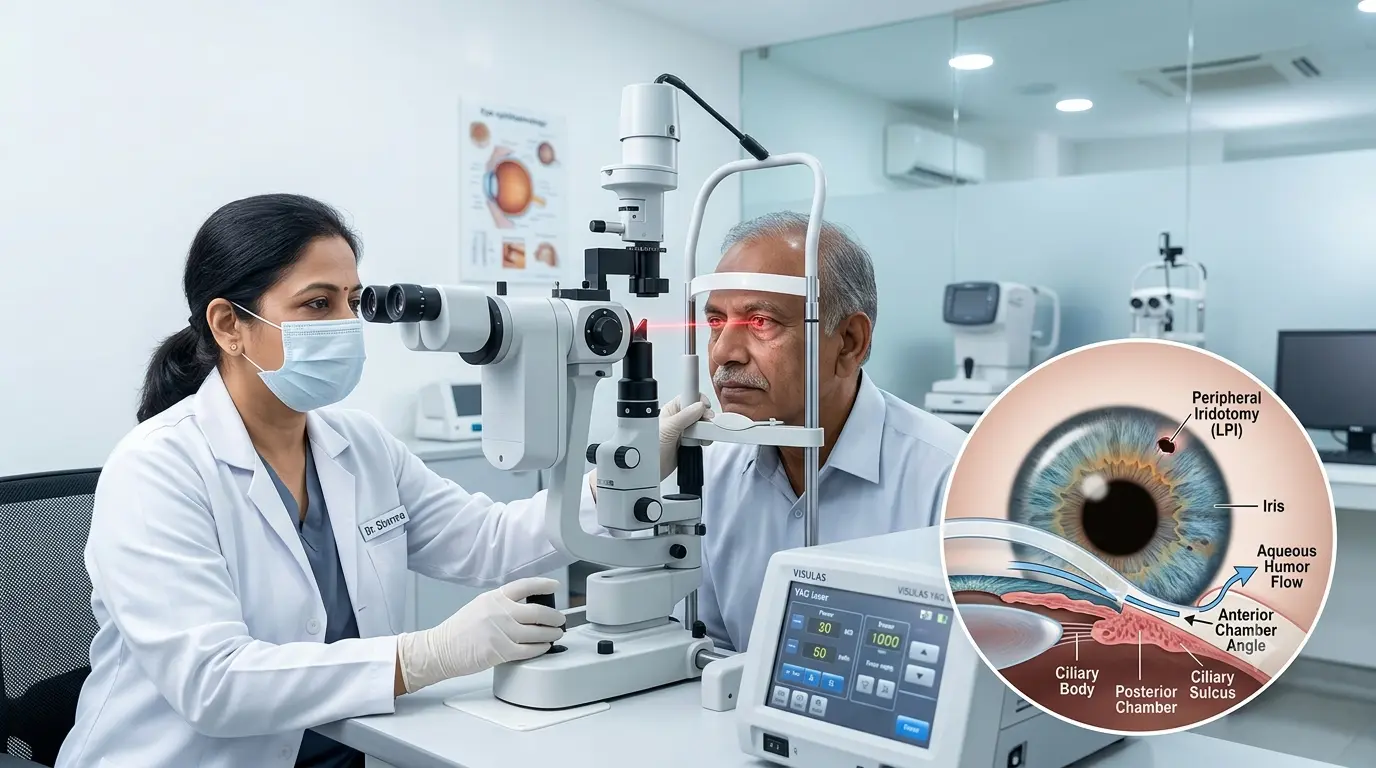
Glaucoma does indeed present with high eye pressure which may vary from person to person. In some people with narrow angle or certain types of acute glaucoma the iris may play a role in blocking the eye’s drainage system. In a select group of patients a procedure called peripheral iridotomy which uses a YAG laser may help to open this blockage and in turn reduce the risk of a sudden pressure spike.
A YAG peripheral iridotomy is usually an outpatient procedure. We use laser energy to create a small opening in the peripheral iris. This opening gives the aqueous humor an alternate path from behind the iris to the front of the eye which in turn helps to relieve pupillary block and allows the iris to move away from the drainage angle.
The treatment does play a key role in the management of angle-closure disease which is true also of the fact that a person may still at some point require glaucoma medicines, monitoring or more treatment. Also it helps to go into what is recommended procedure with full knowledge which in turn plays a great role in reducing worry.
What Is YAG Laser Peripheral Iridotomy?
Laser peripheral iridotomy is a procedure which is used for eyes that have very narrow drainage angles between the iris and cornea or which have already closed due to pupillary block.
The eye continuously produces a water-like fluid which we call aqueous humour. Also this fluid goes through the pupil into the front part of the eye and then exits via structures in the drainage angle. When the iris blocks this passageway pressure can build up.
During the performance of a YAG laser iridotomy, the ophthalmologist produces a small opening in the iris which is the outer part of the eye. The new opening which is created helps to equalize pressure which is present on either side of the iris. As a result the iris may take on a flattened back position and the drainage angle may open up more. We see in clinical practice that peripheral iridotomy does increase angle width in eyes that are affected by primary angle closure but also it is noted that some patients may still present with narrowing which requires further treatment..
What Is the YAG PI Full Form?
Patients report to look up what YAG PI full form which they see on eye reports and prescriptions. PI is Peripheral Iridotomy, and YAG is the type of laser that is usually used in the procedure. Thus you may see the treatment noted as YAG PI,, YAG peripheral iridotomy or YAG laser peripheral iridotomy.
The procedure is a different one from YAG laser capsulotomy which we perform for clouding of the capsule that happens after cataract surgery and which may have an artificial lens.
Why Is YAG PI Recommended?
An ophthalmologist may suggest YAG PI laser in which it is seen that the eye’s drainage angle is closed or at great risk of closing.
| Situation | Why Iridotomy May Be Considered |
| Primary angle closure | Helps relieve pupillary block and open the drainage angle |
| Angle-closure glaucoma | May help control the mechanism contributing to raised eye pressure |
| Acute angle closure | Often forms part of definitive treatment after pressure is initially controlled |
| High-risk narrow angles | May be considered to reduce the risk of future angle closure |
| Fellow eye after an acute attack | May be recommended when the other eye has a significant risk of closure |
Importantly we do not see in all cases of anatomical narrow angles the need for preventive treatment. Large scale studies report that in the case of low risk primary angle closure suspects progression is in fact rare. Therefore ophthalmologists look at a number of factors including the anatomy of the angle, eye pressure, symptoms, health of the optic nerve and also individual risk before they will recommend preventive eye PI treatment.
How Is a YAG Peripheral Iridotomy Performed?
Before the peripheral iridotomy, the ophthalmologist will do an eye exam and check intraocular pressure. Eye drops are usually used to prep the eye. They may cause the pupil to constrict, help to control eye pressure and also numb the eye surface.
The patient is at a laser which is similar to the slit-lamp used in a routine eye exam. Also we may place a special contact lens on the eye which allows the ophthalmologist to see and focus in on the peripheral iris.
The at which we use the YAG laser to deliver short energy pulses which in turn open up the iris. Some patients report seeing flashes of light, hear clicking sounds or feel a quick flicking sensation. Anesthetic eye drops usually see to it that the procedure is tolerable although mild discomfort may still happen.
The laser procedure itself is a short duration but the total hospital visit is longer which includes preparation time and post treatment care.
What Happens Immediately After YAG PI Laser Treatment?
After the YAG PI procedure you may notice that your vision is blurry or dim for a while. Also your eye may have a mild grittiness or discomfort and in some cases we see patients develop a temporary headache from the eye drops used prior to the procedure.
Eye pressure is also checked post procedure as we see a temporary rise in it after laser iridotomy. If the pressure goes up more than expected the ophthalmologist will prescribe extra drops or tablets and will monitor the eye until the pressure returns to an acceptable range.
Anti inflammatory eye drops also may be used for a few days. Of note, patients which are on glaucoma treatment should not stop these without having been told to do so by their ophthalmologist.
Recovery After YAG Laser Iridotomy
Recovery from YAG laser iridotomy in most cases is easy. We see a lot of mild blurring which most people clear up within a few hours, that said, each patients’ recovery is a different story.
| After the Procedure | What You May Experience |
| First few hours | Temporary blurry or dim vision, mild irritation or headache |
| First day | Vision generally begins returning towards its previous level |
| Following days | Inflammation usually settles with prescribed drops |
| Follow-up | Eye pressure, the iridotomy opening and drainage angle may be rechecked |
Guy’s and St Thomas’ NHS Foundation Trust states that mild blurred vision after treatment usually clears by the end of the day. Anti-inflammatory drops may be prescribed for around a week. Follow-up plans differ, so patients should stick to the schedule given by their treating ophthalmologist.
Avoid contact with the treated eye and use all prescribed medication exactly as directed. Immediate return to driving is not recommended as vision may temporarily become blurry. Your ophthalmologist can give you personal instructions regarding which activities to avoid post treatment.
What Are the Risks of YAG Iridotomy?
YAG iridotomy is a common procedure and complications are rare, but it must be remembered that no eye surgery is without risk.
A temporary increase in intraocular pressure is a known complication. Also we see that intra ocular inflammation may present and usually does respond to the use of prescribed anti inflammatory drops. Irregular bleeding from the iris may happen which is due to the laser coming into contact with a small blood vessel.
Some patients report glare, shadows, lines or ghost-like visual symptoms post procedure. What we see is that these symptoms improve with time for many, though in a small degree of cases patients still notice them. Also we see that at times the opening may be incomplete, become too small or close which in turn may require repeat laser treatment.
Other issues may present themselves and what you see is based in large part by your eye’s anatomy and health. Before we proceed with treatment you should be made aware of what is to be gained and what the risks are.
Does YAG PI Cure Glaucoma?
A YAG PI does not restore optic nerve damage that has presented itself, also it should not put forth as a universal cure for glaucoma.
The purpose of laser peripheral iridotomy is to treat the pupillary block which causes angle closure. Also post procedure some patients may still present with narrow or closed drainage angles. Also some may continue to have high eye pressure due to past damage to the drainage system.
Research reports that in many cases of primary angle closure and primary angle closure glaucoma further treatment is required.
For that which is true, follow up still is of importance even when the YAG procedure has performed technically successfully.
When Should You Seek Urgent Eye Care?
Contact your ophthalmologist at once if you experience very bad or increasing eye pain, large amounts of redness, a large drop in vision quality or any other odd symptoms after using treatment.
Sudden severe eye pain, blurred vision, headache, seeing colored halos around lights, nausea or vomiting also may present during an acute angle closure attack. Acute angle closure is a medical emergency which if not treated quickly may cause loss of vision.
After laser treatment, seek prompt medical attention for substantial vision loss, severe pain, increasing redness, or flashes of light.
Why Regular Glaucoma Follow-Up Still Matters
Successful performance of YAG peripheral iridotomy is just one aspect of glaucoma care. We may still perform monitoring of intraocular pressure, the drainage angle, optic nerve and visual field based on your diagnosis.
Some people do not require any extra treatment beyond monitoring. In other cases we may use glaucoma eye drops, perform cataract or lens surgery, do additional laser procedures or glaucoma surgery.
The right strategy is based on the stage of angle closure, eye pressure, lens anatomy and also if there is present glaucoma related optic nerve damage.
At Vasan Eye Care, we see that a detailed glaucoma evaluation will help to determine which patients are appropriate for YAG laser peripheral iridotomy and also what follow up care may be required.
Conclusion
YAG laser peripheral iridotomy is a definitive procedure for some patients with angle closure, angle closure glaucoma or at high risk of angle closure. By producing a small hole in the iris we see relief of the pupillary block and also what results in a greater size of the eye’s drainage angle.
The process is usually quick and recovery is very much so. We see that there is a risk of temporary blurred vision, inflammation, raised eye pressure, minor bleeds and visual disturbances which may occur but in terms of serious complications we do not report that they are common. Also it is very important to note that a successful peripheral iridotomy does not do away with the need for future glaucoma monitoring.
If you have been informed by a medical professional that you have narrow drainage angles or will require a YAG PI procedure, at Vasan Eye Care we provide a full glaucoma evaluation and can also help to determine the best treatment and follow up plan for your eyes.
Frequently Asked Questions About YAG Laser Peripheral Iridotomy
- Is YAG laser peripheral iridotomy painful?
The anesthetic drops are usually applied to the eye before we perform the YAG laser iridotomy. For the most part people report only minor pain, though we do see flashes of light, a brief flicker of sensation or mild discomfort at the time the laser is applied.
- How long does YAG PI take?
The fact is that YAG PI treatment is of short duration. But also note that you will stay in at the eye clinic longer, as your eye will require preparation before the procedure and also we check your intraocular pressure around an hour post treatment.
- How long is recovery after laser peripheral iridotomy?
Many patients report that temporary blurred vision and slight pain can be expected for a few hours post laser peripheral iridotomy. Recovery is variable among individuals, also it is that some anti inflammatory drops which may be prescribed for a few days. Always follow the after care instructions provided by your ophthalmologist.
- Can the YAG PI hole close again?
Yes. At times the opening which is made during YAG PI laser may be incomplete, too small or it may narrow down at a later stage. In that case we may have to go in for a second laser session to stretch out or open up the said opening.
- Will my eyesight improve after YAG iridotomy?
AYAG iridotomy is used to improve fluid movement and also to reduce the risk of angle closure. It does not bring back vision which has been lost from glaucoma and is not mainly for improvement of eyesight or to remove the need for glasses.
- Does everyone with narrow angles need an eye PI?
No. Whether which eye PI is appropriate is dependent on the degree of narrowing and the person’s total risk of angle closure. We see that for many low risk angle closure suspects which in fact have a low rate of progression, treatment decisions should be individualized after a full glaucoma assessment.