
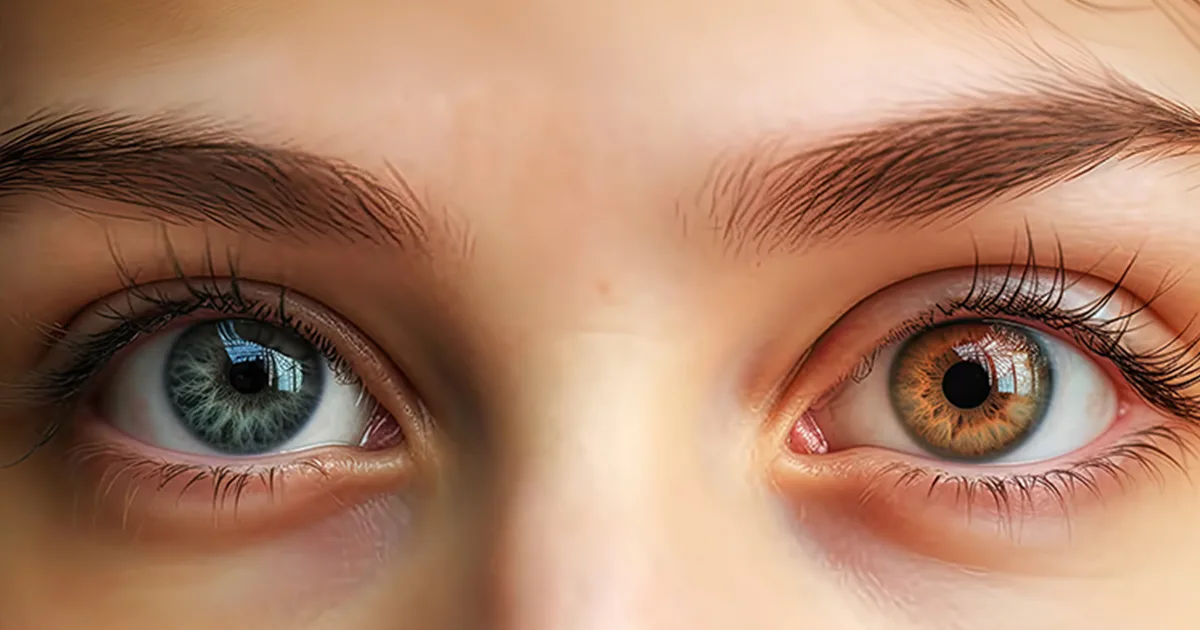
Walking into a room and noticing someone with two different coloured eyes is, for most of us, a small moment of curiosity. One iris may be a deep brown and the other a bright blue. For others, the difference is subtle: a sliver of green in an otherwise hazel iris, or a ring of gold around a brown pupil. This condition is called heterochromia.
Most cases are lifelong and harmless. Some, particularly when the colour change appears later in life, deserve careful review. This guide walks you through the types of heterochromia, the reasons behind them, and what to do next if your eyes have always looked a little different.
What Is Heterochromia?
Heterochromia is a difference in iris colour. The iris, the coloured ring around the pupil, gets its colour from melanin, the same pigment that gives hair and skin their colour. More melanin produces brown eyes; less produces blue, green, or grey. Heterochromia occurs when melanin is distributed unevenly between the two eyes or within the same iris.
It is rarely a disease in itself. For most people, it is a cosmetic variation. For some, it is a clue to an underlying eye, genetic, or neurological condition.
Types of Heterochromia
1. Complete heterochromia (heterochromia iridum)
Each eye is a different colour. For example, one blue, one brown. This is the most visually striking form.
2. Partial or sectoral heterochromia
One part of an iris has a different colour from the rest of the same iris. For example, a brown wedge in an otherwise green eye.
3. Central heterochromia
A ring of different colour around the pupil, while the outer iris is a different shade. For example, a gold-green centre with a grey-blue outer ring.
Can Heterochromia Present in Different Colours?
Yes. The iris colour differences can be:
- Brown and blue
- Blue and green
- Brown and green
- Brown and hazel
- One dark section within a lighter iris
- A gold or amber ring around a pupil in a brown or green eye
- Variations of blue across one iris
The pattern depends on where the pigment sits and how much is present.
What Type of Heterochromia Is Rarest?
Of the three main types, complete heterochromia is the rarest. Partial and central forms are more common but often go unnoticed because the shades are subtle. True complete heterochromia, where one eye is clearly a different colour from the other, is present in less than 1 per cent of the general population.
Do You Inherit Eye Colour From Your Mother or Father?
Eye colour is determined by several genes acting together. You inherit half your genes from each parent. The old idea that a single gene decides brown versus blue is too simple. Today, scientists know that many genes, including OCA2, HERC2, and others, influence how melanin is produced and distributed in the iris.
Heterochromia can run in families, especially in certain genetic syndromes, but it can also arise in a person with no family history. It is not a reliable indicator of paternity or maternity.
What Causes Heterochromia?
Causes fall into two broad groups: present from birth (congenital) and developed later (acquired).
Congenital heterochromia
- Genetic variation in how melanocytes (pigment cells) populate the iris
- Waardenburg syndrome (often with hearing issues and a white hair streak)
- Horner’s syndrome from birth
- Piebaldism and other rare syndromes
- Parry-Romberg syndrome
Congenital heterochromia is usually stable through life.
Acquired heterochromia
- Eye injury causing bleeding or scarring
- Chronic iritis or uveitis
- Fuchs’ heterochromic iridocyclitis
- Long-term use of certain glaucoma drops
- Pigmentary glaucoma
- Eye tumours, including iris naevi and melanoma
- Siderosis from retained metal foreign bodies
- Horner’s syndrome acquired later in life
- Diabetes (can mildly affect iris pigment over time)
Acquired heterochromia deserves a full eye examination. Supportive eye treatments may be needed depending on the cause.
Symptoms and Signs
Heterochromia itself usually has no symptoms. The visual difference is the main feature. Accompanying symptoms usually come from the underlying condition:
- Light sensitivity or pain (inflammation)
- Blurred vision (injury, inflammation, tumour)
- Pupil size difference (Horner’s syndrome)
- Hearing issues or white hair streak (Waardenburg syndrome)
- Drooping eyelid with a small pupil (Horner’s)
- Blind spots, flashes, or shadows (tumour or retinal involvement)
How Is Heterochromia Diagnosed?
A careful history and examination cover most cases.
- Age of onset: from birth or later
- Family history
- Eye trauma or surgery
- Medicines used
- Full eye examination with a slit lamp
- Pupil size and reaction
- Iris transillumination
- Eye pressure measurement
- Dilated fundus examination
- Imaging such as OCT or ultrasound if a lesion is suspected
- Systemic review to rule out syndromes
An eye hospital can usually complete this in one visit.
Is Heterochromia Serious?
For most people, no. Lifelong heterochromia without any other symptoms is cosmetic. Serious causes include:
- Iris tumour, particularly melanoma
- Uveitis, including Fuchs’ heterochromic iridocyclitis
- Horner’s syndrome with an underlying neurological or vascular cause
- Waardenburg syndrome with hearing loss and cardiac risk
- Pigmentary glaucoma with raised eye pressure
A proper review separates benign from significant causes.
How Is Heterochromia Treated?
Heterochromia itself needs no treatment when it is inherited and stable. Treatment is aimed at any underlying condition.
- Uveitis: anti-inflammatory drops, sometimes oral medicines
- Glaucoma: pressure-lowering drops, laser, or surgery
- Iris tumour: specialist oncology
- Horner’s syndrome: neurological investigation and treatment
- Trauma: reconstructive surgery if required
- Waardenburg and related syndromes: multidisciplinary care
Cosmetic contact lenses can even out iris colour for those who prefer a uniform look. They must be fitted by an eye care specialist, never by an unlicensed retailer, and hygiene must be strict.
Famous Cases and Public Curiosity
Public interest in heterochromia often spikes around celebrities. It is worth remembering:
- Not every “heterochromia” attributed to a celebrity online is confirmed
- Some appear to have central heterochromia rather than complete
- Social media filters and lighting can give false impressions
- Online speculation should never replace proper medical assessment
If your eyes are changing, compare with old photographs, take a fresh well-lit photo, and see an eye doctor rather than relying on internet comparisons.
Living With Heterochromia
For most people, heterochromia is part of who they are.
- Protect both eyes with UV-rated sunglasses
- Attend yearly eye examinations
- Inform any new eye doctor of your existing pattern
- Keep a baseline photo for reference
- Avoid unverified “eye colour change” products
- Opt for proper-fit cosmetic contact lenses if desired
When Should You See a Doctor?
Book a review at an eye specialist hospital if:
- An iris colour change appears in adulthood
- A child’s heterochromia comes with hearing issues or other syndrome features
- One eye suddenly looks different from the other
- You notice new spots, patches, or distortion of the pupil
- Vision is affected
- There is eye pain, light sensitivity, or redness
- You wear glaucoma drops and notice gradual colour change
- You are considering cosmetic contact lenses
Urgent review for sudden eye pain, severe vision loss, or signs of neurological illness.
Heterochromia Care at Vasan Eye Care
Vasan Eye Care has been looking after patients across India since 2002, now as part of ASG Enterprises. With more than 150 super-speciality centres, 500+ ophthalmologists, and over 5,000 trained eye care staff, the team evaluates heterochromia in both children and adults, ruling out underlying causes and providing clear guidance on routine care or specialist referral.
Key Takeaways
- Heterochromia is a variation in iris colour between the two eyes or within one iris.
- The three main types are complete, partial (sectoral), and central heterochromia.
- Complete heterochromia is the rarest form, affecting less than 1 per cent of people.
- Most cases are inherited and harmless; some are acquired and need review.
- Eye colour depends on many genes; it is not inherited from just one parent.
- Any sudden change in iris colour deserves a full eye examination.
Frequently Asked Questions (FAQs)
Yes, the colour combinations vary. One eye might be brown and the other blue, green, or hazel. Partial heterochromia can show a wedge of one colour within an otherwise single-coloured iris. Central heterochromia creates a different-coloured ring around the pupil. The combinations depend on where pigment is present and how much melanin the iris contains.
Online discussions often focus on public figures thought to have heterochromia, although not all reported cases are medically verified. Social media filters and lighting sometimes make normal central heterochromia look more dramatic. If you notice changes in your own eyes, a medical review by a qualified eye doctor is more reliable than internet comparisons.
Complete heterochromia, where each eye is a clearly different colour, is the rarest form and affects less than 1 per cent of the general population. Partial and central heterochromia are more common but often go unnoticed because the shades involved are subtle. Examining a well-lit photograph of your eyes can help identify which pattern you may have.
Eye colour is determined by several genes acting together, inherited from both parents. Older ideas suggested one dominant brown-eye gene controlled colour, but modern genetics shows many genes involved, including OCA2 and HERC2. Children can end up with eye colours different from either parent. Heterochromia, in particular, can appear with or without a clear family pattern.
Reviewed by the clinical team at Vasan Eye Care.
References
- National Center for Biotechnology Information. Heterochromia Iridis. https://www.ncbi.nlm.nih.gov/books/NBK563131/
- American Academy of Ophthalmology. Heterochromia. https://www.aao.org/eye-health/diseases/what-is-heterochromia
- WebMD. Heterochromia. https://www.webmd.com/eye-health/heterochromia-iris-colors
- Genetic and Rare Diseases Information Center. Waardenburg Syndrome. https://rarediseases.info.nih.gov/diseases/5524/waardenburg-syndrome
Treatments We Offer:Eye Treatments | Cataract Surgery | LASIK Eye Surgery | Squint Eye Treatment | Retinal Diseases | EPI LASIK | Corneal Services | Refractive Surgery | Oculoplasty Surgery | Dry Eye Treatment | Contoura Vision Surgery | Anti VEGF Agents Treatment | Photorefractive Keratectomy | Vitrectomy Surgery | Epi Contoura Eye Surgery | Customised LASIK Surgery | Retinal Laser Photocoagulation Treatment | Implantable Collamer Lens |Cataract Surgery in Bangalore | Cataract Surgery in Hyderabad | Cataract Surgery Chennai | LASIK Eye Surgery in Hyderabad | LASIK Eye Surgery in Bangalore | LASIK Eye Surgery in Chennai | Retina Services in Hyderabad | Retina Services Chennai | Squint Eye Treatment in Bangalore | Squint Eye Treatment in Hyderabad | Squint Eye Treatment in Chennai | Glaucoma Treatment in Bangalore | Glaucoma Treatment in Chennai | Glaucoma Treatment in Hyderabad
Eye Conditions We Treat: Glaucoma Treatment | Orbital Trauma | Macular Hole | Retinopathy of Prematurity | Uveitis | Traumatic Treatment | Retinal Detachment | Cataract Diseases | Posterior Subcapsular Cataract | Diabetic Retinopathy | Rosette Cataract Surgery | Squint Eye Disease