
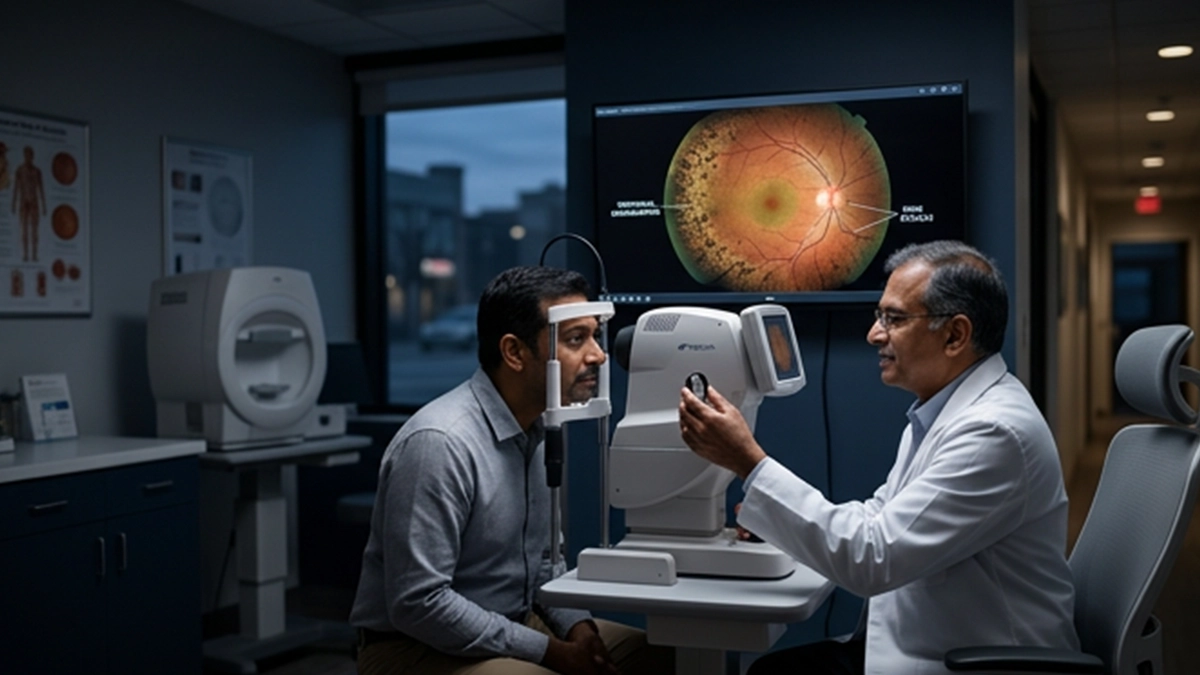
Retinitis pigmentosa is a set of inherited retinal diseases which progress over time. Retinitis pigmentosa symptoms present with night blindness which then follows to loss of peripheral vision. The course of the disease varies from person to person. Though they do not have a universal cure, Vasan eye care does have specialized care and visual rehabilitation which help patients in managing their day to day activities.
What Is Retinitis Pigmentosa?
Retinitis pigmentosa is a disease which affects the photoreceptor cells in the eye’s retina, the light sensitive tissue at the back of the eye. What that sees with our peripheral vision is supported by rod cells which often are the first to go in this disease. As the disease progresses it also attacks the cone cells which are responsible for color and central vision. This is why retinitis pigmentosa symptoms may present very subtly. Early recognition of retinitis pigmentosa symptoms will in turn prompt for early testing and support.
People do have reports of struggling in dark settings which in many instances is paired with normal day time vision. may use the term rp eye disease to put a label on this inherited retinal issue but a proper diagnosis comes out of an eye exam. Also other inherited retinal disorders may present with similar retinal dystrophy symptoms which is why evaluation is key. A specialist will do a comparison between what may see of these retinal dystrophy symptoms and what the exam shows.
Common Symptoms and Warning Signs
Common retinitis pigmentosa symptoms are night vision impairment, slow adaptation to dark, reduced side vision, glare sensitivity and changes in color vision. Not all have the same symptoms and the order of which they appear may differ. Night blindness retinitis pigmentosa is a frequent topic as this may be an early sign which brings the condition to attention.
Night blindness is a symptom of many different issues which include forms other than RP. Thus do not use night blindness retinitis pigmentosa as a stand alone diagnosis. Night blindness retinitis pigmentosa issues should be brought to the attention of an ophthalmologist. Persistent changes are of concern in this issue especially when there is also a report of reduced side vision.
Genetic Risk and Inheritance
RP results from genetic changes which affect retinal function. It may follow autosomal dominant or autosomal recessive as well as X linked inheritance patterns. A family history is a cause for concern but in some cases may be absent. Genetic counselling and testing may help to clarify the inheritance and also what risks may exist within a family.
| Inheritance pattern | General explanation |
| Autosomal dominant | One altered gene copy may be sufficient to cause the condition. |
| Autosomal recessive | Changes in both copies of a gene are generally required. |
| X-linked | The genetic change is associated with the X chromosome. |
| No known family history | RP may still occur without a previously diagnosed relative. |
Comprehension of the genetic element in rp eye disease may put to ease some testing and family discussion issues, yet this can’t exactly predict an individual’s rate of vision change. The term retinal dystrophy symptoms is a broad category which includes a variety of signs, a specialist is able to help determine the likely cause. Also genetic counseling may put to rest questions related to family planning
Diagnosis and Retinal Assessment
An ophthalmologist will do a dilated retinal exam and test visual acuity, periphery vision. Also they may perform visual field testing, optical coherence tomography (OCT), retinal imaging and electroretinography (ERG) which measures the retina’s response to light. Genetic testing also is an option.
These studies which may be used to tell retinal dystrophy symptoms apart from other causes of night vision issues or narrow visual fields. Also they help to identify what changes over time. For acute vision loss or a quick change in sight this requires urgent assessment as it may point to a different eye emergency.
Retinitis Pigmentosa Treatment and Vision Management
There is no universal cure for all types of RP. In the case of Retinitis pigmentosa treatment which may be seen in our clinics that focus on a watch and wait approach to issues related to retina and also on at home care for related eye problems and what our patients’ daily lives present. that may include low vision aids, magnification devices, better lighting at home, training in orientation and mobility, and visual rehabilitation.
Some individuals may present with complications like cataracts or macular swelling which in turn may require separate treatment. Research into gene based therapies is ongoing but what is available is dependent on the genetic variety and treatment availability.Retinitis pigmentosa treatment should be treated by a retinal specialist rather than what is presented online which may not always be verified.
Practically see that for peoples with night blindness retinitis pigmentosa some at home modifications may be helpful. Bright walkways, same lighting throughout the house and an extended period of time to get used to changes in lighting that may present itself will improve safety. Also when in doubt do not drive, and as always follow professional advice on what is ok to do behind the wheel.
Understanding Tunnel Vision and Daily Safety
As visual field shrinks some people develop what is known as tunnel vision. This may make it hard to see steps, people or objects which are at the periphery of your field of view. There are many eye and neurological conditions which Tunnel vision causes which is why it is important to get a proper assessment instead of self diagnosing. Also by understanding what tunnel vision causes it helps to determine the right course of examination.
For those that have RP that see which items are used most often be kept in the same places, also remove trip hazards and they use contrast markers on stairs which in turn supports independence. That also shows that mobility training is useful when peripheral vision is gone to great extent. Tunnel vision causes should be looked into by a qualified health professional especially if the issue is very sudden.
Eye Care at Vasan Eye Care
Vasan Eye Care provides retinal assessment services. People with continuous issues in low light or which also include a loss in side vision should schedule an ophthalmic exam. Early in the retinitis pigmentosa symptoms an evaluation can set the base for what follows. Learn more about what we do in the retina services as the detail our retinal assessment options.
Other eye conditions which also play a role in vision loss. may present info on corneal blindness and the causes of blindness which we hope will help readers to see that vision loss has many causes and requires care which is specific to the condition. That which may present as puffy eyes thyroid issues is a separate issue which should be brought to the attention of a health care professional when persistent.
General education in vision which includes what is 20 20 vision can also put into perspective the difference between central sharpness and peripheral vision. As for information on a prosthetic eye that is a different area of eye care which may in fact be of interest to readers looking at larger scale eye health issues.
Frequently Asked Questions
1. What do you notice in the early course of retinitis pigmentosa?
In the early stages you may notice it is harder to see in dim light and that it takes longer to adjust to darkness. Also some report reduced side vision. An ophthalmologist should evaluate any persistent changes.
2. Is retinitis pigmentosa a hereditary condition?
Most types are genetic and present in various patterns. Genetic counselling may clarify your risk. The term rp eye disease is a broad one so each case must be looked at individually.
3. Can retinitis pigmentosa be made to restore lost vision?
For most Retinitis pigmentosa treatment does not see vision loss from retinal degeneration reversed. Care may consist of watchful waiting, treatment of associated problems, low vision aids and rehab. Some specialized therapies may be appropriate for certain genetic types.
4. Does tunnel vision always mean retinitis pigmentosa?
No. There are many Tunnel vision causes which include various eye and neurological conditions. A retinal exam and appropriate testing is needed to determine the cause of narrowed peripheral vision.
References
- National Eye Institute — Retinitis Pigmentosa
https://www.nei.nih.gov/eye-health-information/eye-conditions-and-diseases/retinitis-pigmentosa - National Human Genome Research Institute — About Retinitis Pigmentosa
https://www.genome.gov/Genetic-Disorders/Retinitis-Pigmentosa