
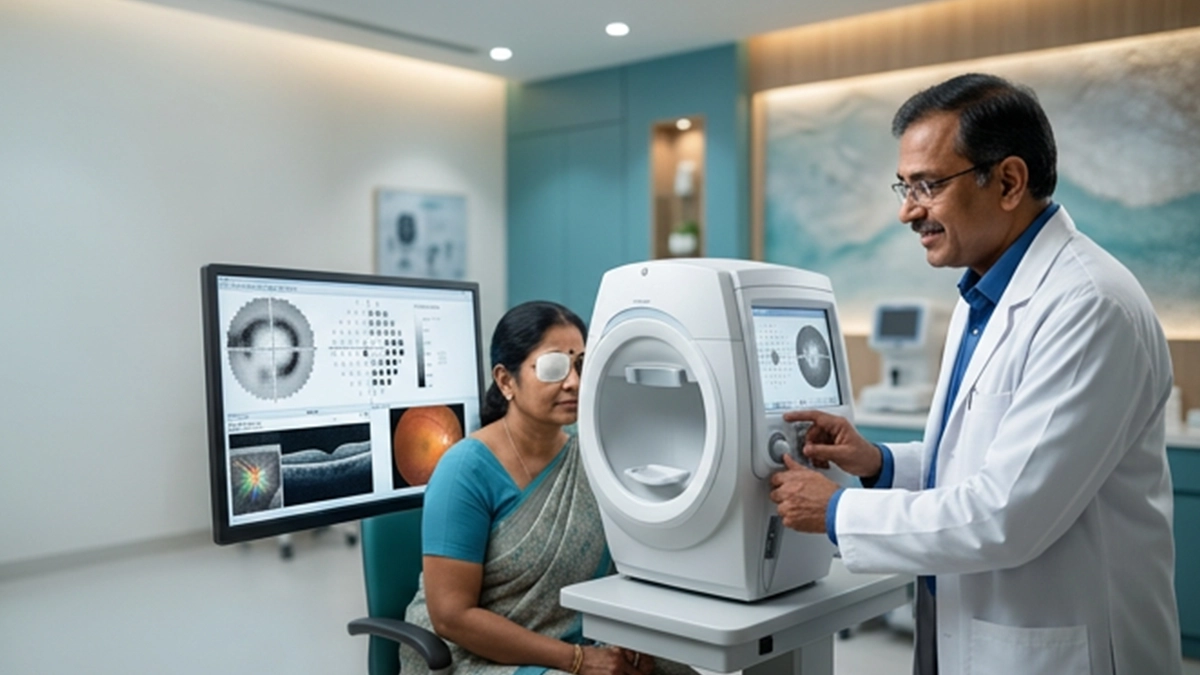
Glaucoma attacks vision slowly, usually before a person is aware of an issue. Vasan Eye Care uses the visual field test for glaucoma which the eye care professional does to see if side vision has gone and also to what extent the loss is growing. It also gives important data on how the optic nerve is doing in terms of transfer of visual info.
What Is a Visual Field Test for Glaucoma?
A visual field test for glaucoma maps out what you see which at the same time that your eyes are focused on a central target. In a glaucoma field test small lights will appear at various locations, and you respond each time you see them. This in turn allows the machine to identify areas of reduced sensitivity.
Automated perimeter is a common tool for this purpose. The Humphrey visual field test is one type of automated assessment used in glaucoma care. A perimetry test for glaucoma may detect changes which may not be noticed during routine activities.
Why Is the Test Important?
The visual field test for glaucoma measures vision function in addition to eye pressure. You can have glaucoma even if your pressure is not very high which is why doctors look at many factors. A peripheral vision test may show blind spots or reduced sensitivity which in turn may indicate optic nerve damage.
At Vasan Eye Care what you do is use a variety of elements from a glaucoma eye test to determine care. Vasan eye Care looks at pressure in the eye and the retina’s nerves which are reported by the test. Based on these results you determine what care to proceed with.
| What the test assesses | Why it matters in glaucoma |
| Central and side vision sensitivity | Helps identify areas of reduced vision |
| Location of visual-field defects | May show patterns linked with optic nerve damage |
| Change over repeated tests | Helps assess whether glaucoma is stable or progressing |
| Test reliability | Shows whether the result is dependable enough to interpret |
How Is the Test Performed?
For a visual field test for glaucoma, you sit facing a large instrument which is shaped like a bowl, keep your gaze on a central point and press a button when you see flashes of light. One eye is tested at a time. The Humphrey visual field test is painless but concentration is very important. If you look away or respond incorrectly that will reduce the results’ reliability, which may in turn require the unusual need to repeat the test.
Understanding Visual Field Test Results
Your visual field test results are presented in map form and also as numbers. Doctors look at the location, depth and repeatability of defects which may appear as dark areas.
A visual field test for glaucoma may tell tale peripheral loss, but similar abnormalities may have other causes. The results should be reviewed in conjunction with optic nerve and eye pressure results.
| Result feature | What the doctor may consider |
| Reliable, normal field | No significant functional loss detected on that test |
| Localised reduced sensitivity | May need correlation with optic nerve findings |
| Repeated glaucoma-like defect | Can support diagnosis or indicate progression |
| Poor reliability indices | Test may need to be repeated |
Why Follow-Up Testing Matters
One visual field test for glaucoma which is a still image. Repeated testing which reports back if a defect is stable or changing. A perimetry test for glaucoma may be repeated based on disease severity and past results. There may be small differences due to fatigue, attention or test reliability. For this reason an ophthalmologist looks for a trend over time instead of a single result.
Visual Field Testing at Vasan Eye Care
If you have glaucoma, elevated eye pressure, a suspicious optic nerve or a history of the disease in your family, your doctor may order a visual field test for glaucoma as part of the follow up. During a full eye exam also your pressure will be checked and the health of your optic nerve will be assessed.
Vasan Eye Care provides glaucoma treatment and diagnostic services that are tailored to each patient’s presentation. Timely evaluation is key which is because once glaucoma related vision loss has occurred it usually does not reverse, though vasan eye care do have treatments which may prevent further loss of sight.
Related Eye Tests and Vision Conditions
Along with visual field testing, other eye examinations can help eye care professionals assess vision and identify potential eye conditions. Learn about horizontal nystagmus causes and how involuntary eye movements may affect vision. You can also explore retrobulbar neuritis to understand how inflammation of the optic nerve can affect eyesight. If you want to learn how eye pressure changes with age, read about normal eye pressure by age and the importance of regular eye assessments. Discover the causes and symptoms of ptosis, a condition in which the upper eyelid droops. You can also understand the Snellen chart distance used during visual acuity testing. For more information about tests that help assess glaucoma, explore the glaucoma eye test page and consult an eye care professional about the appropriate examinations for your needs.
Frequently Asked Questions
1. Is a visual field test painful?
No. A visual field test for glaucoma is non-invasive and at no point will it be painful. Mainly what is asked of the patient is to have steady attention.
2. How long does a glaucoma field test take?
As for the time which a glaucoma field test will take per eye it usually is a few minutes but does depend on the program that is used.
3. What does an abnormal peripheral vision test mean?
An abnormal result in peripheral vision test reports an area of reduced sensitivity which does not in itself confirm diagnosis of glaucoma.
4. Can one test confirm glaucoma progression?
Usually it doesn’t. Doctors look at results of multiple visual field tests and other clinical signs before they determine that glaucoma has progressed.
5. Why might the test need to be repeated?
The Humphrey visual field test may be done again if the first results are not reliable or the doctor is trying to determine if a change is real.
6. Is perimetry used only for glaucoma?
Also a note. Perimetry test for glaucoma is a key element in glaucoma care, but visual field testing also plays a role in the evaluation of other eye or neurological conditions.
References
- National Eye Institute – Glaucoma
https://www.nei.nih.gov/eye-health-information/eye-conditions-and-diseases/glaucoma