
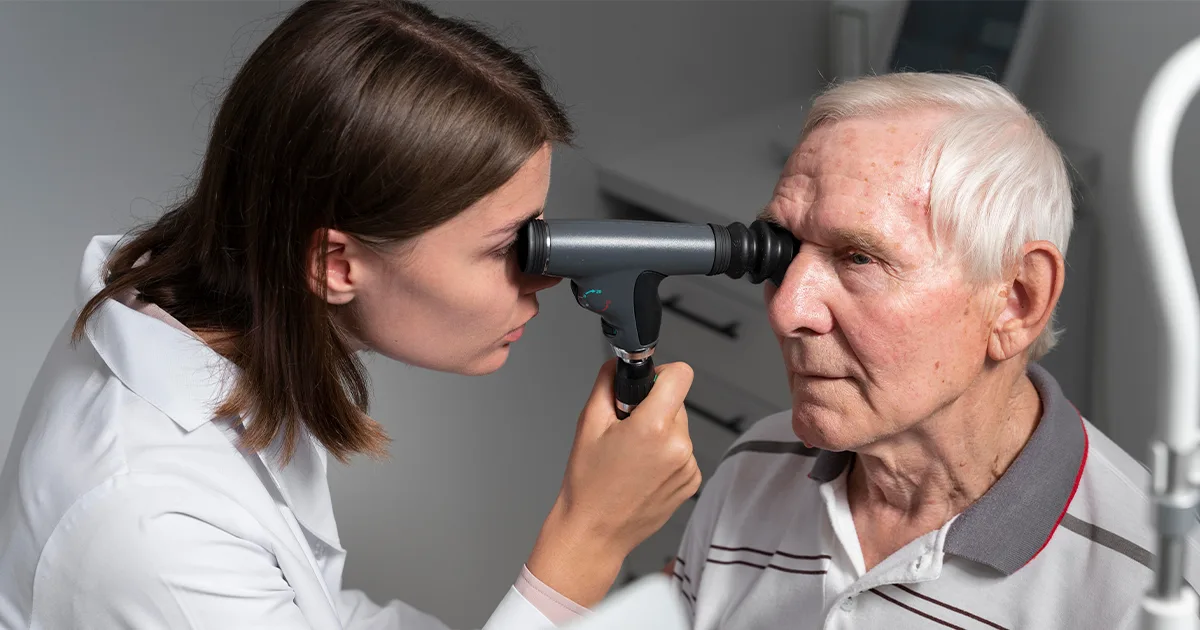
When you sit in the chair for a LASIK consultation, glaucoma evaluation, or keratoconus work-up, the technician may place a small probe against your numbed eye or run a quick scan. A few seconds later, a number in micrometres appears on the screen. That number, your corneal thickness, comes from a pachymetry test.
It is one of the most useful yet least talked-about measurements in eye care. This guide walks you through what pachymetry is, how it works, what the numbers mean, and why they matter.
What Is Pachymetry?
Pachymetry is the measurement of the cornea’s thickness, usually in micrometres. The cornea is the clear, dome-shaped front of the eye. Its thickness typically ranges between 500 and 600 micrometres at the centre, with slight variation towards the edges.
Accurate corneal thickness matters because:
- It affects eye pressure readings
- It determines suitability for laser vision correction
- It helps diagnose and monitor keratoconus
- It informs corneal surgery planning
- It supports medical-legal documentation in some settings
Why Is Pachymetry Important?
1. LASIK and refractive surgery planning
Laser vision correction removes tissue from the stroma. The surgeon needs to know how much tissue is present so that enough remains after surgery. Too-thin residual stroma raises the risk of ectasia (a weak, bulging cornea).
2. Glaucoma evaluation
Standard applanation tonometry, which measures eye pressure, is affected by corneal thickness. Thicker corneas may give falsely high readings; thinner corneas may give falsely low readings. Pachymetry allows correction of these readings.
3. Keratoconus diagnosis and monitoring
Keratoconus thins the cornea and changes its shape. Pachymetry detects thinning early and tracks changes during treatment.
4. Corneal transplant and endothelial surgeries
Thickness data helps surgeons plan the right technique.
5. Monitoring corneal oedema
In conditions like Fuchs’ dystrophy, the cornea thickens due to fluid accumulation. Pachymetry tracks this.
6. Paediatric eye care
Sometimes used to understand congenital conditions.
How Does a Pachymetry Test Work?
Several technologies can measure corneal thickness.
1. Ultrasound pachymetry
- A small probe is gently touched to the numbed cornea
- Sound waves measure thickness
- Fast, reliable, inexpensive
- Requires contact with the eye
2. Optical pachymetry
- Non-contact
- Uses optical methods with slit-lamp attachments
3. Specular microscopy with pachymetry
- Non-contact
- Combines cell count and thickness
4. Anterior segment OCT pachymetry
- High-resolution, non-contact
- Produces detailed thickness maps
5. Scheimpflug imaging (Pentacam, similar devices)
- Non-contact
- Produces a full 3D corneal map
- Useful for keratoconus and refractive surgery planning
What to Expect During a Pachymetry Test
Ultrasound pachymetry
- Numbing drops are instilled
- You sit upright, looking straight ahead
- The doctor or technician brings the probe tip gently against the centre of your cornea
- The device records measurements in seconds
- The probe is removed, and drops are wiped away
- Total time: 1 to 2 minutes per eye
Non-contact pachymetry (OCT, Scheimpflug)
- You place your chin on the rest
- You fixate on a target
- The device captures images rapidly
- No contact with the eye
- Total time: 1 to 3 minutes
Both are painless. Most patients find them faster and simpler than expected.
What Do the Numbers Mean?
Average central corneal thickness
- Normal range: approximately 540 to 560 micrometres
- Thicker corneas: above 580 micrometres
- Thinner corneas: below 520 micrometres
- Keratoconus: often below 500 micrometres in progressive cases
These ranges are guides, not strict cut-offs. Ethnicity, age, and individual variation all play a role.
How thickness affects intraocular pressure readings
- Thicker corneas tend to give higher-than-true readings
- Thinner corneas tend to give lower-than-true readings
- Correction factors are applied, although the exact adjustment remains debated in the literature
Thickness and LASIK
Most LASIK protocols require at least 250 to 300 micrometres of residual stroma after laser treatment. If pachymetry shows a thin cornea, alternatives such as PRK, SMILE, or ICL may be safer. These decisions are made at an eye hospital by experienced refractive surgeons.
Thickness and keratoconus
Progressive thinning is one of the earliest measurable changes. Pachymetry maps, combined with corneal topography, allow the diagnosis and monitoring of keratoconus with high accuracy.
Pachymetry Before LASIK
Before any lasik or refractive surgery, detailed corneal measurement is essential. A typical work-up includes:
- Visual acuity and refraction
- Slit-lamp examination
- Corneal topography
- Pachymetry (often as part of a Scheimpflug scan)
- Pupil size measurement
- Tear film assessment
- Aberrometry
- Retinal examination
If the cornea is too thin, the surgeon may suggest refractive surgery alternatives such as SMILE or PRK, or a lens-based option.
Pachymetry in Glaucoma Care
In glaucoma evaluation, pachymetry guides decisions in several ways.
- Adjusts interpretation of intraocular pressure readings
- Helps stratify risk of conversion from ocular hypertension to glaucoma
- Guides target IOP in certain cases
- Useful in post-corneal refractive surgery patients, whose IOP readings are often artificially low
Pachymetry in Keratoconus
- Central and paracentral thinning patterns are characteristic
- Progressive thinning indicates disease progression
- Pachymetry maps guide corneal cross-linking decisions
- Useful in selecting suitable patients for ICRS (intracorneal ring segments)
How Often Do You Need a Pachymetry Test?
- Once, as part of the first refractive surgery or glaucoma work-up
- Repeated every year or two in keratoconus patients, especially during adolescence
- Repeated if significant prescription changes occur
- Repeated after corneal surgery as needed
- Repeated in Fuchs’ dystrophy to track thickness changes
Are There Risks?
Pachymetry is generally very safe.
- Ultrasound pachymetry requires contact; strict hygiene prevents infection
- Numbing drops can occasionally sting briefly
- Non-contact devices have no direct eye contact
- No radiation, no injections, no long-term effects
It is one of the safer tests in eye care.
Preparing for a Pachymetry Test
- Bring any previous reports or prescriptions
- Inform the doctor of dry eye, contact lens wear, or recent eye surgery
- Avoid contact lenses for the hours recommended before the test
- Plan for transport if combined with a dilated fundus examination
- Allow a slightly longer visit if combined with corneal topography
Combining Pachymetry With Other Tests
Pachymetry rarely stands alone. It is usually combined with:
- Corneal topography
- OCT of the anterior and posterior segments
- Tonometry
- Visual field testing in glaucoma
- Aberrometry in refractive surgery
- Specular microscopy in cataract pre-operative assessment
Supportive eye treatments such as lubricating drops can improve image quality if dry eye is present before the test.
When Should You See a Doctor?
Book a visit if:
- You are considering LASIK or other refractive surgery
- You have keratoconus or a family history of it
- You have ocular hypertension or suspected glaucoma
- You have had corneal surgery or injury
- You notice worsening vision or changes in prescription
- You have been diagnosed with Fuchs’ dystrophy or corneal oedema
Pachymetry Care at Vasan Eye Care
Vasan Eye Care has been looking after patients across India since 2002, now as part of ASG Enterprises. With more than 150 super-speciality centres, 500+ ophthalmologists, and over 5,000 trained eye care staff, the group routinely performs pachymetry as part of refractive surgery planning, glaucoma management, and keratoconus care. A typical visit combines pachymetry with corneal topography or OCT for a full view of the cornea.
Key Takeaways
- Pachymetry measures corneal thickness, usually in micrometres.
- It is essential in LASIK planning, glaucoma evaluation, and keratoconus monitoring.
- Normal central thickness is around 540 to 560 micrometres.
- Corneal thickness affects intraocular pressure readings and surgical options.
- The test is quick, painless, and safe.
- It is usually combined with corneal topography and OCT for a complete picture.
Frequently Asked Questions
A pachymetry test measures the thickness of your cornea, the clear front layer of the eye. It is usually done with an ultrasound probe or a non-contact optical device. Thickness is reported in micrometres, and the result guides decisions in LASIK planning, glaucoma management, and keratoconus monitoring. The test takes just a couple of minutes per eye and is painless.
LASIK removes tissue from the corneal stroma. A minimum residual thickness is needed to preserve corneal strength and prevent ectasia. Pachymetry tells the surgeon how much tissue can safely be removed. If the cornea is too thin, alternatives such as PRK, SMILE, or a lens-based procedure may be advised instead. This is a key safety check before any refractive procedure.
Standard eye pressure measurement can be influenced by corneal thickness. Thicker corneas tend to give higher-than-true pressure readings, while thinner corneas give lower-than-true readings. Pachymetry allows adjustment of these readings, helps stratify risk in ocular hypertension, and guides target pressure decisions. It is especially important in post-LASIK eyes, where IOP readings are often artificially low.
Yes. Pachymetry is one of the safer tests in eye care. Ultrasound pachymetry involves brief contact with the numbed cornea under strict hygiene. Non-contact devices such as OCT and Scheimpflug imaging have no direct eye contact. There is no radiation, no injection, and no long-term effect. Mild stinging from numbing drops settles within minutes in most patients.
Reviewed by the clinical team at Vasan Eye Care.
References
- American Academy of Ophthalmology. Pachymetry. https://www.aao.org/eye-health/treatments/corneal-pachymetry
- National Center for Biotechnology Information. Pachymetry. https://www.ncbi.nlm.nih.gov/books/NBK560580/
- Cleveland Clinic. Cornea. https://my.clevelandclinic.org/health/body/21562-cornea
- National Eye Institute. Eye Tests. https://www.nei.nih.gov/learn-about-eye-health
Treatments We Offer: Eye Treatments | Cataract Surgery | LASIK Eye Surgery | Squint Eye Treatment | Retinal Diseases | EPI LASIK | Corneal Services | Refractive Surgery | Oculoplasty Surgery | Dry Eye Treatment | Contoura Vision Surgery | Anti VEGF Agents Treatment | Photorefractive Keratectomy | Vitrectomy Surgery | Epi Contoura Eye Surgery | Customised LASIK Surgery | Retinal Laser Photocoagulation Treatment | Implantable Collamer Lens |Cataract Surgery in Bangalore | Cataract Surgery in Hyderabad | Cataract Surgery Chennai | LASIK Eye Surgery in Hyderabad | LASIK Eye Surgery in Bangalore | LASIK Eye Surgery in Chennai | Retina Services in Hyderabad | Retina Services Chennai | Squint Eye Treatment in Bangalore | Squint Eye Treatment in Hyderabad | Squint Eye Treatment in Chennai | Glaucoma Treatment in Bangalore | Glaucoma Treatment in Chennai | Glaucoma Treatment in Hyderabad
Eye Conditions We Treat: Glaucoma Treatment | Orbital Trauma | Macular Hole | Retinopathy of Prematurity | Uveitis | Traumatic Treatment | Retinal Detachment | Cataract Diseases | Posterior Subcapsular Cataract | Diabetic Retinopathy | Rosette Cataract Surgery | Squint Eye Disease